

Professor John Robertson OBA
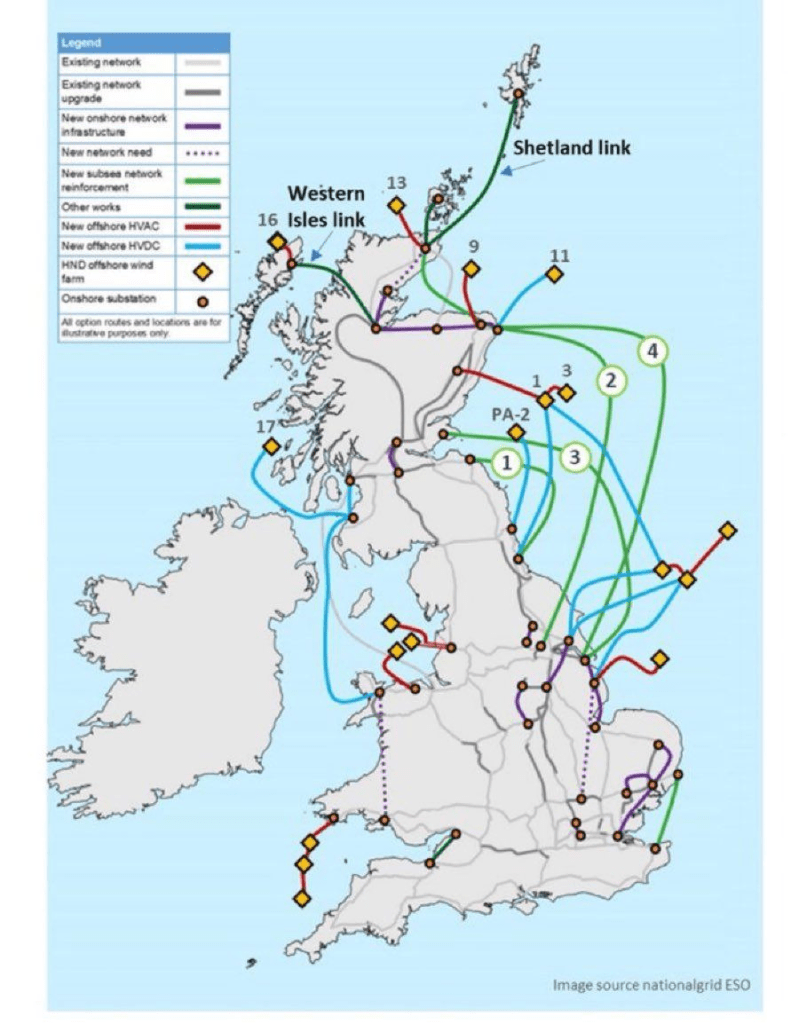
In the map above you can see the full range of networks transferring electricity from wind farms in Scottish waters, across the border into England & Wales. It’s a dramatic illustration of the UK’s increasing dependency on Scotland’s electricity generation.
Just how much?
From Energy Statistics for Scotland – Q2 2025 published today:
In the second quarter of 2025, 8.1 TWh of renewable electricity was generated in Scotland. This is the most renewable electricity generated in the second quarter of any year in Scotland
Scotland’s capacity for electricity generation from renewable sources has continued to increase and currently stands at 17.7 GW – a 4.3% increase compared to 17.0 GW at the end of the second quarter of 2024
As of the end of June 2025, there were 1,114 renewable energy projects with an estimated capacity of 76.5 GW in the planning pipeline in Scotland. https://www.gov.scot/publications/energy-statistics-for-scotland-q2-2025/
From 2004 to 2023, Scotland transferred 232 097 GWh of electricity across the border to England: https://www.gov.uk/government/publications/energy-trends-december-2024-special-feature-articles
1GWh is worth around £200 000 – £300 000 per year. https://www.iea.org/reports/electricity-mid-year-update-2025/prices-trends-in-wholesale-markets-differ-across-regions
So, 232 097 GWh is worth around £60 billion. Does Scotland get a share of that revenue? Will Ayrshire? We’ll see below.
The above facts provide a starting point for the public consultations on SP Energy Networks’ proposed Western Link 2 project, which would transmit around 2 GW of renewable energy from Ayrshire to Wales via a subsea cable, beginning next week, it seems a good time to set out some of the evidence that may not make it into the SP presentations. The events are:
| Tuesday 4 November, 2 – 7pm | Glenfield Bowling Club, Queens Drive, Kilmarnock KA1 3XF |
| Wednesday 5 November, 2 – 7pm | Westcliffe Hotel, 15–16 Louisa Drive, Girvan KA26 9AH |
| Friday 7 November, 10.30am – 3.30pm | Carvick Webster Hall, 12 Main Street, Monkton, KA9 2QL |
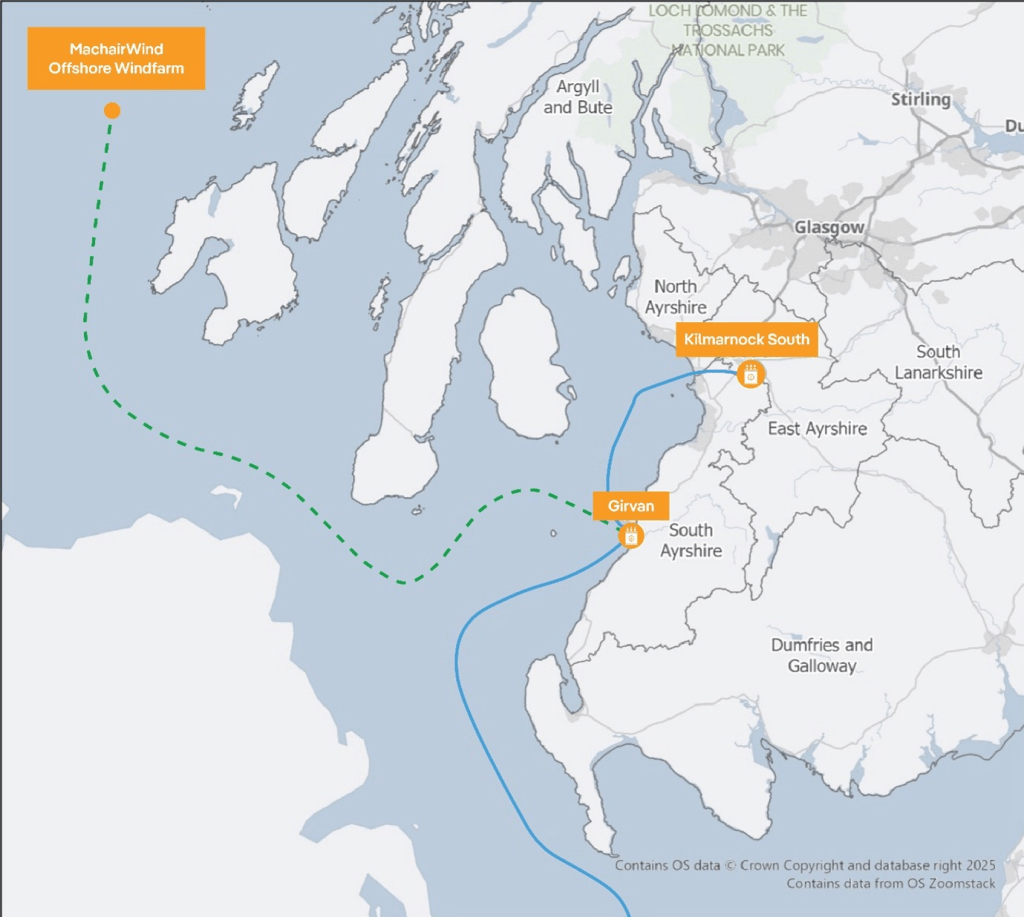
In this map below, you can see the intended route from North Ayrshire to North Wales and to the large population in the West Midlands, around Birmingham but it also reveals the location of three developments which may be very disruptive for local communities and the environment in Monkton, Kilmarnock and Girvan.
SP describe these as:
- A 13km underground cable linking a new converter station next to Kilmarnock South substation with a landfall point on the coast near Monkton, Ayrshire
- A 30km offshore HVDC cable between Monkton and a new switching station at Grangestone, north of Girvan in Ayrshire
There is some detail for clearly very large installations at: https://www.spenergynetworks.co.uk/pages/western_link_2.aspx#tablist1-panel1
An expert, independent, impact assessment needs to be done soon. This should not be done by the Scottish Environment Protection Agency (SEPA) given their history of succumbing to pressure from such as the MoD, in approving increased nuclear submarine emissions levels at Coulport and Rosyth. Equally university researchers dependent on industry and/or government funding are not suitable for this.
In the meantime, we can all take part in this, researching, disseminating and using what we find to engage with local politicians to act on our behalf.
First, are there any economic benefits for Scotland or for Ayrshire from the already numerous cables running from Scotland to England?
Does the Scottish Government Receive Direct Revenue for electricity transfers to the rest of the UK?
No to both.
The Scottish Government does not receive direct revenue from these exports. The UK’s electricity market, privatized since the 1980s, means:
- Private companies generate and sell the electricity on the wholesale market.
- Profits from sales (including to English consumers) flow to these companies, not to devolved governments.
- There is no specific fiscal transfer or payment mechanism from the UK Government to Scotland for exported renewable electricity, unlike some resource-based revenues (e.g., oil and gas, which are reserved to Westminster).
Source: https://x.com/i/grok?conversation=1983090494923030766
I’m no accountant but its clear that SP pays corporation tax for its activity in the UK directly to HMRC and other income is gathered by its owner Iberdola, HQ in Bilbao, Spain. In 2024, they paid out E6.4bn to shareholders and E1.2bn in bonuses.
As far as I can see, their declared profits before tax in the UK were£1.6bn but they only paid £280m in corporation tax to HMRC, well below the 25% official rate.
I’m not equipped to report on this accounting with confidence but it seems clear, they make a lot of money in the UK, pay themselves and their shareholders lots but far less to the HMRC that might then find its way back to spending in communities such as Ayrshire.
Turning to domestic consumers and customers of SP in Ayrshire, do they benefit from that?
No. See this:

So, the people of Ayrshire pay the most of SP’s customers in both fixed and unit charges. Remember, these small unit differences add up to substantial figures over the weeks, months and years.
How many permanent jobs will SP western link 2 provide?
Publicly available information on Western Link 2 does not specify a number of permanent jobs the project will provide. The project is still in consultation, and detailed economic impact assessments (including job creation forecasts) have not yet been released. SP Energy Networks highlights general economic benefits, such as boosting the Scottish economy through increased network capacity, enabling new industry and housing developments, and attracting investment. However, no quantitative data on jobs—permanent or otherwise—is provided in project documents or announcements. For context, the original Western Link (operational since 2017) supported over 450 jobs during its planning and construction phases, but permanent operational jobs were not quantified separately in available sources.
That last bit tells you everything – not that many? How about new converter station next to Kilmarnock South?
How many staff does an electricity converter station typically require?
A typical HVDC (High Voltage Direct Current) converter station—the most common type of “electricity converter station”—requires 10 to 30 permanent operations and maintenance (O&M) staff during normal operation. This varies by size, technology, and location:
I’m getting a clear picture here – in return for major disruption, massive wealth for shareholders and executives outside of the UK, limited revenue for HMRC, no revenue for the Scottish Government, no benefits for local consumers, damn few permanent jobs and we haven’t yet got to environmental harms.
If we were independent, things might be different. We could tax them properly like Norway does!
Environmental Concerns?
The Grok AI, belonging to Elon Musk has clear pro-business biases built in so I had to squeeze this out of it with supplementary questions such as: Do environmental groups have stronger more negative views?
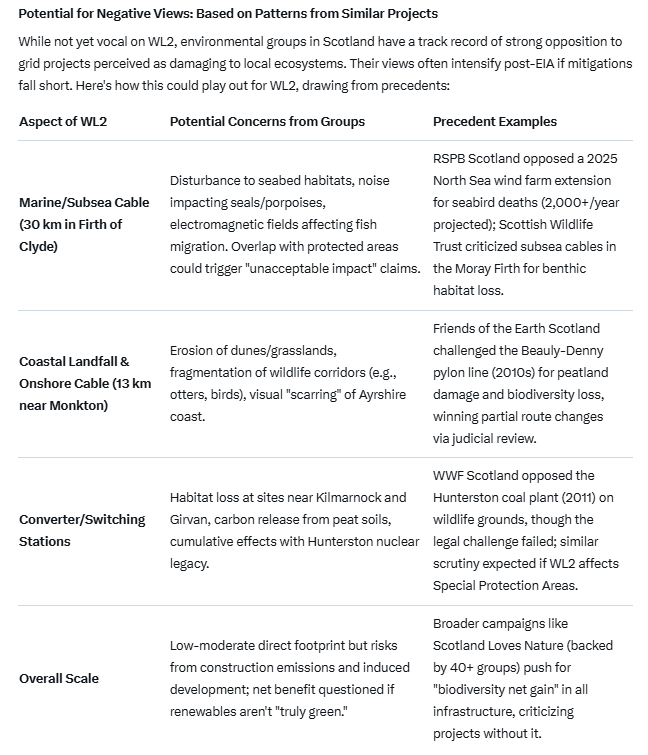
These seem reasonable concerns to me.
To conclude, as with much I write here, I offer it as the quick response of a generalist researcher so, I know there’s knowledge and experience out there in the 1 500 TuS followers and 20-30 000 across social media. Please let me know what you think.
Discover more from Talking-up Scotland
Subscribe to get the latest posts sent to your email.
 Talking-up Scotland
There is already an Iberdrola Western Link from Hunterston to Deeside , Flintshire via the Wirral Peninsula. I believe capable of supplying 4 million homes every years. https://www.iberdrola.com/about-us/what-we-do/smart-grids/western-link
LikeLike
Impact assessment yet?
LikeLiked by 1 person
Scotland in surplus in fuel and energy and nearer the source, pays more.
LikeLiked by 2 people
Scotland is CHARGED more, words matter, we don’t ‘pay more’ willingly..SNP really needs to start pointing out that the English Government enforces higher electricity prices/bills onto Scotland, both domestic supply and non domestic, while Scotland is awash with oil, gas and renewables. It’s incredibly unfair and really just confirms that Scotland is a colony of England and we all know that colonisers are not known for their generosity etc.
LikeLiked by 2 people
So here we are: even more plans to send electricity generated from our indigenous renewable sources out of Scotland almost entirely to England.
What increased benefit to Scotland’s economy relative to England’s will come from this valuable transfer? Yes, there may be an increase in numbers employed and salaries paid to workers in the renewables supply chain based in Scotland – but what is the actual net additional benefit? And where does the tax revenue on corporate profits go? Where does the tax on company dividends go? Where does any windfall tax on profits go?
And where do the controls on pricing of this electricity used in Scotland lie? With Westminster of course: the present Westminster government has just ensured that electricity generated in Scotland and transmitted to England will provide cheaper, more secure energy to England’s economy than would be feasible without Scotland-sourced supply but again, it will deliver no benefit to the source’s (Scotland’s) economy – no price benefit domestic or commercial users in Scotland – relative to England’s!
Of course, there is a commercial and economic case to generate energy from renewable sources over and above what Scotland may need in future – and then to ‘export’ the excess, but to do so in a international trading sense which accrues benefits to the source country, as a minimum in international financial markets. And there is merit in having agency over how much is exported alongside agency over domestic pricing and taxation of corporates in the energy sector. Scotland is fortunate to have the natural resources and the skills to exploit them but it has none of the agency and I fear will gain little of the benefit.
The story of offshore oil & gas is being played out again before our eyes. (Anyone got a ready source of economic and social comparisons between Aberdeen and Stavanger?)
And following the history of the UK (i.e. England) benefiting from ‘Scotland’s oil & gas’ and the future being written now on how England will benefit preferentially from Scotland’s renewable energy resources, both Westminster-based and Holyrood-based Unionist politicians tell us Scotland needs to embrace a new generation of nuclear power plants with all the costs and all the intergenerational impacts/costs of the next generation of toxic waste that comes with it!
We were unable to optimise the benefits for Scotland of the oil & gas era: Scotland in Union is surely now realising it is unable to optimise the benefits from the first decades of the renewable energy period. Why should we place trust in those that have ruled over the exploitation of Scotland’s energy resources to date when they claim the necessity of new nuclear power for Scotland?
LikeLiked by 2 people
O/T
There was an article on the BBC website on the2 September this year on the main Scotland page in relation to the new UK party called Your Party.
“Is Jeremy Corbyn’s party about to make a Holyrood breakthrough”?
Was this based on facts or a headline that was more a case of wishful thinking by a BBC Correspondent working for a BBC, that as a British organisation , are happy for any party but the SNP to win seats in any elections…..even a new party led by Jeremy Corbyn.
The writer of this article was David Wallace Lockhart.
However this BBC political correspondent then decided to destroy all of his credibility in his story as the first two lines of this article stated this:
Sometimes the left of Scottish politics can feel like a crowded place.
You have the SNP, Labour and the Scottish Greens all claiming to be the natural home for voters who are that way inclined.
“Left” and “Labour” ?
Is this the same Labour party that currently exists and that has done everything it can to try to communicate to certain voters and certain media that they are not a left wing party , indeed they have gone to great lengths to purge left wing politicians and members from the Labour party.
Here is what Owen Jones stated – as in an actual Journalist.
“Labour isn’t the Left”
“In fact it’s done everything it can to scream about how it isn’t the left”.
“It’s also done everything it can to crush the left“.
“To drive the left out of the Labour party”.
“To say ‘we hate you, go off and die in a ditch and BTW we think you’re scum”.
“But also you’ve got to vote for us”
So then why does David Wallace Lockhart write that “the left of Scottish politics can feel like a crowded place” and then includes the Labour party in Scotland as part of this equation, as in the Labour party led by the branch office manager Anas Sarwar, who is by no means someone that could be described as being left wing and is also someone who endorses and so supports the actions taken by his right wing HQ Labour leader, that includes the purging of left wing politicians from the Labour party ?
Lockhart also writes that “Jeremy Corbyn is relaxed about the idea of a second referendum, having recently told BBC Scotland News that if voters want one “that’s fine by me”.
Thus surely this is him, Corbyn, doing a U-turn on his previous position on this subject when he was formerly the Labour leader …..
Indeed in 2017 The Guardian stated that he, Corbyn, said that:
“the suggestion he would be ‘absolutely fine’ with another referendum is down to ‘mischievous misreporting’“
In November 2019 his position on another referendum was this:
“Initially he told reporters that this would not happen in the first five-year term of a Labour government. He later clarified that it would not be a priority in the “early years”. He said he would “not countenance an independence referendum in the early years of a Labour government because our priorities will be elsewhere.”
Your Party is a UK political party who will field candidates throughout the whole of Britain in future UK GE’s, if they still exist as a party, and their priority will not be to support Scotland having another justified independence Referendum and they will also not want to be identified as a party that is agreeable to Scotland having another vote.
I can almost hear the infamous quote “Now is not the time” being said by some of them within Your Party at some point in the future…..but now it seems is the time for them to try and gain support for their party in Scotland , what with the elections coming up here next year, by tempting us with the (fake?) notion that they, as a party, will ‘agree to’ and so ‘not object’ to us having another referendum in the future.
They will ‘agree’ and they will ‘not object to’…..but it’s really not up to them is it….and we do not need their permission or blessing….that’s the whole point…nor do we need another party telling us there are other more important priorities….when frankly there is nothing more important or seen as more of a priority for Scotland than it being independent.
I think David Wallace Lockhart is at it….but then again he works for the BBC, so he has a job to do in Scotland, and that job is to try and persuade more voters to not vote SNP and so basically just vote for any other party next year…..
That is why BBC articles like this are pumped out as part of the BBC’s contribution to the #SNPBAD campaign that they are a part of, together with UK political parties…..they are even willing to promote the new party led by Corbyn , who formerly, the BBC used to be more keen on attacking him than promoting him as a party leader.
Guess times change, especially if the BBC thinks that he, Corbyn, and indeed his new party can gain seats next year at the expense of the SNP…..but surely not just at the expense of the SNP in Scotland ?
Perhaps not at the expense of the SNP at all ??????
Liz S
LikeLiked by 1 person
Labour polled 11% in recent Welsh by election. Plaid Cymru won.
LikeLike