


Professor John Robertson OBA
BBC Scotland‘s insert in BBC Breakfast, no doubt in its Reporting Scotland episodes, to come three times today and its website have the above classic tabloid headline, and:
Just a week before she was due to give birth, Jacqui Hunter was given the devastating news that her daughter had died in the womb. Less than 24 hours later, Jacqui was also dead.
The 39-year-old had been told she would have to give birth to her stillborn daughter, who was called Olivia, and was given medication to bring on the labour. Within hours Jacqui was having intense contractions and at one point slumped into the arms of her husband, Lori Quate, who thought she had fainted.
As staff at Ninewells Hospital rushed to help her, she suffered a cardiac arrest. Jacqui died two hours later from an amniotic fluid embolism – a rare and life-threatening emergency.
It was not until the next day that Lori found out his wife had been given eight times the recommended dose of the drug to bring on labour – a mistake which some experts say may have contributed to her death.
So, deeply tragic, but no confirmed malpractice.
Here’s a key comment from the report:
Lori is one of dozens of people – families, midwives and experts – who have told a BBC Disclosure investigation that urgent action is needed to improve maternity safety in Scotland.
But there are calls for a national inquiry similar to one being carried out in England, where a series of independent reviews have found that hundreds of mothers and babies could have survived with better care.
You see what the agenda is here; to construct a crisis in Scotland’s maternity units with only anecdotal evidence, overseen by an SNP government, with a view to protecting Scottish Labour from collateral electoral damage from the very real crisis being managed so badly by UK Labour.
What is that crisis?
More than 500 avoidable baby deaths implicated in reports across 14 NHS England maternity services but not one in Scotland – here’s why
Click on the above to read the fully sources detail.
There have also been several spikes in neonatal deaths in recent years.
These are clues that the system is not working as well as it should.
Experts say there is no reason to believe Scotland is any different to other parts of the UK, where a series of independent reviews have identified common failings relating to staffing, poor workplace culture, listening to families and learning from mistakes.
There are two independent safety investigation and inspection bodies in England, which are regularly reporting on their findings.
In Scotland, the last major review of maternity care was in 2017 after a BBC investigation revealed a number of babies had died at Crosshouse Hospital in Kilmarnock.
In 2022, a targeted investigation was launched into two spikes in the neonatal death rate over a six-month period.
It found no evidence of systematic failures in care but noted that some deaths may have been preventable.
To confirm the above, Factcheck – Maternity services in NHS Scotland far far safer than in NHS England
NHS England has to pay out more than twice as much as NHS Scotland for ‘maternity failings’
£1.3 billion was paid out in Scotland in 2024/205 compared to £27 BILLION in England: https://www.cwj.co.uk/site/newsandevents/legalnews/costs_of_NHS_maternity_care_claims_revealed.html
Per head, that £1.3 billion becomes £13 billion, less than half the NHS England pay-outs of £27 billion.
Why might this difference exist?
See this from Stirling University researchers in the BMJ in 2019:
We found few differences in maternity care experience for women based on their physical or socioeconomic characteristics. Our findings indicate that maternity care in Scotland is generally equitable. https://bmjopen.bmj.com/content/9/2/e023282
Further measures in Scotland:
In January 2024, the Daily Mail reporting a drop in the number of midwives, had:
Women are dying during childbirth at the same rates as two decades ago, ‘alarming’ new data shows. An independent review into maternity deaths showed 293 women died during pregnancy and within six weeks of giving birth between 2020 and 2022. Experts said the upward trend is the most compelling evidence yet that failures now span ‘across the entire maternity system’ and is ‘not just one or two hospitals.’ https://www.dailymail.co.uk/health/article-12947355/Deaths-women-childbirth-hits-highest-level-two-decades-amid-string-scandals-experts-warn-failures-span-entire-maternity-system.html
The overall rate in 2020-2022, was 13.41 deaths per 100 000 births and based on the graph in the Daily Mail piece was around 11.8 in 2020.
The rate in Scotland was 10.9 for 2018/2020, the most recent figures.
Today, the Scottish Government responded to a Freedom of Information request from, I’m guessing, a disappointed so-called health correspondent at BBC Scotland or the Herald, to reveal that spending, to improve maternity and neonatal services was £4.m in 2022/2023 up from around only £3m in the previous two years. https://www.gov.scot/publications/foi-202400409637/
As for midwife supply, in 2023, the total number of midwives in Scotland had grown from 3 529 to 3612. https://www.gov.scot/publications/foi-19-00620/
NHS Scotland caring for 8% of the population but with not one of the five major maternity crises and a system that is ‘equitable’
From BBC Health in June 2025:
Health Secretary Wes Streeting, has said “we must act now” as he announced a national investigation into maternity care in England.
The announcement comes after a series of critical reports into maternity care over the past decade.
- In March 2015 an investigation found mothers and babies died unnecessarily at the University Hospitals of Morecambe Bay NHS Trust between 2004 and 2013 – the report described a dysfunctional culture with substandard clinical skills, poor risk assessments and a repeated failure to properly investigate cases and learn lessons.
- In March 2022 an investigation into services at the Shrewsbury and Telford NHS Trust found that more than 200 mothers and babies could have survived with better care.
- Then, in October that year, a review into maternity services at East Kent Hospitals University NHS trust found that at least 45 babies might have survived if they had been given proper treatment.
- And an ongoing review into the maternity care provided by Nottingham University Hospitals NHS trust, due to be completed next year, is set to be the biggest yet, with around 2,500 cases being examined.
- Meanwhile, an annual review in 2024 of units by inspectors at the Care Quality Commission found not a single one of the 131 units inspected received the top outstanding rating for providing safe care.
Dr Clea Harmer, chief executive of the baby loss charity Sands, said the national investigation was “much-needed and long-overdue”.
The ‘Scottish’ media are quiet. If they had something, they’d be all over it like nappy rash.
I searched for ‘Scotland maternity inspections substandard‘ – only English ‘hits’.
I searched the Healthcare Improvement Scotland site – nothing.
I tried ‘Scotland maternity hospital inspection concerns‘ – bingo!
As in the headline, only one minor concern in 2017 and another in 2013 but hey, using Reporting Scotland editorial standards, that’ll do. Get Gulhane or Baillie on the phone.
Equitable in Scotland?
See this from Stirling University researchers in the BMJ in 2019:
We found few differences in maternity care experience for women based on their physical or socioeconomic characteristics. Our findings indicate that maternity care in Scotland is generally equitable. https://bmjopen.bmj.com/content/9/2/e023282
Finally, there have been no spikes in neonatal deaths in NHS Scotland
The BBC Scotland report return to this old favourite. It’s so untruthful, I’ve had to add a bit…of truth:
There have also been several [rumoured]spikes in neonatal deaths in recent years. These are clues [if they are true but they’re not] that the system is not working as well as it should.
Experts[who?] say there is no reason to believe Scotland is any different to other parts of the UK, where a series of independent reviews have identified common failings [they can’t be common if they do not happen in Scotland] relating to staffing [far more midwives per head in Scotland], poor workplace culture, listening to families and learning from mistakes.
There are two independent safety investigation and inspection bodies in England, which are regularly reporting on their findings. In Scotland, the last major review of maternity care was in 2017 after a BBC investigation revealed a number of babies had died [because?] at Crosshouse Hospital in Kilmarnock.
In 2022, a targeted investigation was launched into two spikes in the neonatal death rate over a six-month period. It found no evidence of systematic failures in care but noted that some deaths may have been preventable.
BBC Scotland faking baby death ‘spikes’ that were never there
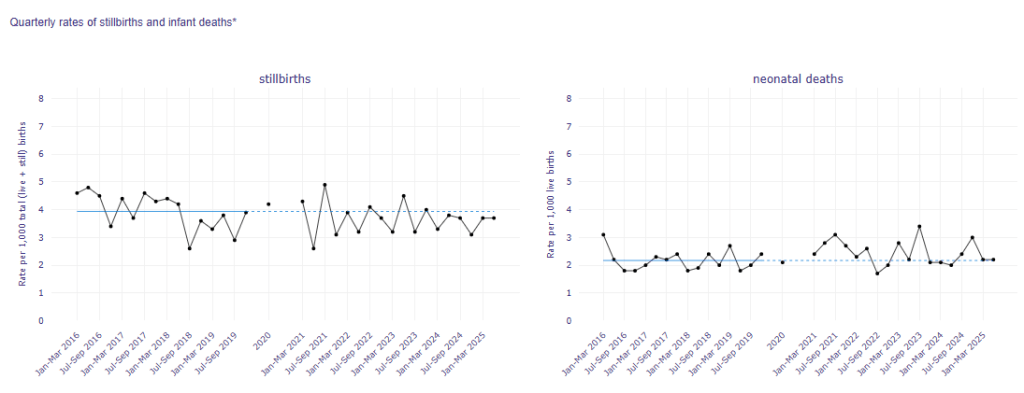
From Scottish pregnancy, births and neonatal data dashboard, published on 14th January 2025, you can see Scotland’s falling stillbirth trend with variation between 3 and 5 per 1 000 births around the ‘normal’ level of 4, from one quarter to the next. There is one quarterly figure of 5 per 1 000 in July-September 2021 but it is not repeated and is no more significant then the very low figure in the previous quarter. Scotland’s higher level of midwife and home visitor staffing must be credited as a major factor in this trend.
In the second graph, on deaths in the first four weeks of life, you can see a slightly higher rate in the last three years with one additional death per 1 000 before returning recently to around the ‘normal’ level. Worsening Tory austerity, hitting the poorest, often single, mothers, the hardest must be considered as an explanation. In July – September 2023, the rate increased, by less than 1.5 but, but this is not repeated. There are no statistically significant spikes.
Yet, BBC Scotland today, reporting on a single baby death suggest:
From this month, maternity units across Scotland will routinely face unannounced inspections by the NHS safety watchdog, Healthcare Improvement Scotland. It comes in response to a number of spikes in newborn deaths in recent years.
This is not true. There have been no ‘spikes’ and the quarterly variations were not repeated.
For context, Scotland has the lowest stillbirth rate in the UK. See:
Stillbirth rates per 1,000 total births in 2021 for the UK were 3.54 and varied between the devolved nations; 3.52 (England); 3.27 (Scotland); 3.88 (Wales); and 4.09 (Northern Ireland).
These little percentage differences mean thousands of lives.
Sources:
https://scotland.shinyapps.io/phs-pregnancy-births-neonatal/
Discover more from Talking-up Scotland
Subscribe to get the latest posts sent to your email.
 Talking-up Scotland
Classic BBC Ambulance Chasing – Sarwar would be impressed !
LikeLiked by 1 person
Aye, saw that deplorable piece on the BBC’s UK News page…
BBC Dredging, Glasgow….
LikeLiked by 1 person
O/T The leadership of the British Labour Party in Scotland just cannot resist the lure of negativity about Scotland. It just cannot let an opportunity go by, even in circumstances where its party has a relatively poor track record in government in Wales on a similar issue – IMHO, constrained and negatively influenced by Westminster and the devolved settlement. This should cause the leadership in Scotland to ‘reflect’ but its ‘Unionism’ seems to rule out any tempering of its relentless negativity towards what public servants in Scotland and the present Scottish Government are achieving against the (Westminster determined) odds!
The Scotland page of the BBC News website has this headline today (October 28): ‘GP surgeries to get £531m for recruitment over three years’.
We learn that Scotland’s health secretary has announced that an extra £531m will be allocated to recruit staff in GP surgeries over the next three years. Subject to budgetary approval in Holyrood, the Scottish government will initially give £98m in the 2026-27 budget, £183m the following year and £249m in the third year.
The chair of BMA Scotland’s GP committee is quoted: “For some time, we have been clear that the only way to put general practice in Scotland on a sustainable footing for the future and to improve access for patients was direct investment into practices to recruit and retain GPs.
“This investment should finally enable the profession to feel optimistic about the future and provides the opportunity to make working in general practice in Scotland the rewarding, safe and sustainable career it should be once again.” (my emphasis)
The BBC Scotland piece refers to Scotland’s GP Whole Time Equivalent staffing figure decreasing between 2015 and 2025, from 3,675.1 to 3,591.5. But the BBC, this public service media organisation with a mission to inform, makes NO ATTEMPT to inform us about the shifts in general practice that has seen work previously done by GPs now done by allied healthcare professionals. It also refers to the number of GP practices in Scotland falling by 10% over the past decade, from 987 in July 2015 to 885 in July 2025. But it makes NO ATTEMPT to inform us about the number of mergers that may have led to NO NEGATIVE IMPACT on service provision.
The chair of the Royal College of General Practitioners (RCGP) in Scotland is quoted: “We are confident that this new direction of travel from the Scottish government will in time deliver the world class care that patients deserve.”
No quote from Tory Gulhane for once in this BBC Scotland article. Why – the Scottish Government intervention too good, too welcome even for the Tories to find a negative? No quote from a Lib Dem politician in Scotland either. Why – news too positive? But of course the British Labour Party’s health spokesperson in Scotland, Jackie Baillie has her say. She is quoted by the BBC stating that the SNP had “floundered” over GPs!
She said: “It is right that the Scottish government has finally recognised the funding challenges they have created for GP surgeries.”
For context, for perspective, let’s turn to the Welsh section of the BBC News website (from 17 July 2024): ‘Top GP says doctors are united in fear about NHS’ – The BMA also said the proportion of the NHS’ budget spent on GP services has dropped from 8.7% in 2005-06 to 6.1%
‘Dr Gareth Oelmann (a GP partner in Gwent) said, without a “rescue package” from the Welsh government to stop practices closing, the “situation is grave” and if general practice fails “the rest of the NHS will follow”.’
“Finally recognised”? Over a year later, from October 2, 2025: ‘NHS Wales at risk of collapse without urgent GP funding reforms’ – see https://www.openaccessgovernment.org/nhs-wales-at-risk-of-collapse-without-urgent-gp-funding-reforms/199095/
‘Escalating workloads, staff shortages, and insufficient resources are putting the NHS in Wales under severe strain, highlighting the urgent need for funding reforms to support general practice and protect patient care.’
‘Since 2012, 100 surgeries have closed, and GPs are now seeing up to 35% more patients each. A recent British Medical Association (BMA) survey indicates that 89% of GPs in Wales report being unable to meet patient demand.’
The leadership of the British Labour Party in Scotland’s relentless negativity about the contribution of Scotland’s health service and its relentless negativity about the present Scottish Government is hypocritical – and candidly illogical – given it never acknowledges ‘context’, never acknowledges the evident serious shortcomings of the British Labour Party’s governance of Wales – ham-strung as it also is by devolved powers.
The British Labour Party leadership in Scotland are ONLY able to see potential to gain electorally from this type of negative campaigning for one reason. They are only able to air brush out the Party’s track record of devolved government in Wales for one reason. It’s because of a supportive, uncritical, pro-Union mainstream media that supposedly ‘serves’ Scotland’s polity.
LikeLiked by 1 person