

Professor John Robertson OBA
BBC Scotland has the above this morning. Soon after, Murray Foote and others hade exposed their dirty tricks:
BBC Scotland had essentially ‘double-counted’ the salary and other costs of the crew members already needed to run the ferries as if they were new additional costs because of building in Turkey.
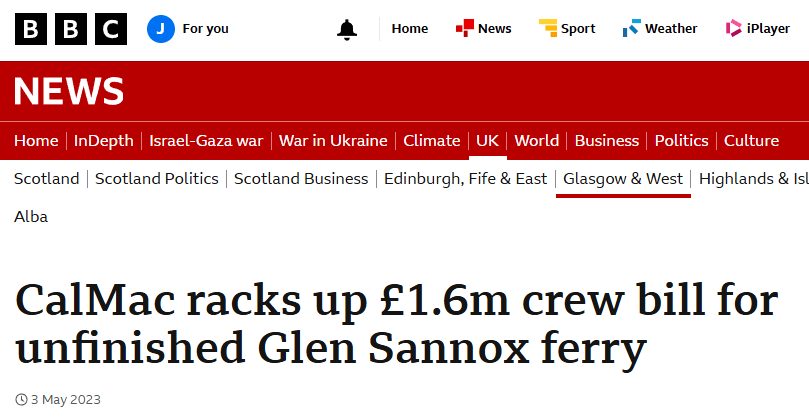
In May 2023, they tried a similar, smelly, trick with this:
I wrote then:
Ferry operator Calmac has run up a £1.6 million bill for crewing cost for the Glen Sannox, which is still under construction.
Calmac has hired 14 staff to date and they’re all working on other vessels at the moment.
I can’t find the necessary crew size for the Glen Sannox but a Channel ferry requires 185 on one shift so needs at least 400 to cover all shifts, holiday, sickness absence?
Channel ferries are around twice the length. The Glen Sannox will take 1 000 passengers. A Channel ferry typically takes 2 000.
So, the Glen Sannox might need between 100 and 200 to cover all shifts?
Those 14? Less than 10% of eventual crew size.
Cost, £1.6 million. Average wage more than £100 000?
You can still support Talking-up Scotland at any time at: https://www.crowdfunder.co.uk/checkout/help-talking-up-scotland-tell-truth-about-scotland/payment/nBQxjVzq/details or by direct bank transfer method - Bernadette/John Robertson, Sort code 08-91-04, Account 12266421
Discover more from Talking-up Scotland
Subscribe to get the latest posts sent to your email.
 Talking-up Scotland
A typical BBC Scotland Ferry Fairy Story .
And they have the brass neck to claim to have a Verify Unit !
LikeLiked by 1 person
I suspect that it probably is a Vanity Unit
LikeLike
Their “Verify” Unit is to verify their stories are not true… Can’t have the truth getting out…
John H
LikeLike
Regarding this confected news item about CMAL/CalMac new ferry costs, how often does this happen – the SAME news story gets the prime position on the BBC News website’s main Scotland page AND the Scotland Politics page AND the Scotland business page at the same time and over at least two days?
Note carefully the BBC’s headline for the story provided by the Tory Party in Scotland: Over £1m spent on sending Scottish ferry staff to Turkey. (See https://www.bbc.co.uk/news/articles/ce3kvd0kp9vo)
You will find that the headline does NOT have any quotation marks: the headline does NOT contain the phrase ‘it’s claimed’ or similar. The BBC Scotland’s journalist and editor have opted to take ownership of the words appearing in the headline. And keep in mind the BBC’s choice of words – the sum of £1m was ’spent on sending’ staff to Turkey!
STV News online has this headline: ‘More than £1m spent sending staff to Turkey to oversee ferry construction’. Note again the emphasis on the cost of ‘sending’ staff somewhere foreign.
We are given an explanation within the BBC article which makes the BBC’s (and STV’s) headline – and indeed the prominence the BBC gives to this concocted Tory outrage – frankly ridiculous.
‘CalMac and CMAL said their staff’s work in Turkey was “vital” and “essential”. A CalMac spokeswoman said most of the money related to staff costs, including wages, which would have been paid regardless of where the crew were. (my emphasis)
‘She said the extra amount – £23,000 – was for travel and subsistence costs which covered flights to and from Turkey, hotel accommodation, and general subsistence costs. CMAL also said the same wages would have been paid to its staff regardless of travel costs.’
The National on October 24 had this headline: ‘Did SNP ‘spend £1 million flying staff to Turkey’ as Tories claim? ‘(https://www.thenational.scot/news/25571167.snp-spend-1-million-flying-staff-turkey-tories-claim/ )
It concludes its own fact checking with this: ‘FACT CHECK RATING: False. Very, very false. Including staff’s wages in the amount spent sending them to Turkey is simply misleading.’
It’s quite a contrast between BBC Scotland’s very prominent coverage of a story – one headlined in such unequivocal and misleading terms – and a ‘false, very false’ judgement of the same story by a newspaper, even if it’s from The National!
All this is being pushed by the BBC at the same time I hear a BBC advert for itself broadcast on Radio 4. In terms, it refers to the ‘fight for the truth is on‘ and ‘trust is earned‘ and something about, in conclusion, attributing this to ‘our BBC’! Enough to make you boak!
LikeLiked by 3 people
I have no knowledge of the procurement of new vessels from shipyards so I asked ChatGPT this question: ‘When procuring the construction of a new vessel – e.g. a roll on roll off ferry – what proportion of total contract costs do CLIENTS budget for to fund project oversight and on site inspection and monitoring?’
ChatGPT’s response included this: ‘For newbuild ship procurement (such as a Ro-Ro ferry), owners typically budget a defined proportion of the overall contract value to cover project management, site supervision, inspection, and technical oversight.‘
ChatGPT provided me with lots of detail, with references, with the tasks typically undertaken by the owner of the vessel being built and the typical costs based on common industry practice for vessels of differing complexity being built in different countries. It concludes:
‘Typical total: 2 – 5 % of the vessel contract price.’
Influencing factors on where within this range the budget is likely to lie:
– Complexity of the vessel — Custom Ro-Pax ferries with hybrid propulsion or LNG systems demand more oversight (closer to 4–5%)
– Shipyard location — Distant or lower-cost jurisdictions often require more intensive supervision (travel + local liaison)
– Client’s internal capacity — If the owner has an in-house newbuild department, external spend may be lower (1–3%)
– Contract form — Turnkey or design-and-build contracts may shift more responsibility to the yard, reducing owner oversight needs.
ChatGPT provides this example: for a €150 million Ro-Ro ferry, a realistic owner’s oversight budget might look like:
– Project management & engineering: €1.5 million
– Site team (2–3 inspectors + senior superintendent): €3.0 million
– Specialist inspection/testing: €0.75 million
– Contingency: €0.75 million
– ≈ €6 million total (4 %).’
This is a cost to the vessel owner in addition to the construction price paid to the yard based on common industry practice (ChatGPT tells me): it is cost of this order of magnitude regardless of where the yard is located.
My understanding is that the total contract price for the ferries being built for CMAL in Turkey is c.£200m. And 4% of £200m is £8m.
I asked a follow up question: ‘You refer to variation in budgeting due to procurement in different jurisdictions. What status would the Cemre yard in Turkey merit in terms of need – or not – for more intensive oversight/monitoring by the client?’ (Cemre is the yard building the CMAL ferries.)
ChatGPT responded: ‘Short answer: Medium–high oversight (budget ≈3–4%, possibly higher if you expect repeated change orders or future design iterations).
‘Cemre has active experience building RoPax / passenger ferries and low/zero-emission designs, and has been awarded multiple standardised ferry contracts. That supports confidence in technical capability.’
(I stumbled upon this from May 19, 2025 which is relevant to appreciating the standing of this Turkish yard: ‘Cemre Shipyard: New battery-powered ferry sets sail for Denmark – Danish ferry operator Molslinjen has taken delivery of a new battery-powered RoRo passenger ferry built by Turkish shipbuilder Cemre Shipyard.’
The newbuild zero-emission ferry Nerthus is one of two double-ended 11.6-meter-long ferries ordered by Molslinjen from Cemre in 2022. Elsewhere Molslinjen’s CEO, Kristian Durhuus. is quoted: “Both of our newbuilds have been affected by delays. Earthquakes and the unstable situation in the Turkish economy have played a part, so it’s with relief that we can now send the first ferry homeward.”
LikeLiked by 1 person
This bunkum story also appears on the BBC’s UK News page… 🙄
LikeLike
BBC cost £6Billion. Half on estate. Enough to eradicate poverty.
LikeLike