

Professor John Robertson OBA
In the Telegraph today, the above and:
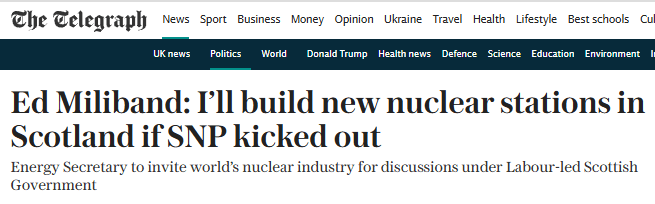
Ed Miliband has pledged to start immediate work on building new nuclear power stations in Scotland if the SNP is kicked out of office in next year’s Holyrood election.
That’s a clear threat then.
To what?
- Increased child leukaemia
- Increased breast cancer
- Increased thyroid cancer
- Increased all cancers
First, increased child leukaemia:
I asked the Elicit AI for scientific research which claims to help researchers be 10x more evidence-based:
How dangerous is it to live 5km from a nuclear power station?
After more than 5 minutes, it responded:
Studies show mixed results on living within 5km of nuclear power plants, with some European research finding roughly doubled childhood leukemia risk while studies from other regions generally show no significant overall cancer risk.
Which regions?
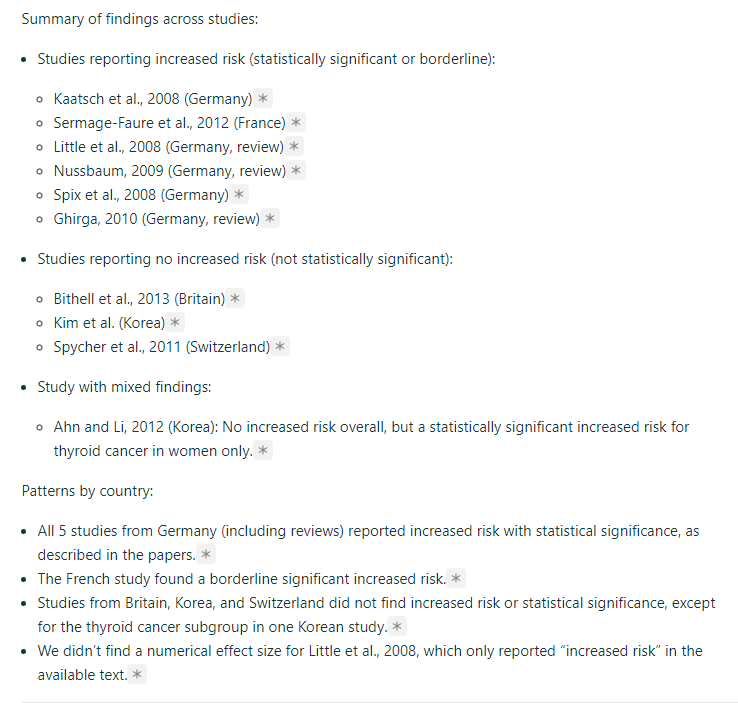
This is stark. Why do 5 German research groups all find statistically significant risks to health in living within 5km of a nuclear power station and why is there only one recent British study and it finds no risk?
I take it no one thinks German nuclear power stations were intrinsically more dangerous than British ones and so the only tenable explanation is that German researchers, where nuclear energy production is no longer government policy, are more free of the inhibitions making it difficult for those in Britain and France, where it is still policy, to present research findings that might undermine the industry. That Britain and France also maintain nuclear weapons dependent on having nuclear power stations to produce plutonium and tritium, will be a powerful presence in the minds of those directing research there.
Now, that the Germans find risk and the others do not does not leave the matter unresolved. It means that living within 5km of a nuclear power station is dangerous and that you cannot trust British or French researchers to have the courage to apply methods that might reveal that.
Second, increased breast cancer:
In March 2001, independent researchers, commissioned by local residents living near Bradwell nuclear power station in Essex, published Cancer Mortality and Proximity to Bradwell Nuclear Power Station in Essex, 1995-99; Preliminary results showing:
substantial excess mortality risks, particularly from breast cancer in women who had lived in wards adjacent to the river Blackwater. This finding was similar to the findings of earlier studies on coastal populations near the Irish Sea and near the Hinkley Point nuclear site in Somerset.2
Soon after, local authority researchers criticised the above research and with access to statistics denied to the first group, insisted:
no evidence of any statistically significant increases in cancer in any ward in the study area and that the risks of cancer in populations living in annular areas described by circles around the nuclear site of radii 4, 10 and 17km around the plant showed no association with proximity to the plant.3
A year later, the first researchers revisited their findings and accepted some errors but stated:
there is no difference in the overall result, as we shall show.
Two results are immediate. First the corrected files make the estuary effect more apparent, since the Maldon wards now have more breast cancer deaths after the correction, and second, the effect is reinforced after the inclusion of the two extra years 2000 and 2001.4
and now claim:
Analysis of the corrected file for 1995-99 for the 26 ward area confirms the existence of significantly raised breast cancer mortality in wards which border the mud flats and creeks of the river Blackwater compared with wards which do not. This finding is reinforced slightly by the correction. Thus we see that the Blackwater estuary wards have (Table 4) 58% more breast cancer deaths than the non-Blackwater wards.5
In the full research report the authors reveal deliberate attempts by the local authority researchers to:
cover up a significant health problem and its source. 6
They conclude with damning comments which reinforce what I have written repeatedly about the importance of being deeply sceptical of official statements downplaying the risks of nuclear energy in Southern Scotland:
Ever since the 1983 discovery of the Sellafield (Seascale) leukaemia cluster it has become increasingly apparent to people living near nuclear sites that the epidemiological examination of radiation risk has been the subject of bias and cover-up at a very high level. It is also clear to these people that the reassurances they are given by the organisations who are paid to protect their health are worthless. If the truth about radiation and health is to be discovered, then accurate mortality and incidence data must be discovered, and statistical and epidemiological analysis should be undertaken by environmental groups funded by government, as well as by establishment groups. However, in recent years regional Cancer Registries have intensified restrictions on releasing incidence data, withholding figures which, according to their own Guidelines, ought to be available on request. The notable exception is that in 1995 the Wales Cancer Registry released its entire small area cancer incidence database to Green Audit – an event which was followed swiftly by closure of the WCR and a complex of data destruction and denial which COMARE signally failed to investigate in an even handed fashion.
There is not a level playing field in this debate. On one side there are small independent environmental research groups working under difficult conditions with inadequate information being attacked by the establishment and funded at a pathetic level by groups of local citizens. On the other side are the weighty government organisations with budgets of millions of pounds and departments full of qualified researchers.
It is to be welcomed that the opposition or ‘dialogical’ approach to examining risk in this area has now been accepted and partly put into practice in the new CERRIE committee. This approach has the capacity to deal with the scientific advice problem. However, the affair of breast cancer near Bradwell shows that there is a large trust deficit remaining in this area, associated with the internal operations of SAHSU, the Cancer Registries and COMARE. This is not an isolated affair: similar attacks, denials, cover-ups and shenanigans have occurred following Green Audit studies of cancer on the Welsh and Irish coasts and near Hinkley Point and Oldbury nuclear power stations. There is also the problem of the funding of citizen groups who wish to have an independent analysis of the situation, and the release of data to these groups to make such studies possible. The present situation is unacceptable.7
Sources:
- chrome-extension://efaidnbmnnnibpcajpcglclefindmkaj/https://llrc.org/llrc/health/subtopic/bradrep5.pdf
- ibid page 2
- ibid page 2
- ibid page 3
- ibid page 8
- ibid page 10
- ibid pages 10-11
Third, increased thyroid cancer:
From the National Institute for Health and Care Excellence, in October 2024, Hypothyroidism:How common is it?:
A review article notes that the prevalence of overt hypothyroidism in Europe varies between 0.2–5.3%, depending on the definition of hypothyroidism used. A retrospective analysis of General Practice data in the North East of England (n = 66,843) found the overall single-point prevalence of treated hypothyroidism was 4.5% in 2016.
A review of UK national databases found the prevalence of treated hypothyroidism increased from 2.3% (1.4 million) to 3.5% (2.2 million) of the total UK population between 2005 and 2014. There was large geographical variation of treated hypothyroidism across the UK, with London having the lowest (1.4%) and the Western Isles of Scotland having the highest (6.3%) prevalence.1
The authors make little of the level in the Western Isles nor of its higher prevalence around the coasts of Scotland and down as far a the North-East of England, typically around 3 to 5 times that in London.
Exposure to radiation can cause hypothyroidism.2
The dominant oceanic currents around Scotland flow past the Sellafield nuclear re-processing plant, described as the most toxic in Europe.3
The presence of radiation at unacceptable levels, in the seafood gathered on the coast of South-West Scotland, has been reported in articles by former SNP MP, Alan Dorans.4, 5, 6
Sources:
- https://cks.nice.org.uk/topics/hypothyroidism/background-information/prevalence/#:~:text=A%20review%20of%20UK%20national,%2C%20White%20ethnicity%2C%20and%20obesity
- https://www.ahns.info/survivorship_intro/hypothyroidism/#:~:text=What%20are%20the%20signs/symptoms,can%20take%20years%20to%20manifest.
- https://www.gov.scot/publications/scotlands-marine-atlas-information-national-marine-plan/pages/8/
- http://www.thenational.scot/news/24044180.ayrshire-radiation-highlighted-labours-nuclear-support-attacked/
- http://www.thenational.scot/politics/24235536.study-highlights-mental-health-harms-living-next-nuclear-plants/
- http://www.thenational.scot/politics/24175238.can-labour-prove-safety-nuclear-energy-support/
Fourth, increased all cancers:
From Public Health Scotland in 2023:
Cancer incidence in Scotland, age-adjusted rates and 95% confidence intervals (CI) of expected rates,* 2010-2021
The rate, or risk, of new cancers also increased to 644 per 100,000 (an increase of 3.1% compared with 2019) and was higher than expected from the long-term trend.
Imagine these were drug cases. Would our media want to know how they compare with the rest of the world? Just a bit. ‘Drug capital of Europe!!‘
Note: Cancer cases rather than cancer deaths are a better measure of the risk from pollution of the environment. Scotland’s superior NHS is, no doubt, compensating for what follows.
From the World Health Organisation in 2022:
The average level of cancer cases in Europe is only 280 per 100 000 compared with 640 in Scotland. In North America, it’s 364.7 and in Oceania (Australia, NZ), it’s 409. In Asia and Africa, I feel sure, detection rates are even lower due to ‘third-world’ health provision.
Scotland is clearly the cancer capital of the whole world. Why is that not news?
And England, most of it further way from Sellafield and Trident than most Scots are? From the Gov UK site, the rate is 540 per 100 000, also very high globally but significantly lower than in Scotland at 640.
With the most dangerous radioactive plant in Europe at Sellafield in Cumbria, only miles from the border, with the experimental nuclear facility at Dounreay in Caithness, with UK and for some time, US, nuclear submarines and missiles based only 35-40 miles from Glasgow and sailing along the West of Scotland coastline, and with two major power stations at Hunterston and Torness, both within the densely populated central belt, Scotland has been exposed to large-scale and largely unknown risks for 70 years now.
While no government-funded scientists will ever admit to any link between the contamination and cancer cases, the onus is not on us but on them to prove there is none.
And before you say it – Scots smoke more? No they don’t.
15% of Scots smoke. Fewer than in most European countries.
Links and sources:
https://gco.iarc.fr/today/en/dataviz/bars?types=0_1&mode=population&key=asr&sort_by=value1
You can still support Talking-up Scotland at any time at: https://www.crowdfunder.co.uk/checkout/help-talking-up-scotland-tell-truth-about-scotland/payment/nBQxjVzq/details or by direct bank transfer method - Bernadette/John Robertson, Sort code 08-91-04, Account 12266421
Discover more from Talking-up Scotland
Subscribe to get the latest posts sent to your email.
 Talking-up Scotland
Ed Milliband’s ”threat” to build more cancer producing nuclear power stations in Scotland has got to be the final nail in Scottish (?) Labour’s hopes of winning the 2026 Holyrood election .
In this ”voluntary” union we are being threatened by the abusive dominant partner that regardless of opinion in Scotland THEY will force us to accept a proven threat to people’s health in order to bolster Nuclear profits !
Aye right !
LikeLiked by 4 people
Just build the nuclear plant 5 km further away? duh.
LikeLike
Scotland doesn’t need another BritNat ‘nuclear plant’, duh.
LikeLiked by 2 people
And then close to some other town?
LikeLike
So clearly they recoginse how dangerous these ‘plants’ will be.
LikeLiked by 1 person
Hi John
I’ve started copying extracts of your/T-U-S comments, onto Bluesky and have directed them to you, which will hopefully build support etc.
I did so with the one above.
I used to be a committed ‘snp’ Member/supporter/follower, but that changed some time ago.
My take on their Independence credentials is that “they’re no longer entitled to make that claim!”
My support of/for your work remains strong, but hopefully you won’t be disappointed by my Bluesky comments, with regard to the ‘snp’.
Should you wish to have a wee look “@hmcghel.bsky.social”.
Keep up your valuable and appreciated work for the Restoration of Scotland’s Independence.
LikeLiked by 1 person
Thanks Helen
I do post on BlueSky so just sharing might be easier. Then folk can read the whole thing as well as earning me clicks for my stats.
I’d prefer you did that that
John
Have followed you
LikeLike