

Professor John Robertson OBA
In the Guardian today:
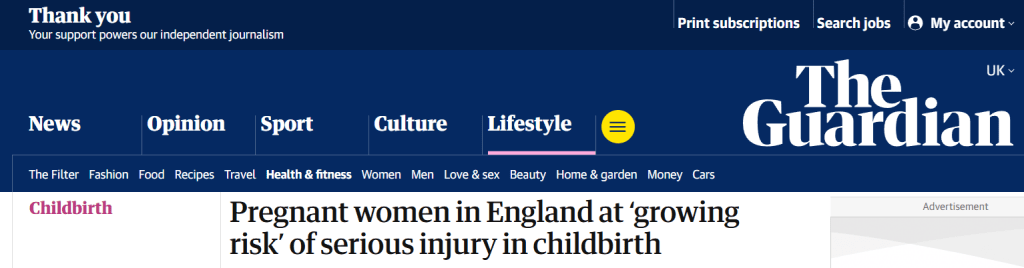
Pregnant women in England are at growing risk of suffering a serious injury while giving birth, NHS figures reveal. The number of mothers sustaining a third- or fourth-degree perineal tear while delivering their baby has risen from 25 in 1,000 in June 2020 to 29 in 1,000 in June this year – a 16% increase.
Such injuries can have a “life-changing” impact on women’s physical and mental health, cause post-traumatic stress disorder and leave them afraid to have another child. Childbirth experts linked the rise in the most serious forms of tear to poor NHS care, understaffing in NHS maternity units and mothers getting older and larger. The disclosure of the rise comes after huge concern about the poor quality of NHS maternity care prompted Wes Streeting, the health secretary, to launch an inquiry into maternity and neonatal care and set up a taskforce to recommend improvements.
Poor identification and treatment of third- and fourth-degree tears are among the mistakes that NHS staff make that help explain why errors in maternity care cost the service more than £1bn a year.
For example, University Hospitals Sussex NHS trust in August agreed to pay £500,000 in damages to a woman who suffered lifelong damage after her fourth-degree tear was wrongly diagnosed as a second-degree tear when she gave birth at the Princess Royal hospital in Haywards Heath in August 2021.
The contrast in Scotland with England’s crisis-ridden NHS maternity services could not be sharper.
NHS England has to pay out more than twice as much as NHS Scotland for ‘maternity failings’
£1.3 billion was paid out in Scotland in 2024/205 compared to £27 BILLION in England:
https://www.cwj.co.uk/site/newsandevents/legalnews/costs_of_NHS_maternity_care_claims_revealed.html
Per head, that £1.3 billion becomes £13 billion, less than half the NHS England pay-outs of £27 billion.
Why might this difference exist?
See this from Stirling University researchers in the BMJ in 2019:
We found few differences in maternity care experience for women based on their physical or socioeconomic characteristics. Our findings indicate that maternity care in Scotland is generally equitable. https://bmjopen.bmj.com/content/9/2/e023282
Further measures in Scotland:
In January 2024, the Daily Mail reporting a drop in the number of midwives, had:
Women are dying during childbirth at the same rates as two decades ago, ‘alarming’ new data shows. An independent review into maternity deaths showed 293 women died during pregnancy and within six weeks of giving birth between 2020 and 2022. Experts said the upward trend is the most compelling evidence yet that failures now span ‘across the entire maternity system’ and is ‘not just one or two hospitals.’ https://www.dailymail.co.uk/health/article-12947355/Deaths-women-childbirth-hits-highest-level-two-decades-amid-string-scandals-experts-warn-failures-span-entire-maternity-system.html
The overall rate in 2020-2022, was 13.41 deaths per 100 000 births and based on the graph in the Daily Mail piece was around 11.8 in 2020.
The rate in Scotland was 10.9 for 2018/2020, the most recent figures.
Today, the Scottish Government responded to a Freedom of Information request from, I’m guessing, a disappointed so-called health correspondent at BBC Scotland or the Herald, to reveal that spending, to improve maternity and neonatal services was £4.m in 2022/2023 up from around only £3m in the previous two years. https://www.gov.scot/publications/foi-202400409637/
As for midwife supply, in 2023, the total number of midwives in Scotland had grown from 3 529 to 3612. https://www.gov.scot/publications/foi-19-00620/
NHS Scotland caring for 8% of the population but with not one of the five major maternity crises and a system that is ‘equitable’
From BBC Health in June 2025:
Health Secretary Wes Streeting, has said “we must act now” as he announced a national investigation into maternity care in England.
The announcement comes after a series of critical reports into maternity care over the past decade.
- In March 2015 an investigation found mothers and babies died unnecessarily at the University Hospitals of Morecambe Bay NHS Trust between 2004 and 2013 – the report described a dysfunctional culture with substandard clinical skills, poor risk assessments and a repeated failure to properly investigate cases and learn lessons.
- In March 2022 an investigation into services at the Shrewsbury and Telford NHS Trust found that more than 200 mothers and babies could have survived with better care.
- Then, in October that year, a review into maternity services at East Kent Hospitals University NHS trust found that at least 45 babies might have survived if they had been given proper treatment.
- And an ongoing review into the maternity care provided by Nottingham University Hospitals NHS trust, due to be completed next year, is set to be the biggest yet, with around 2,500 cases being examined.
- Meanwhile, an annual review in 2024 of units by inspectors at the Care Quality Commission found not a single one of the 131 units inspected received the top outstanding rating for providing safe care.
Dr Clea Harmer, chief executive of the baby loss charity Sands, said the national investigation was “much-needed and long-overdue”.
The ‘Scottish’ media are quiet. If they had something, they’d be all over it like nappy rash.
I searched for ‘Scotland maternity inspections substandard‘ – only English ‘hits’.
I searched the Healthcare Improvement Scotland site – nothing.
I tried ‘Scotland maternity hospital inspection concerns‘ – bingo!
As in the headline, only one minor concern in 2017 and another in 2013 but hey, using Reporting Scotland editorial standards, that’ll do. Get Gulhane or Baillie on the phone.
Equitable in Scotland?
See this from Stirling University researchers in the BMJ in 2019:
We found few differences in maternity care experience for women based on their physical or socioeconomic characteristics. Our findings indicate that maternity care in Scotland is generally equitable.
You can support Talking-up Scotland at: https://www.crowdfunder.co.uk/checkout/help-talking-up-scotland-tell-truth-about-scotland/payment/nBQxjVzq/details or by direct bank transfer method - Bernadette/John Robertson, Sort code 08-91-04, Account 12266421
Discover more from Talking-up Scotland
Subscribe to get the latest posts sent to your email.
 Talking-up Scotland
guid stuff!
LikeLiked by 1 person
“The ‘Scottish’ media are quiet. If they had something, they’d be all over it like nappy rash.”
Maternity and neonatal care – Best Start five-year plan 2017–2024: report
published 16 May 2024
https://www.gov.scot/publications/best-start-five-year-plan-maternity-neonatal-care-20172024-report/pages/9/
Conclusion
The delivery of three quarters of the Best Start recommendations is a result of the combined work of the Best Start Programme Board and Subgroups, maternity and neonatal staff in Health Boards, NHS Education for Scotland, Public Health Scotland, the Scottish Perinatal Network, and the Scottish Government. As illustrated in this report, this has led to fundamental and long-lasting changes to the delivery of services and the ethos of the delivery of care.
This report marks the end of the Programme infrastructure which supported delivery of the ‘Best Start’. However, the work to implement the recommendations, including the core recommendations of continuity of carer and the new model of neonatal intensive care continues, and the Best Start model of care now moves to be embedded in maternity services as ‘business as usual’.
The context for delivery of maternity and neonatal services has changed over the last seven years and will continue to change. Safety of maternity and neonatal services remains a priority for action, and the recently announced Healthcare Improvement Scotland development of maternity standards and the introduction of Safe Delivery of Care inspections will focus the agenda for maternity and neonatal services moving forward.
Best Start was designed to improve maternity and neonatal care, with staff working together to put women, babies and families at the centre of care. The achievements that have been highlighted in the report have delivered on that ethos and the improvements that have been made have fundamentally changed maternity and neonatal services in Scotland.
👏👏👏
LikeLiked by 1 person
I put ‘published 16 May 2024’, I should be 16 May 2025.
LikeLike