

Professor John Robertson OBA
From People requiring a social care assessment and care at home services published today:
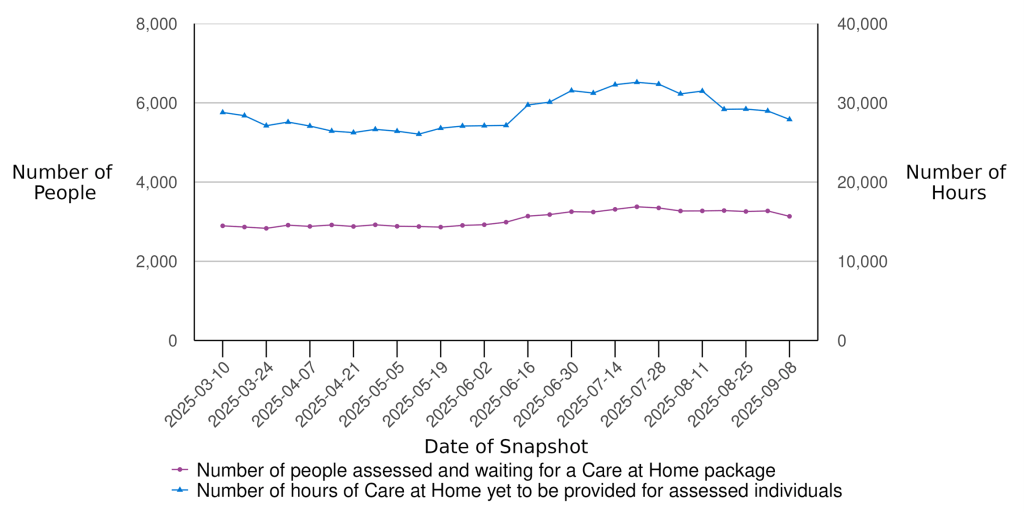
The estimated number of people assessed and waiting for a care at home package was 3,135 on 8 September 2025. This is similar to the number of people (3,122) waiting for a care at home package this time last year (9 September 2024).
Of those people in Scotland waiting for care at home following an assessment of their needs, the total estimated number of weekly hours of care that they were waiting to receive was 27,904 as at 8 September 2025. This represents a decrease of just over 8% from the estimated number of hours at this time last year (9 September 2024).
In England, there were 418 000 assessed but waiting in July 2024 (latest data): https://www.adass.org.uk/documents/adass-spring-survey-2024/
All things being equal, per head, you’d have expect the NHS England figure to around 31 000 (10 times Scotland’s 3 135) but at 418 000, it was 13 times higher.
Talking-up Scotland's special crowd funder has closed but you can support at any time at: https://www.crowdfunder.co.uk/checkout/help-talking-up-scotland-tell-truth-about-scotland/payment/nBQxjVzq/details or by direct bank transfer method - Bernadette/John Robertson, Sort code 08-91-04, Account 12266421
Discover more from Talking-up Scotland
Subscribe to get the latest posts sent to your email.
 Talking-up Scotland
My husband has been in Ninewells and Whitehills in Forfar for approximately a month. He was diagnosed with non recent strokes and dementia to add to his already impressive list of illnesses. He was given a release date from Whitehills of 17th September pending a care package being in place but this wasn’t ready by the 17th. Try explaining that to a dementia sufferer who has been counting down the days.
I decided that I would take responsibility for his care till the care package materialised because I had already been caring for him for a few years now. I have to admit that I’m finding it very hard. Not only the constant care, day and night, but watching the accelerating decline of the man I’ve spent 64 years with.
So, although I have great respect for our NHS, it does make me wonder how many more like us are struggling and if there are others unlucky enough to live on their own who have no alternative but to stay in hospital. Is it possible that the Care part of the service is understaffed mainly due to brexit, or is it more complex than that?
LikeLike
I’m really sorry to hear of your struggles.
All my best wishes and many thanks for your support over the years.
John
LikeLike
Thank you.
LikeLike
If anything, this creates a problem of a wholly different type for the Scottish Care system.
My daughter runs a major care and support home. She and her staff are dedicated to the welfare of the residents. However, that care home has never made a profit, and the existence of empty rooms stretch an already inadequate income, making it hard to employ the numbers of skilled care staff required to ensure the safety and comfort of residents.
She tells me that theirs is not by any means a unique experience. This widespread problem results in care staff at all levels enduring enormously high stress levels and associated illnesses, even post Covid.
James Gillies
LikeLiked by 1 person
‘that care home has never made a profit‘
For the avoidance of doubt, I’m not seeking to question your personal insight at all. Your particular example does seem to differ from care homes owned by private equity companies who presumably are only involved because of access to profit.
I don’t know much about the sector – at least to date – but interested to understand more. A highly diverse sector, even amongst private sector providers – or different in Scotland?
From https://thephagroup.com/blog/private-equity-communications-reputation/ :
‘PE firms have long been attracted to the care home sector lured by the promise of a steady government income and the long-term demographics of Britain’s aging population. Britain’s care homes are separate from the NHS, funded by the government. Care homes rely on support from local authorities, but there has been a significant drop in state funding. Private equity has become an important source of capital to fund new beds and upgrade assets. As of 2022, private equity companies alone accounted for 55,000 beds, or about 12.6% of the total for-profit care beds for older people in the United Kingdom, according to LaingBuisson, a healthcare consultancy. Today, private equity firms own three of the country’s five biggest care home providers.’
LikeLike
I may be repeating myself here but there is something ringing bells here for me. A few years ago, a state of the art private care home opened in my home town. Everything seemed fine and the clients were happy.
However, almost overnight, after a very short time, say two years at most, the place suddenly closed down.
To this day, the building stands empty.
LikeLike
Sorry to hear about your husband kelticgirl
I don’t know what it is in Scotland this covers E,W and NI
https://www.herts.ac.uk/about-us/news-and-events/news/2025/ketamine-deaths-increase-twenty-fold-since-2014-with-mixing-drugs-on-the-rise,-new-herts-research-shows
LikeLiked by 1 person
update on the crowdfunder?
LikeLike