


With only 2 days left, support Talking-up Scotland's work to counter the lies and get you the facts, daily, at: https://www.crowdfunder.co.uk/checkout/help-talking-up-scotland-tell-truth-about-scotland/payment/nBQxjVzq/details or by direct bank transfer method - John Robertson, Sort code 08-91-04, Account 12266421
Professor John Robertson OBA
The Sunday Post has the above in direct contradiction of the facts of drug addiction in Scotland in recent years, ignoring what is ‘the’ news, the trends.
First, drug deaths are falling in Scotland while surging elsewhere in the UK
Even ignoring the above doubts, drug deaths are surging in England & Wales as they plummet in Scotland
England and Wales:

Scotland:

Drug deaths in England & Wales undercounted by 25%
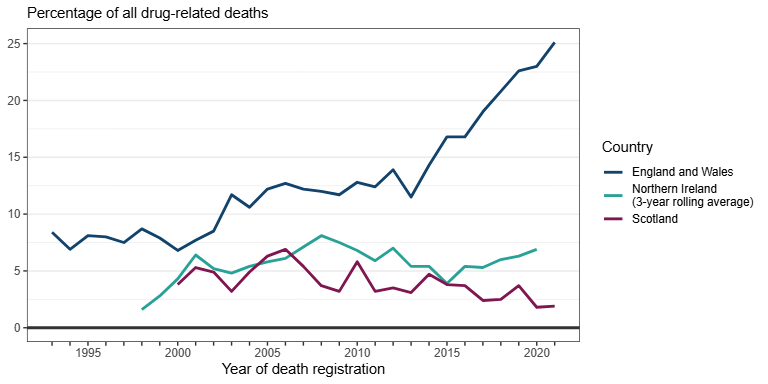
In August 2023, two years ago, the UK Civil Service, estimated with convincing argument and evidence, that the data from England is undercounted by up to 25%. If correct, they would rise above the death rate in Scotland.
Here’s a summary of their research:
From Comparability of drug-related death statistics across the United Kingdom by Paul Breen of the UK Civil Service on 4 August 2023, here are, I think, the key points.
First:
The definitions used for drug-related death statistics are consistent across the UK, but there are important differences in data collection methods and in the death registration systems that affect these statistics.Second:
For England, Wales and Northern Ireland, the only information received by the ONS and NISRA is what is included on the death certificate. The amount of information varies and can be very limited. For drug-related deaths in Scotland, NRS receives additional information on the drugs involved.
Second:
The differences mean that the amount of information held on drug-related deaths varies across the UK. In 2021, 25.1% of drug-related deaths registered in England and Wales had no information on the specific substances involved. The equivalent figure for Scotland was 1.9%, and for Northern Ireland the figure was 6.6%. The proportion of drug-related deaths where no information about specific substances is known has remained consistent over time in Scotland and Northern Ireland. Meanwhile, the proportion of these deaths has been increasing over time in England and Wales, with important consequences for drug-related death statistics.
Third:
In most cases a death cannot be called a drug misuse death when no information on the specific substances is known or provided. Because of this, figures for drug misuse are underestimates. But the figure for England and Wales underestimates the number by a far greater extent.
The different levels of missing data mean that the respective figures for drug misuse published by the ONS for England and Wales, NRS for Scotland, and NISRA for Northern Ireland, are not directly comparable.
So, I think this means that around a quarter of all English drug-related deaths are not being counted because the drug is not identified but in Scotland less than a fiftieth fall into this category.
If correct this may mean that not only does Scotland have the highest drug death rate in Europe but so does the whole of the UK and within the UK, Scotland’s rate may be lower than in England.
Second, NHS Scotland drug treatment bursts 90% target with 96% treated in 3 weeks and 60% in only 1 week or less
From National drug and alcohol treatment waiting times 1 January 2025 to 31 March 2025 published today:
Nationally, the Standard [90% within 3 weeks]was met for referrals to community-based services across all substances: drugs (96.1%), co-dependency (93.9%) and alcohol (90.5%).
Note the 3 843 treated within a week or less.
The 90% target of referrals starting treatment for problematic use of drugs has been been met since June 2021
Discover more from Talking-up Scotland
Subscribe to get the latest posts sent to your email.
 Talking-up Scotland
The FERRET disagrees today. He says that Pete Wishart is wrong and his claims are false.
His publication goes to some length to put Scotland’s drug deaths high above those in rUk, something I do struggle to understand.
LikeLike
This particular paragraph with my emphasis makes a mockery of any claim to journalism let alone credibility for the Ferret… https://archive.ph/ddwFJ
“There are slight differences in the way that drug deaths are measured in the UK, so when comparisons are being made between Scotland and England, ‘drug poisoning’ deaths are measured – which is how drug deaths are measured in England – rather than ‘drug misuse’, which is the headline figure for Scotland”
So nothing to do with the detail as recorded on the death certificate from which the figures are drawn eh, it’s all down to incorrect labelling ? Absolute numbskulls.
LikeLiked by 2 people
Thanks
On it
John
LikeLiked by 2 people
A very long time ago, I, while sympathetic, would look down on those who had ‘allowed’ themselves to become addicted to hard drugs or alcohol. Although I’ve not been personally or familially affected by the opioid overdose crisis, I suffer enough unrelenting PTSD symptoms (etcetera) to know, enjoy and appreciate the great release by consuming alcohol or THC.
In the book (WHAT HAPPENED TO YOU? Conversations on Trauma, Resilience and Healing) he co-authored with Oprah Winfrey, Dr. Bruce D. Perry (M.D., Ph.D.) writes in regards to self-medicating trauma, substance abuse and addiction:
“For people who are pretty well-regulated, whose basic needs have been met, who have other healthy forms of reward, taking a drug will have some impact, but the pull to come back and use again and again is not as powerful.
“It may be a pleasurable feeling, but you’re not necessarily going to become addicted. Addiction is complex. But I believe that many people who struggle with drug and alcohol abuse are actually trying to self-medicate due to their developmental histories of adversity and trauma.”
Societally neglecting, rejecting and therefore failing people struggling with crippling addiction should never be an acceptable or preferable political, economic or religious/morality option. They definitely should not be consciously or subconsciously perceived by sober society as somehow being disposable.
But the more callous politics that are typically involved with lacking addiction funding/services tend to reflect conservative electorate and representatives’ opposition, however irrational, against making proper treatment available to low- and no-income addicts, including safe(r) drugs.
Too often the worth(lessness) of the substance abuser is measured basically by their ‘productivity’ or lack thereof. They may then begin perceiving themselves as worthless and accordingly live and self-medicate their daily lives more haphazardly. (Not surprising, many chronically addicted people won’t miss this world if they never wake up.)
Typically, societally overlooked is that intense addiction usually doesn’t originate from a bout of boredom, where a person consumed recreationally but became heavily hooked on a (self)medicating substance that eventually destroyed their life and even those of loved-ones.
The unfortunate fact about self-medicating is: the greater the induced euphoria or escape one attains from it, the more one wants to repeat the experience; and the more intolerable one finds their non-self-medicating reality, the more pleasurable that escape will likely be perceived. In other words: the greater one’s mental pain or trauma while not self-medicating, the greater the need for escape from one’s reality — all the more addictive the euphoric escape-form will likely be.
Especially when the substance abuse is due to past formidable mental trauma, the lasting solitarily-suffered turmoil can readily make each day an ordeal unless the traumatized mind is medicated.
LikeLike