

Support Talking-up Scotland's work to counter the lies and get you the facts, daily, at: https://www.crowdfunder.co.uk/checkout/help-talking-up-scotland-tell-truth-about-scotland/payment/nBQxjVzq/details or by direct bank transfer method - Sort code 08-91-04, Account 12266421
Professor John Robertson OBA
In the Bulletin of Atomic Scientists, two days ago:
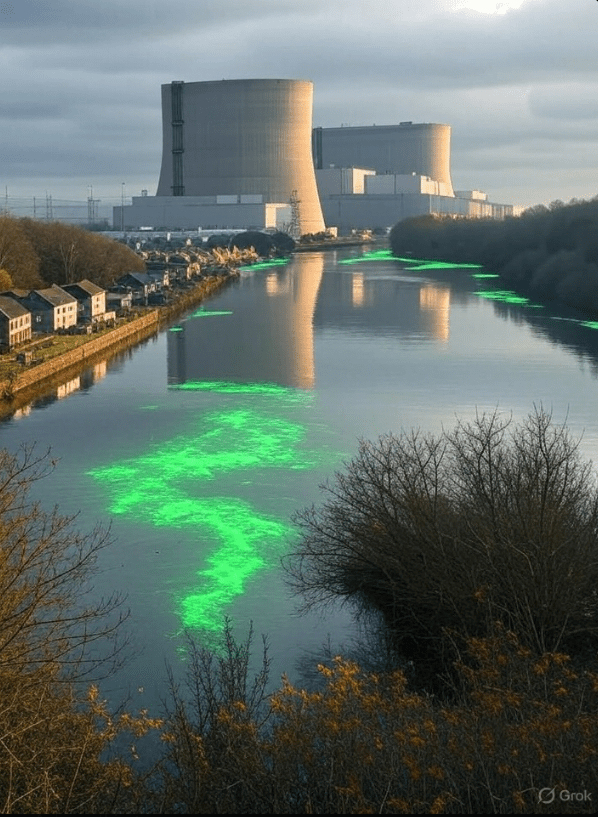
The last and only national study of the health risks posed by existing US nuclear reactors was conducted in the late 1980s. But by then, many of the 62 nuclear plants had only been operating for a relatively small number of years, not enough time for the effects of radiogenic exposure to appear in workers and the nearby population. An attempt to launch a new study in 2009 was ultimately cancelled despite many reported cases of cancer and other diseases. (Credit: Constellation Energy,
CC BY-SA 4.0, via Wikimedia Commons)
Nuclear power reactors were introduced in the United States during the 1950s. Despite concerns about potential health hazards posed by routine radioactive emissions into the environment, few research articles have been published in professional journals. The only national study of cancer near reactors was conducted by federal researchers in the 1980s and found no association between proximity to reactors and cancer risk. But since then, articles on individual nuclear facilities have documented elevated cancer rates in local populations.
Current proposals to expand US nuclear power, along with concerns about protracted exposures near aging reactors, make it imperative that an objective, current national study of cancer near existing reactors be conducted.
The full article is well worth reading, at: https://thebulletin.org/2025/09/why-a-national-cancer-study-near-us-reactors-must-be-conducted-before-any-new-expansion-of-nuclear-power/
What this highlights is both the need for fuller more careful research and the very real danger of collusion by researchers dependent on government and/or nuclear industry funding. We’ve seen an excellent example play out in the UK where only determined efforts by independent researchers confirmed the very real threat of excess breast cancer mortality in mature women living near the Bradwell nuclear power station in Essex.
Here it is in full:
In March 2001, independent researchers, commissioned by local residents living near Bradwell nuclear power station in Essex, published Cancer Mortality and Proximity to Bradwell Nuclear Power Station in Essex, 1995-99; Preliminary results showing:
substantial excess mortality risks, particularly from breast cancer in women who had lived in wards adjacent to the river Blackwater. This finding was similar to the findings of earlier studies on coastal populations near the Irish Sea and near the Hinkley Point nuclear site in Somerset.2
Soon after, local authority researchers criticised the above research and with access to statistics denied to the first group, insisted:
no evidence of any statistically significant increases in cancer in any ward in the study area and that the risks of cancer in populations living in annular areas described by circles around the nuclear site of radii 4, 10 and 17km around the plant showed no association with proximity to the plant.3
A year later, the first researchers revisited their findings and accepted some errors but stated:
there is no difference in the overall result, as we shall show.
Two results are immediate. First the corrected files make the estuary effect more apparent, since the Maldon wards now have more breast cancer deaths after the correction, and second, the effect is reinforced after the inclusion of the two extra years 2000 and 2001.4
and now claim:
Analysis of the corrected file for 1995-99 for the 26 ward area confirms the existence of significantly raised breast cancer mortality in wards which border the mud flats and creeks of the river Blackwater compared with wards which do not. This finding is reinforced slightly by the correction. Thus we see that the Blackwater estuary wards have (Table 4) 58% more breast cancer deaths than the non-Blackwater wards.5
In the full research report the authors reveal deliberate attempts by the local authority researchers to:
cover up a significant health problem and its source. 6
They conclude with damning comments which reinforce what I have written repeatedly about the importance of being deeply sceptical of official statements downplaying the risks of nuclear energy in Southern Scotland:
Ever since the 1983 discovery of the Sellafield (Seascale) leukaemia cluster it has become increasingly apparent to people living near nuclear sites that the epidemiological examination of radiation risk has been the subject of bias and cover-up at a very high level. It is also clear to these people that the reassurances they are given by the organisations who are paid to protect their health are worthless. If the truth about radiation and health is to be discovered, then accurate mortality and incidence data must be discovered, and statistical and epidemiological analysis should be undertaken by environmental groups funded by government, as well as by establishment groups. However, in recent years regional Cancer Registries have intensified restrictions on releasing incidence data, withholding figures which, according to their own Guidelines, ought to be available on request. The notable exception is that in 1995 the Wales Cancer Registry released its entire small area cancer incidence database to Green Audit – an event which was followed swiftly by closure of the WCR and a complex of data destruction and denial which COMARE signally failed to investigate in an even handed fashion.
There is not a level playing field in this debate. On one side there are small independent environmental research groups working under difficult conditions with inadequate information being attacked by the establishment and funded at a pathetic level by groups of local citizens. On the other side are the weighty government organisations with budgets of millions of pounds and departments full of qualified researchers.
It is to be welcomed that the opposition or ‘dialogical’ approach to examining risk in this area has now been accepted and partly put into practice in the new CERRIE committee. This approach has the capacity to deal with the scientific advice problem. However, the affair of breast cancer near Bradwell shows that there is a large trust deficit remaining in this area, associated with the internal operations of SAHSU, the Cancer Registries and COMARE. This is not an isolated affair: similar attacks, denials, cover-ups and shenanigans have occurred following Green Audit studies of cancer on the Welsh and Irish coasts and near Hinkley Point and Oldbury nuclear power stations. There is also the problem of the funding of citizen groups who wish to have an independent analysis of the situation, and the release of data to these groups to make such studies possible. The present situation is unacceptable.7
Sources:
- chrome-extension://efaidnbmnnnibpcajpcglclefindmkaj/https://llrc.org/llrc/health/subtopic/bradrep5.pdf
- ibid page 2
- ibid page 2
- ibid page 3
- ibid page 8
- ibid page 10
- ibid pages 10-11
Right, definitely off-duty till next Monday! Where's that dog lead?
 Talking-up Scotland
Before you go on your break John I thought this would interest you.
Speaking to a friend whose daughter lives in Sheffield and had to go into hospital she had to spend over 13 hours in ambulance waiting outside the hospital so not all a bed of roses down there as they would like to make out.
LikeLiked by 1 person
THIS ADDITIONAL NUCLEAR KILLER STATION
WILL BE GOOD FOR ENGLAND
IT WILL BRING DOWN POPULATION IN SCOTLAND
GIVING ENGLAND EXACTLY WHAT THEY DREAMED ABOUT
lLESS SCOTS SPONGING OFF THEM
AND LOTS MORE ENGLISH GREED
LikeLike
Just saw that Starmer was entertaining tRump to talk about new nuclear etc… watch out Scotland!!
LikeLiked by 1 person
O/T
Just saw this in the Daily Telegraph online today.
It is a list of 20 train operators ranked from worst to best. Scotrail came 2nd top.
See the full list here
https://archive.is/JHtDL
LikeLiked by 2 people