


Number of drug misuse deaths and 5-year rolling average, 1996 to 2024

‘Milk blood to keep from running out’ – James Cook pushes Scotland’s FALLING drug deaths on us day-after-day to try to keep us thinking if we can’t even stop this how can we run a country?
Support Talking-up Scotland's work to counter the lies and get you the facts, daily, at: https://www.crowdfunder.co.uk/checkout/help-talking-up-scotland-tell-truth-about-scotland/payment/nBQxjVzq/details or by direct bank transfer method - Sort code 08-91-04, Account 12266421
Professor John Robertson OBA
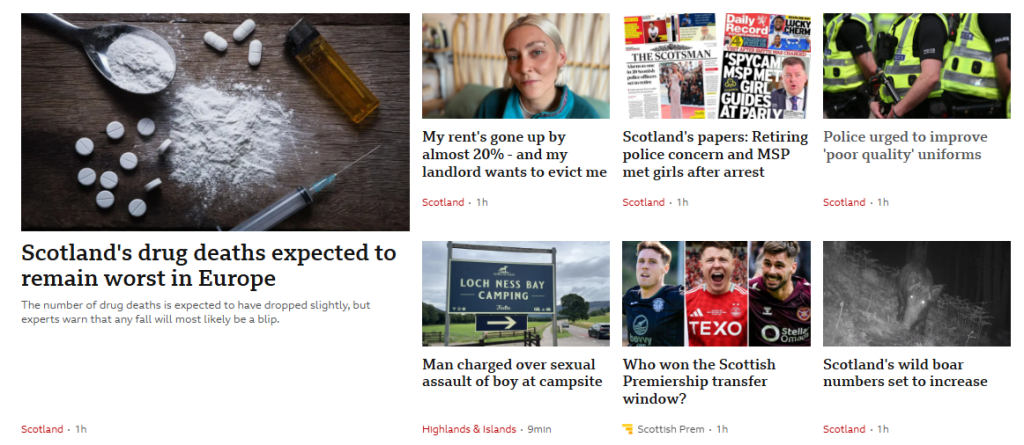
Yesterday and on through this morning, James Cook has been the top story. They’ve just updated:
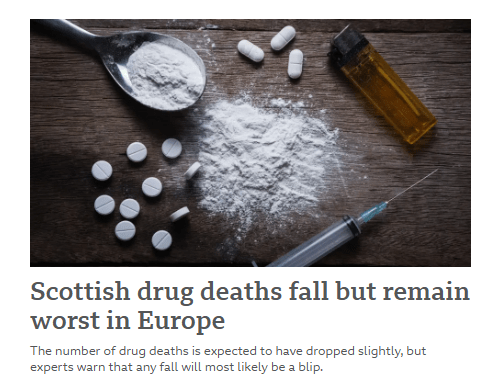
Yesterday, we had:
Figures to be published on Tuesday are expected to show that Scotland remains the drugs death capital of Europe for the seventh year in a row.
In 2023, there were 1,172 drug misuse deaths in Scotland, bringing the total in a decade to 10,481, according to official figures.
Although experts expect that number to have dropped slightly for 2024, they are warning that any fall will almost certainly be a blip.
Who are the experts?
Kirsten Horsburgh, chief executive of the Scottish Drugs Forum, Annemarie Ward…sigh….the same old faces with some kind of grudge against the Scottish Government – is the latter not giving the respect they feel they deserve? Seeing other experts, ones with qualifications and a track record in research?
A year ago, it was Scotland’s drug deaths still worst in Europe after 12% rise and this graph:

I’ve added the longer term trend which is more meaningful than any one year variation.
In the last few minutes, I see they’ve fallen again to 1 017 reinforcing the trend and revealing last year to be the blip: https://www.nrscotland.gov.uk/publications/drug-related-deaths-in-scotland-2024/
Discover more from Talking-up Scotland
Subscribe to get the latest posts sent to your email.
 Talking-up Scotland
Great work as always. I’ve been trying to find out how drug related deaths are calculated in both Scotland and England, do you know if they use the same system? Jill
LikeLike
I don’t think they are using the same system but you might get more info here about the Scottish system at least
https://www.nrscotland.gov.uk/publications/drug-related-deaths-in-scotland-2024/#:~:text=Contents&text=In%202024%2C%20there%20were%201%2C017,a%2012%25%20increase%20in%202023.
LikeLike
Hi Jill
This major difference.
John
https://talkingupscotlandtwo.com/2025/08/24/uk-government-researchers-say-25-of-englands-drug-deaths-not-counted-to-cast-serious-doubt-on-scotland-having-the-highest-level/
LikeLike
Hmm, your posts are not showing up at all now in ‘reader’ side bar, have to click on the bell top right and even them hard top read! Very strange…anyone else having that issue?
LikeLike
Sorry AH
Me no techy
John
LikeLiked by 1 person
No probs I’ll get my son to take a look..strange though.
LikeLike
Looks like I was unsubscribed…sorted now I think.
LikeLiked by 1 person
Hi John I thought you might find this interesting!!!
Scotland is not the “drug capital” of Europe.
We all saw the headlines yesterday
“ although Scotland’s drug deaths fell they still ‘remain’ the highest in Europe”.
Based on what comparable statistics?
From AI…”Comparable statistics allow for systematic evaluation, hypothesis testing, and data-driven decision-making by identifying similarities and differences between groups or phenomena.
To be comparable, data must either be collected with
standardised methods and definitions
or have undergone
a thorough assessment of differences in methodology to ensure meaningful interpretation.”
So what standardised data do the BBC, STV and the rest of British media use to make such bold negative statements about Scotland?
Well none actually!!!
As has been reported on TUS England’s drug deaths data is “ undercounted by up to 25%.”
What about Europe?
From the European Union Drugs Agency (EUDA) this report titled
Drug-induced deaths situation (FAQ drug-induced deaths in Europe)
Drug-induced deaths situation (FAQ drug-induced deaths in Europe) | http://www.euda.europa.eu
In the report they clearly state that
“Exclusion criteria
Deaths for which a drug has been found in the toxicological analysis but in which this drug did not have a causal or determinant role in the death are not included in the EUDA statistics. This may happen when a toxicological analysis is undertaken in certain investigations (e.g. traffic accidents, suicides and violence). Deaths that are indirectly related to drug use are also excluded from the regular national statistics of ‘drug-induced’ or ‘overdose’ deaths (e.g. deaths related to HIV/AIDS acquired through injecting drugs).”
They then go on to report that
“It is estimated that at least 7 400 overdose deaths occurred in the European Union in 2023. This rises to an estimated around 8 100 deaths if Norway and Türkiye are included. These overall numbers must be understood as underestimations, as there are limitations to drug-induced deaths data as some countries report that their monitoring system is missing some cases. For example, a cross-validation of the 2022 data from the different registers (general and special registers) in Spain suggested that, when based solely on the general register, only 4 out of 5 cases might be reported. In Germany and Italy, the mortality register only contains cases that have come to the attention of the police. Thus, cases outside of police focus may be under-reported. However, the extent of the underestimation is unknown.”
Note the “These overall numbers must be understood as underestimations as there are limitations to drug induced data”!!!
If you look at the methodology used to monitor drug-induced deaths in Europe we have this,
“ Where do the data on drug-induced deaths come from?
There are two kinds of mortality registers from which cases of drug-induced deaths can be retrieved and reported: general mortality registers and special mortality registers.
Now it gets (deliberately?) a bit vague.
“What sources of data are used in different countries to estimate numbers of drug-induced deaths?
Most countries report data from both sources (general and special registers), which allows triangulation and validation of the data.”
So far good so good?
Nope!!!
“While the trends are usually consistent between both sources, there can be discrepancies between the general mortality register and the special mortality register data in some countries. This can be because the coding of the causes of deaths in the general mortality register is not sufficiently sensitive, or because the data reported from the special register do not cover the whole country.
Depending on the certification and coding procedures in the registries, and the flux of information between the special and the general mortality registries, there are reporting delays in some countries.”
Just to muddy the statistics even more.
“What is the preferred source of data chosen by the countries for use in EUDA publications?
When both sources are available, the countries are asked to choose which is more valid and which should be taken as the reference for the EUDA. The data from the selected source are then used to compute the European figures and European trends.
Meanwhile, at national level, figures from both sources (the selected source or ‘national definition’ and the other source) are given in the Statistical Bulletin.
Sixteen countries indicated that the general mortality register was their preferred source, while 13 preferred the special register. Twelve countries report data from both sources.”
So no standardised methodology seems to be used to collect drug deaths data across Europe, therefore how many European countries, just like they do in England, are underestimating their statistics, and by how much?
JB
LikeLike
Fantastic
You’ve done great service here
https://talkingupscotlandtwo.com/2025/09/03/european-union-drugs-agency-drug-deaths-must-be-understood-as-underestimations-as-in-england-proving-that-scotland-is-only-the-drug-death-accurate-reporting-capital-of-europe/
John
LikeLike