

Professor John Robertson OBA
Today, from BBC Scotland, the above and:
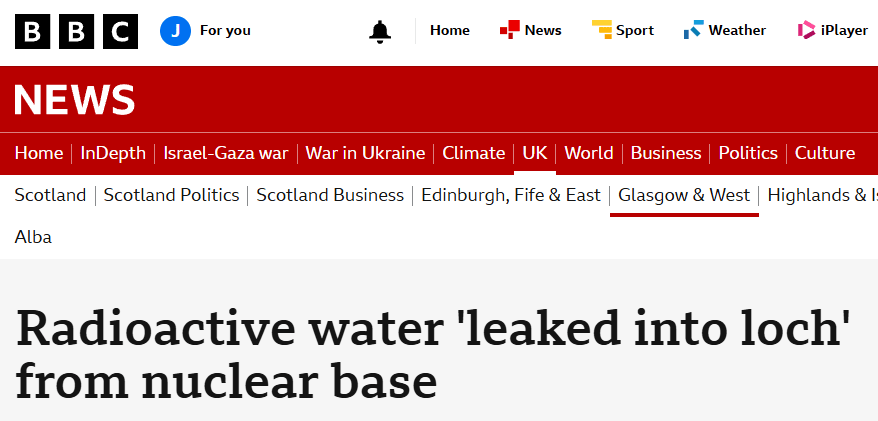
Radioactive water from a Royal Navy nuclear weapons base leaked into a loch after old pipes repeatedly burst, according to official files. The Guardian, external and The Ferret, external found the material was released into Loch Long, Argyll and Bute, after a six-year battle to access documents which involved Scotland’s Information Commissioner, external.
The Scottish Environment Protection Agency (Sepa) said its assessments found the risk to the environment from effluent discharges was “of no regulatory concern”. The Ministry of Defence (MoD) also said there had been “no unsafe releases of radioactive material” into the environment.
The joint investigation revealed that files compiled by Sepa, a government pollution watchdog, stated the navy failed to properly maintain a network of 1,500 water pipes at the Coulport armaments depot.
See that ‘leaked into loch‘, that should be leaked into loch. The radioactive water from those 1 500 pipes did really leak into the loch. No one is denying that now, not even the MoD.
From the CND, November 2024:
Radioactive air emissions have been increasing year-on-year at Coulport one of Britain’s nuclear submarine bases in Scotland. This development is of some concern as it would lead to increased health risks wherever the emissions were inhaled.
Investigations by The Ferret and The National newspaper found that emissions of radioactive tritiated water vapour had doubled at the Royal Navy’s nuclear weapons storage depot at Coulport on Loch Long between 2018 and 2023. According to the Scottish Pollution Release Inventory, tritiated water vapour emissions at Coulport were 1.7 billion becquerels (units of radioactivity) in 2018, rising steadily to 4.2 billion units in 2023. Tritiated water vapour is harmful when inhaled, ingested or absorbed through the skin as its radiation causes cancer and cardiovascular diseases including strokes.
The investigation also found that eight miles from Coulport at Faslane, where Britain’s nuclear submarines are based, tritiated water containing over 50 billion units of radioactivity had been dumped into the Gareloch. The level of dumping peaked in 2020, when 16.6 billion units were discharged.
The Ferret noted that in 2019, the Scottish Environment Protection Agency (SEPA) “changed the rules to allow certain tritium-contaminated effluents from nuclear submarines at Faslane to be discharged into the Gareloch.” Both SEPA and the MoD claim these emissions are within official safety limits.
However Dr Ian Fairlie, CND’s science advisor, states that these limits are unreliable, as official estimated doses from tritium contain “large uncertainties.”
CND General Secretary Sophie Bolt said:
“From faulty nuclear-armed subs on dangerously extended patrols to crumbling nuclear waste sites, Britain’s nuclear industry is putting us all at great risk. Instead of enforcing the highest levels of environmental standards, the government is just redefining what ‘acceptable risk’ means. All so it can allow the dumping of radioactive water, putting local people at greater risk of cancer. This is beyond reckless. It’s time to scrap Trident and its replacement, and decommission the nuclear industry.”
https://cnduk.org/radioactive-pollution-is-increasing-at-britains-nuclear-bases/
At the same time Cancer incidence in the under-50s has dramatically increased.
From the Health Foundation in September 2024:
Growing numbers of adults under 50 years [more likely to be exposed at work, in education or outdoor recreation including swimming than over 50s] are experiencing a cancer diagnosis (often known as early or young-onset cancer).
This is a developing field, but evidence is mounting that rates of young-onset cancer incidence are increasing, particularly in high-income countries in the global north. A study looking at global trends focusing on 29 types of cancer in people aged 14–49 years, found incidence of these cancers increased by around 79% between 1990 and 2019, with around 3.3 million cases globally in 2019 and countries in more economically developed regions particularly affected.
In the UK, cancer incidence rates among people aged 25–49 years increased by roughly 22% between 1993–95 and 2016–18 (while incidence rates among those aged 75 years and older increased by around 9%).
Scottish Labour is, of course, committed to the Trident programme.
No doubt, someone will blame the locals for smoking-induced lung cancer but but smoking rates have been in steep decline for decades:
Smoking prevalence is similar in males and females, with a decline observed in both sexes over time; from 2003 to 2021, prevalence fell from 28% to 11% in females and from 29% to 12% in males.
The big C Cancer is the main risk from humans ingesting tritium.
Finally on the tritium now being dumped in the Clyde in billions of units. From Scientific American in 2014:
The big C Cancer is the main risk from humans ingesting tritium. When tritium decays it spits out a low-energy electron (roughly 18,000 electron volts) that escapes and slams into DNA, a ribosome or some other biologically important molecule. And, unlike other radionuclides, tritium is usually part of water, so it ends up in all parts of the body and therefore can, in theory, promote any kind of cancer.
Some evidence suggests the kind of radiation emitted by tritium—a so-called beta particle—is actually more effective at causing cancer than the high-energy radiation such as gamma rays, even though skin can block a beta particle. The theory is that the low-energy electron actually produces a greater impact because it doesn’t have the energy to travel as far and spread its impact out. At the end of its atomic-scale trip it delivers most of its ionizing energy in one relatively confined track rather than shedding energy all along its path like a higher-energy particle. This is known as density of ionization, and has been shown with the similar form of radiation called an alpha particle.
Ionization is what makes radiation dangerous for human health. Essentially, the radioactive particle smashes into the atom or molecule and pushes out an electron or other particle, leaving that atom or molecule in a charged or ionized state. These charged molecules can then cause other damage as they interact with other atoms and molecules. That includes damage to DNA, genes and other cellular mechanisms. Over time this DNA instability results in a higher chance of cancer. As a result, scientists work under the assumption that any amount of radiation poses a health risk.
Scottish Labour is, of course, committed to the Trident programme.
Discover more from Talking-up Scotland
Subscribe to get the latest posts sent to your email.
 Talking-up Scotland
Panic over SEPA says the MOD have now got down to repairing the leaking pipes so I guess only half the population of Argyle would likely be exposed and it is far away from London so no great harm done. For those living next to Loch Long enjoy your fish and chips albeit they might glow in the dark at the moment.
LikeLiked by 3 people
AND WHAT IS DAME BAILIIE SAYING AND DOING ABOUT THIS DEATH VALLEY
KILLING MACHINE
IF THIS WAS IN ENGLAND THE CORRUPT PRESS WOULD BE ALL OVER THE
E GLISH POLITICAL PARTIES WHO SIGNED UP
LikeLike
It’s only North Britain after all, a part of the ‘precious’ Union without sufficient clout to make a difference in Westminster and Whitehall as to how the MoD operates!
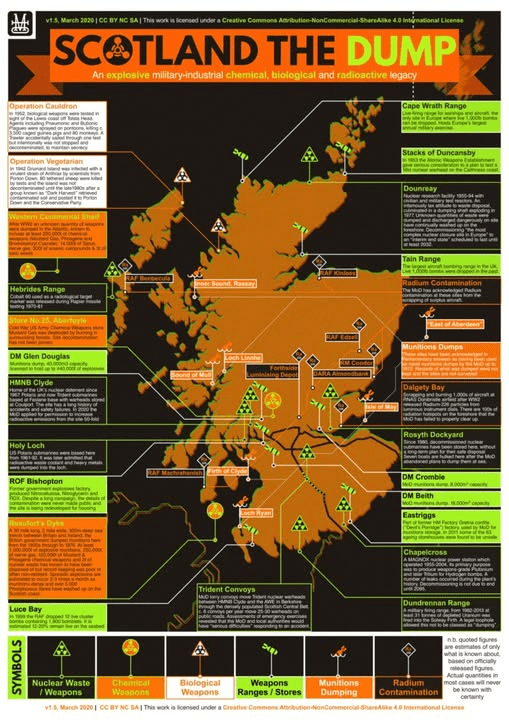
Here is a bullet-point list of MoD Pollution & Legacy Sites in Scotland that have received some public profile over the past c.20 years (courtesy of ChatGPT and not checked further by me):
Radioactive and Nuclear Legacy:
Dalgety Bay (Fife) – WWII-era contamination from disposal of radium-painted aircraft dials.
Radioactive particles discovered in 1990; beach closure in 2010 due to rising contamination. £10M MoD-funded remediation began in 2021; completion expected soon with 2-year SEPA monitoring.
Coulport (Argyll & Bute) – Tritium Leaks. Low-level radioactive water leaked into Loch Long due to aging pipework (2010, 2019, 2021). Failures not publicly disclosed until 2025; SEPA cited poor maintenance and delays. Pipes part of 1,500+ aging assets; MoD now under pressure to accelerate upgrades.
Rosyth Dockyard (Fife) – Submarine Hulks. Seven nuclear-powered submarines defuelled but still stored; dismantling began with HMS Swiftsure. Target to fully de-nuclearise site by 2035; current dismantling pace is slow. Longstanding environmental concern; £13M spent over 5 years on storage alone.
Vulcan NRTE (Caithness) – Ex-submarine reactor test facility adjacent to Dounreay. Decommissioning to transfer to the NDA by 2027–28. Funding gaps exist as no dedicated mechanism covers military nuclear site cleanup.
Dounreay (Caithness) – Civil site but closely tied to defence history. Tens of thousands of radioactive fuel particles discharged into the sea (1960s–1980s). SEPA confirms seabed cannot be fully restored; ongoing offshore particle recovery.
Chemical Weapons Disposal (WWI, WWII legacy):
Beith (North Ayrshire) – Former bomb-filling site for chemical agents during WWII. Identified under Project Cleansweep; no independent confirmation of full decontamination.
Aberfoyle (Stirling) – Ex-US chemical weapons store (known as “No 25 Aberfoyle”). Smoke generators burned near Torrie Forest; MoD claims area is now safe. Campaigners have called for full environmental audits.
Gruinard Island (off Wester Ross) – Site of WWII anthrax weapon testing by MoD. Deemed decontaminated in 1990, but public concern remains over possible residual risk.
Other Former MOD and Military Sites of Concern:
MOD West Freugh (Dumfries & Galloway) – Former airfield and testing site; depleted uranium tested in 1990s. Radiological survey reportedly found no significant contamination.
ROF Bishopton (Renfrewshire) – WWII-era explosives (cordite) manufacturing plant. Site decommissioned in 2002; now partly redeveloped for housing. Concerns persist over residual contamination in undeveloped areas.
RAF Kinloss (Moray) – Former RAF base closed in 2012; now Army barracks. No known contamination issues, but long-term land use transition ongoing.
Dundrennan Range (Kirkcudbright, Solway Firth) – Over 6,000 depleted uranium (DU) shells—approximately 20 tonnes—were test-fired into the Solway Firth between 1982 and 2004. DU contamination has been detected in soil at the range, with levels “well above acceptable limits,” and corrosion of DU fragments continuing to spread contamination. The MoD evaded marine pollution laws (OSPAR Convention) by labeling the test rounds as “placements” instead of “dumping” BBC Herald Scotland. Environmental monitoring has been ongoing since 1983, including soil, sediment, shellfish, and grass sampling. Although contamination in target zones is fenced and controlled, concerns persist over long-term effects and health implications.
Cape Wrath Training Area – Live firing with tracer ammunition led to a fire in 2008, affecting approximately 137 hectares of land; area left to regenerate naturally without formal environmental assessment. Concerns remain over wildlife disturbance, fires triggered by ordnance, and stray shells—one shell landed miles off-target in 2002.
General Firing Ranges & Heavy Metals – MOD firing ranges are routinely managed by contractors (e.g., Amey) who oversee maintenance including “de-leading” operations to remove accumulated lead from bullet catchers. However, lead contamination remains a known concern at shooting ranges. Range decommissioning typically requires costly remediation, and community experiences suggest challenges in effective environmental cleanup from lead and other heavy metals.
Other points:
Secrecy Over Clyde Nuclear Bases (Faslane & Coulport) – SEPA prevented from releasing over 20 documents due to national security concerns. Ongoing transparency disputes raised by environmental watchdogs and journalists.
No Central Register of Unrestored MOD Sites – There is no public, comprehensive list of all unused or unrestored MOD sites in Scotland. Site histories must be pieced together from FOI requests, journalism, local records, and MoD disclosures. Calls persist for a national audit of defence legacy sites, particularly those with environmental risks.
But to repeat, this is just North Britain after all, a part of the ‘precious’ Union without sufficient clout to make a difference in Westminster and Whitehall as to how the MoD operates and how it clears up its mess!
LikeLiked by 3 people
Why should there be Tritium there. The bombs arrive and are fitted that don’t do processing there
Even the nuclear reactors don’t emit Tritium
LikeLike
YET AGAIN ENGLAND THINK NOTHING OF KILLING SCOTS
WITH SERIOUS RADIOACTIVE WASTE IN DUMBARTON
AND BAILLIE RUNS FOR COVER
LikeLike