


Professor John Robertson OBA
The two pieces today on ‘Scotland’ and its role in slavery, the first accurately worded, the second not so, remind me of an earlier debate prompted Anas Sarwar, defended by Prof Tom Devine. Here’s how it went in August 2022:
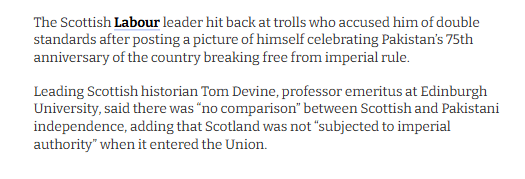
Sarwar’s support for Pakistan’s independence, considered hypocritical by many including me, was dismissed by Devine as ‘no comparison‘ because Scotland was not ‘subjected to imperial authority‘ and because ‘Scots‘ (sic) took part in the Empire with ‘relish and enthusiastic commitment.‘
He’s wrong. Like even the best of historians, he seems to have forgotten that ‘Scots‘ embraces a far wider spectrum than those few thousands from some Scottish elite groups who did, as he puts it, take part enthusiastically. The millions who remained in Scotland, along with thousands of ordinary soldiers who died in India were the tragic victims of an Empire which had been growing across the British Isles for centuries before their subjection to it – England. It was always called ‘England.’ Ask any Pakistani today and they’ll call it that too.
Surely no credible academic could consider the Union with England anything other than a hostile takeover resulting in monumental suffering, poverty, ill-health, clearance, death in war and mass emigration, for all but a few.
Doesn’t this map of British forts in Scotland in 1746 speak, with articulation, of imperial authority?
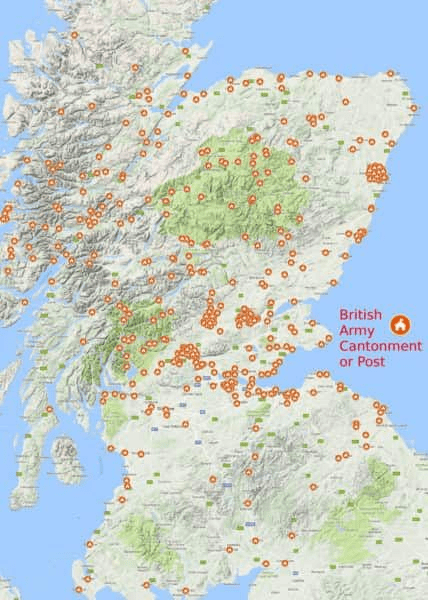
Were there this many British forts, per square mile, in 18th Century India?
Also, didn’t many of India/Pakistan’s elites take part in the Empire with ‘relish and enthusiastic commitment?’
So, what to do? The ill-gotten gains are easily traceable. HMRC can bill the elites (20%?) and pass the money to the governments in the numerous countries which British elites drained of their wealth.
I’ve checked – all of my ancestors going back to 1640 were coalminers, labourers on the land and cannon-fodder in the Black Watch. As late as the 1960s, we lived in miners rows and slum cottages with outside lavvies. This is nothing to do with us.
Discover more from Talking-up Scotland
Subscribe to get the latest posts sent to your email.
 Talking-up Scotland
I couldn’t agree more with the sentiments and conclusions in this article.
I’d go further though.
Not only did I share a lineage of miners and agricultural labourers, but I, through education, personally achieved success in my chosen profession. During this journey from ‘working class’ to ‘middle class’ I never once encountered a fellow Scot who had been heir to fortunes amassed by their forebears.
This tells me that the common five eighths of old remain the same today no matter that education may have allowed for elevation of occupation from the toil of manual labour.
The elites of old have their successors in today’s Scotland. Largely identified as the Tweed, Twinset and Pearls brigade the pseudo upper class who, while boasting historic Scottish names, have so many marbles in their mouths they can readily be misidentified as escapees from the ‘Home Counties’ of England.
These are not my people and their forebears did not act for the benefit of my people!
LikeLiked by 6 people
‘I never once encountered a fellow Scot who had been heir to fortunes amassed by their forebears?’
Me too.
LikeLiked by 3 people
the Guardian have a few Scotland is shite stories on the slavery issue, Scotland’s Government was in London in they days, and Edinburgh Uni would have been packed full of British placemen, keen to get on in the British Establishment way.
LikeLiked by 1 person
What’s even worse, the slave owners were compensated after emancipation for the loss of their property. But the slaves were not.
LikeLiked by 4 people
Just wondering if any PM has apologisrd on behalf of their Majesty’s Government for its role in slavery and colonialism?
LikeLiked by 2 people
Or the for their brutallity towards the Scots and the clearances in Scotland, or their heinous starvation of the Irish, no way would the English ever say sorry to their local past and current colonies.
LikeLiked by 3 people
Capella,
That’s right, the loan to pay off the slavers was so large, it took until 2015 to finally pay it off.
Britain also had a key role in ending the trade, through Parliament’s passage of a law to abolish slavery in 1833. As part of that law, British plantation owners were paid for the loss of their slaves, to the tune of some £20m. The UK only finished paying off the debt it incurred to cover the payments in 2015.
LikeLiked by 2 people
I’ve seen this before. It’s got to be that Scotland’s the same as England, in fact worse…the pretendy lefty rag the Guardian making sure the English can point the finger, you are no better and should hang you heads in shame and stop pretending you can be independent of the wonderful English in England, they saved you from your evil selves.
LikeLike
I know people who hate the Scottish because they apparently helped and joined the English in a brutal oppression of the Irish. Again, no doubt some were paid well to do that, but the general population were not involved.
LikeLike
Exactly John. The poor majority have always been used as labourers, factory fodder and cannon fodder, a type of slavery in itself. 😦
LikeLiked by 1 person