


In the Irvine Times on 10 April 2020:
Energy minister Michael Shanks on Hunterston takeover – ENERGY Minister Michael Shanks MP has hailed the UK Government’s takeover of Hunterson B as “a very significant moment” in the site’s long history. In an exclusive interview, Mr Shanks – who was born in Irvine and attended school in Prestwick – said returning to Hunterston brought back memories of visiting the site as a child.
He said: “I was here on a school trip in primary school, so it was great to stand in the reactor hall again and see it in its current state. “For most people in Ayrshire, Hunterston has been a feature for their entire lifetime, but it’s also been a critical part of our energy generation mix. For 46 years it helped power the country – and that chapter has now come to an end.”
Remind me, just who have they taken Hunterston B over from?
Électricité de France, owned by? France, the French Government.
Why did they sell it? They don’t want to pay for the costs on making the site radiation-free, safe, again.
Who will pay?
Us, via the Nuclear Liabilities Fund (NLF) of £20.7bn to pay for all UK nuclear decommissioning.
How long with this new chapter, that wee Michael is so excited about last?
70 to 100 years https://www.newcivilengineer.com/latest/significant-milestone-for-nuclear-sector-as-hunterston-b-relicensed-for-decommissioning-19-03-2026/
Might some radioactive isotopes last?
Some isotopes have half-lives vastly exceeding the ~13.8 billion-year age of the universe.
Relevant to Nuclear Power Stations and Decommissioning (Like Hunterston B)In the context of a nuclear reactor like Hunterston B (an AGR with a graphite moderator, concrete structures, and spent fuel residues), the longest-persisting radioactive materials come from:
- Activation products in the graphite core and structural materials.
- Fission products and actinides from fuel (though most fuel is removed during defuelling).
- Naturally occurring or long-lived contaminants.
Key long-lived examples include:
| Isotope | Half-Life | Relevance to Nuclear Sites (e.g., AGRs like Hunterston B) | Type of Radiation |
|---|---|---|---|
| Chlorine-36 (Cl-36) | ~301,000 years | Produced by neutron activation in concrete and graphite; mobile in groundwater, a concern for long-term waste disposal. | Beta |
| Technetium-99 (Tc-99) | ~211,000–220,000 years | Long-lived fission product; can dominate residual activity in some wastes after shorter-lived ones decay. | Beta |
| Iodine-129 (I-129) | ~15.7 million years | Long-lived fission product; bioaccumulates in thyroid but low specific activity due to long half-life. | Beta & gamma |
| Carbon-14 (C-14) | ~5,730 years | Major activation product in graphite moderators (common in UK AGRs and Magnox reactors); significant in irradiated graphite waste. | Beta |
| Uranium-238 (U-238) | ~4.47 billion years | Dominant in spent fuel or trace contamination; natural background level comparator. | Alpha |
| Uranium-235 (U-235) | ~704 million years | In spent fuel residues. | Alpha |
| Neptunium-237 | ~2.14 million years | Actinide in spent fuel/waste. | Alpha |
Hmm, fancy a new house on that site?
“For most people in Ayrshire, Hunterston has been a feature for their entire lifetime?” Indeed but what kind of ‘feature Michael?’
This:
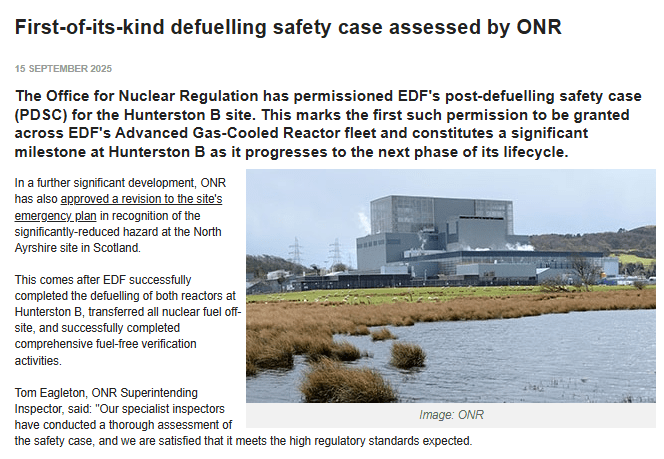
As the authorities approve [15 September 2025] the progress in reducing hazard at the Hunterston B nuclear site in North Ayrshire, I’m deeply suspicious and reminded of the harm that was done over 45 years.

By Professor John Robertson, OBA
Hunterston B Nuclear power station, in North Ayrshire, Scotland, was in operation for nearly 45 years, from February 1976 until November 2021.1
In that time, there will have been around 30 re-fuelling instances2 and up to 300 inspections.3
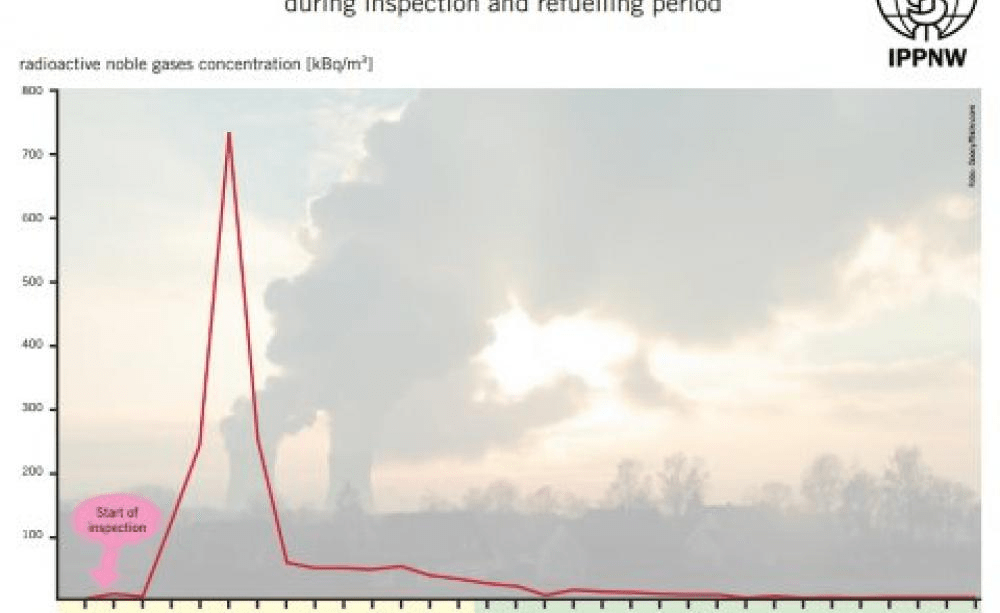
During these events, there are spikes of radioactive emissions. Researchers in Germany, published this in 2011:
According to the International Physicians for the Prevention of Nuclear War (IPPNW) in Germany, the normal emission concentration during the rest of the year is about 3 kBq/m³, but during inspection/refuelling (in the afternoon and evening of September 22nd) this concentration abruptly increased to ~700 kBq/m³ with a peak of 1,470 kBq/m³. In the following days (September 22nd – 29th), the concentrations of released radioactive noble gases were still much higher (average = 100 kBq/m³) than during normal power operation.
In order to refuel, reactor pressure vessels must be opened which releases to the local environment very large volumes of radioactive gases and vapours, including noble gases, H-3 (tritium), carbon-14, and iodine-131. Until now, the nuclide amounts were only published as annual averages throughout the world. Now, after requests by IPPNW and the Green Party in the Bavarian State Parliament (Landtag), non-averaged values have been made available for scientific evaluation for the very first time anywhere in the world.4
What consequences might there be from these spikes, 500 times the supposed safe level, over several days, for the population around nuclear power stations such as Hunterston B in North Ayrshire or, indeed from any new installations if UK Labour gets its way on this?
From Dr Ian Fairlie in 2014:
On 23rd August, The Ecologist published very clear evidence of increased cancers among children living near nuclear power stations around the world, including the UK.
The story sparked much interest on social media sites, and perhaps more importantly, the article’s scientific basis (published in the academic peer-reviewed scientific journal the Journal of Environmental Radioactivity) was downloaded over 500 times by scientists.
Given this level of interest and the fact that the UK government is still pressing ahead with its bizarre plans for more nuclear stations, we return to this matter – and examine in more detail an important aspect which has hitherto received little attention: massive spikes in radioactive emissions from nuclear reactors.5
What is the evidence, specifically for Ayrshire and other parts of Scotland upwind of Hunterston B?
I can find no precise, local data, but from Public Health Scotland, in 2023:
The rate, or risk, of new cancers [in Scotland] also increased to 644 per 100,000. 6
The average level of cancer cases in Europe is only 280 per 100 000 compared with 640 in Scotland. In North America, it’s 364.7 and in Oceania (Australia, NZ), it’s 409. 7
Scotland is clearly the cancer capital of the world. Why is that not news?
And England, most of it further way from Sellafield and Trident than most Scots are? From the Gov UK site, the rate is 540 per 100 000,8 also very high globally but significantly lower than in Scotland at 640.
And before you say it – Scots smoke more? No they don’t.
15% of Scots smoke.9 Fewer than in most European countries.10
Sources:
- https://en.wikipedia.org/wiki/Hunterston_B_nuclear_power_station
- https://nuclear.duke-energy.com/2016/03/23/out-with-the-old-in-with-the-new-fuel/#:~:text=How%20often%20are%20nuclear%20plants%20refueled%3F%20Most%20nuclear,it%20minimizes%20the%20impact%20to%20the%20electricity%20grid.
- https://www.nrc.gov/reading-rm/doc-collections/fact-sheets/oversight.html#:~:text=Each%20year%2C%20NRC%20specialists%20conduct%2010%20to%2025,at%20the%20plants%20and%20issues%20that%20may%20occur.
- https://www.ippnw.eu/en/nuclear-energy-and-security/artikel/85877f0d9c07a9c13e7729feef095980/spikes-of-radioactive-emissions-dur.html
- https://theecologist.org/2014/sep/29/radioactive-spikes-nuclear-plants-likely-cause-childhood-leukemia
- https://publichealthscotland.scot/publications/cancer-incidence-in-scotland/cancer-incidence-in-scotland-to-december-2021
- https://ec.europa.eu/eurostat/statistics-explained/index.php?title=Cancer_statistics#Deaths_from_cancer
- https://www.statista.com/statistics/312961/new-cancer-cases-rate-england-age-gender/#:~:text=Cancer%20is%20an%20aggregation%20of,excluding%20non%2Dmelanoma%20skin%20cancer
- https://www.gov.scot/publications/scottish-health-survey-2022-volume-1-main-report/pages/11/#:~:text=As%20noted%20above%2C%20in%202022,%25%20and%2013%25%20respectively).
- https://www.euronews.com/health/2023/08/14/smoking-in-europe-which-countries-are-the-most-and-least-addicted-to-tobacco-and-vaping#:~:text=According%20to%20data%20compiled%20by,smoked%20fewer%20than%2020%20units.
Discover more from Talking-up Scotland
Subscribe to get the latest posts sent to your email.
 Talking-up Scotland
Unionists are very speedy to tell us that Scotland is the drugs death capital of Europe. Not so quick to point these extra cancer deaths though.
LikeLiked by 2 people