

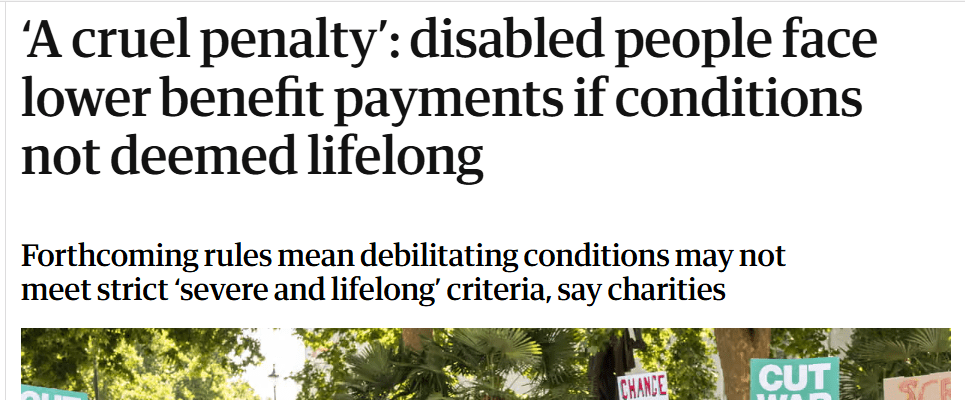
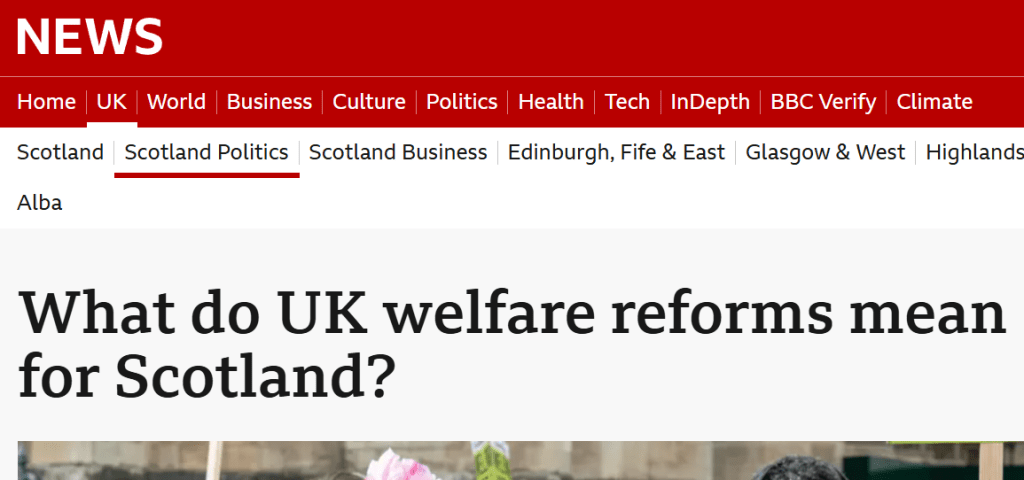
In the Guardian, today, the above (left) and:
Hundreds of thousands of severely ill and disabled people making new claims will have their benefits cut if the government assesses that their condition might improve, charities have said.
In April, the health element of universal credit – an extra payment for people assessed as too unwell to work or prepare for work – will be halved to £50 a week and frozen for new claimants unless their condition is found to be terminal or severe and lifelong with no prospect of improvement.
Will this apply in Scotland?
PIP and equivalent disability payments — PIP is devolved in Scotland and has been replaced by Adult Disability Payment (ADP), administered by Social Security Scotland. The Scottish Government has explicitly stated it will not follow Westminster’s approach to cuts or stricter eligibility for these extra-costs disability benefits. It has no plans to introduce similar “lifelong only” restrictions or reductions. By early 2026, the transfer from PIP to ADP was largely complete or well advanced, so new rules targeting PIP won’t directly hit most people in Scotland.
https://spice-spotlight.scot/2025/03/18/disability-benefit-reform-implications-for-scotland/
Scottish ministers (e.g., Shirley-Anne Somerville and Shona Robison) have criticised the UK reforms as detrimental and ruled out mirroring them for devolved payments like ADP or Child Disability Payment. https://www.bbc.com/news/articles/cwyxqx19j0yo
Typically, in the above BBC Scotland report (right), Scotland’s different spirit is concealed in the headline and is only revealed, by a Scottish Government minister in a supposedly Scottish news outlet in Scotland (!) in the 12th paragraph:
Social Justice Secretary Shirley-Anne Somerville has been clear that the Scottish government “will not follow Labour’s lead on any of these changes”.
Just one line, before BBC Scotland quickly resume platforming the UK Government position again:
We essentially have two governments moving in different directions when it comes to social security. The UK government is still keen to get a grip on welfare spending in light of a forecast £30bn increase in the cost of working-age health-related benefits – although the rebellion over this bill will make it hard to actually achieve that. The watchword has long been about getting people back into work and keeping budgets from ballooning in future years.
There’s no more from Somerville and the rest of the piece descends into an attack on SNP budgeting and a Labour Party defence: https://www.bbc.co.uk/news/articles/cwyxqx19j0yo
Discover more from Talking-up Scotland
Subscribe to get the latest posts sent to your email.
 Talking-up Scotland
Hi, I think you have misunderstood what it going to happen. The government is not planning on halving PIP in April 2026 it is planning to halve the disability element of Universal Credit, which is not devolved, so Scotland will not have a choice to keep it as it is. This is a similar situation to the bedroom tax – which is also an element in Universal Credit. In this instance the Scottish government enabled people to claim the rent reduction back from their local council. Will the Scottish government be able to make another fund available for those losing their disability benefit? It must add an enormous strain to the Scottish budget to have to compensate for every evil plan of the Westminster government. As a secondary point, I am one of the people who currently receive the LCWRA disability element of Universal Credit and I had no idea of the proposed halving of my benefit until I read your article. I am shocked that, if I am to lose a significant chunk of my benefits I have not been informed in advance. I have made financial commitments based on expected income.
LikeLike