

From the New Hampshire Bulletin, yesterday:
In the late 1970s, when Seabrook resident David Wright was about 9 years old, his father began bringing him along to protest the construction of a nuclear power plant across the marsh from their family home.
Some locals were fired up. “They didn’t want a reactor in their backyard,” Wright said.
Thousands who shared that sentiment turned out in the Seabrook area for a series of acts of civil disobedience during the plant’s construction, culminating in the May 1, 1977, detention of more than 1,400 protestors. At the time, Rolling Stone reported, the event ranked among the largest mass-arrests in American history. (Wright said he and his father were not in attendance that day.)
and:
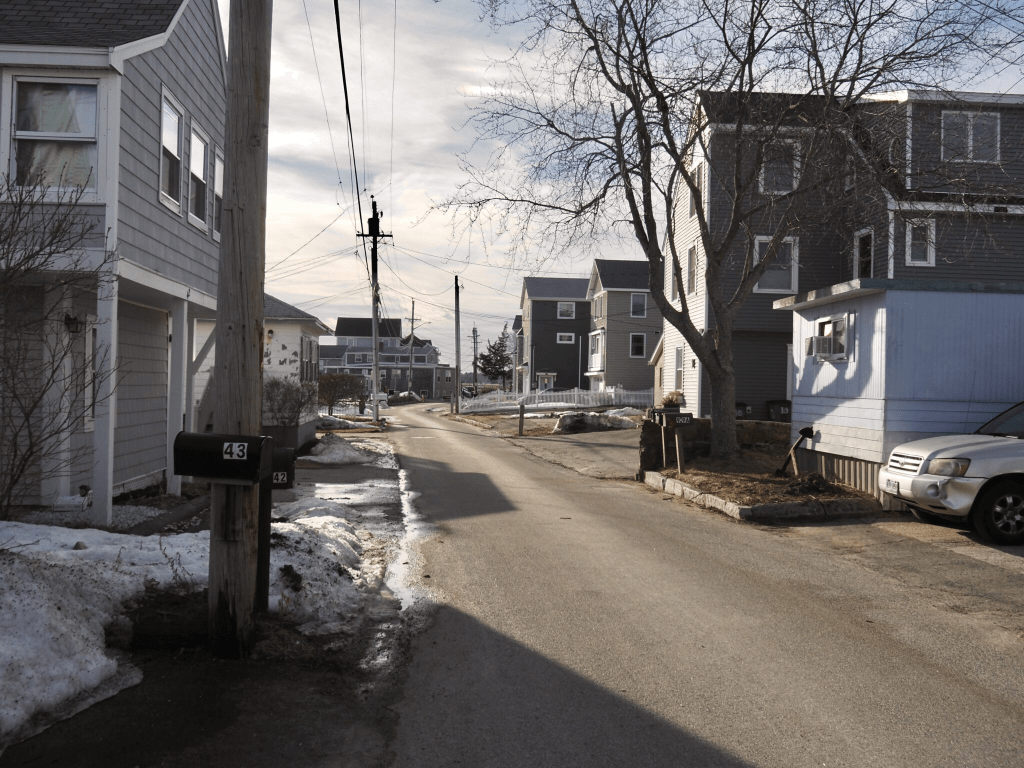
“Everyone who dies on this street dies of cancer,” said Marie Souther, a lifelong resident of Seabrook’s River Street. With a few dozen houses and cottages clustered on either side, the road juts off Ocean Boulevard into the tidal Blackwater River. Just to the west, across the marsh, is Seabrook Station, though Souther remembers a time before it came online — and before much of the development that now crowds the marsh. The river, clearer then, was home to starfish and sea urchins. It has lost much of its biodiversity over the years, Souther said.
As time has passed, she has also lost several of her neighbors to cancer. Souther tallied the total of River Street residents she knows who have been diagnosed with different forms of the disease at a dozen or more. That includes Souther and a member of her immediate family, both of whom have survived colon cancer.
and:
Research into the topic has historically been limited, often conducted in the wake of an accident, with oversimplified datasets, or highly localized, according to Yazan Alwadi, a researcher at the Harvard T.H. Chan School of Public Health. Last month, Alwadi and co-authors published a study in the journal Nature Communications that compared nationwide cancer death data to the proximity of patients’ homes to nuclear power plants.
The analysis concluded that a person’s risk of dying of cancer increases with their proximity to a plant. The association was strongest in men aged 65-74 and women aged 55-64, but was also evident in other age groups.
Locals feel they know something but in the USA as in the UK or France, experts always contradict them. In Germany, however, all the experts agree with the locals. Wonder why? Read this:

I asked the Elicit AI for scientific research which claims to help researchers be 10x more evidence-based:
How dangerous is it to live 5km from a nuclear power station?
After more than 5 minutes, it responded:
Studies show mixed results on living within 5km of nuclear power plants, with some European research finding roughly doubled childhood leukemia risk while studies from other regions generally show no significant overall cancer risk.
Which regions?
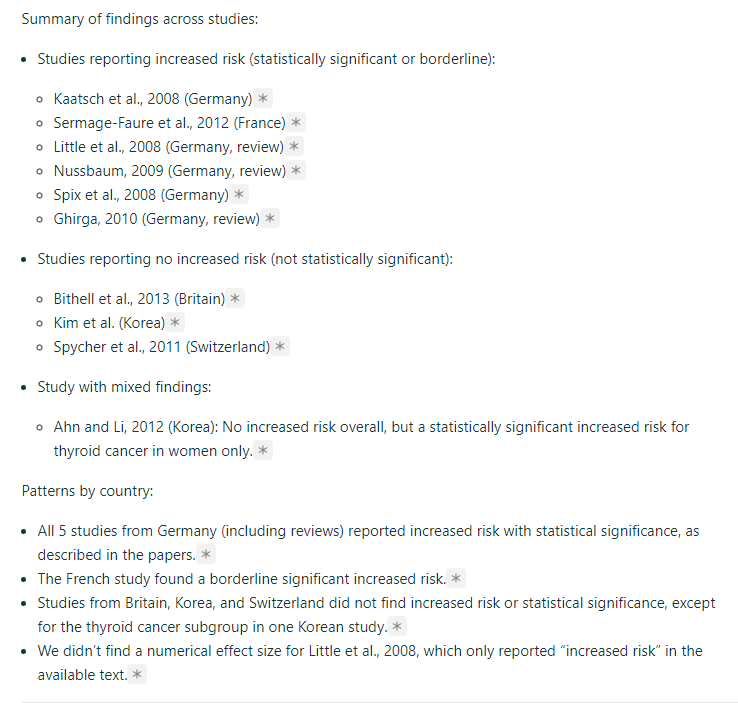
This is stark. Why do 5 German research groups all find statistically significant risks to health in living within 5km of a nuclear power station and why is there only one recent British study and it finds no risk?
I take it no one thinks German nuclear power stations were intrinsically more dangerous than British ones and so the only tenable explanation is that German researchers, where nuclear energy production is no longer government policy, are more free of the inhibitions making it difficult for those in Britain and France, where it is still policy, to present research findings that might undermine the industry. That Britain and France also maintain nuclear weapons dependent on having nuclear power stations to produce plutonium and tritium, will be a powerful presence in the minds of those directing research there.
Now, that the Germans find risk and the others do not does not leave the matter unresolved. It means that living within 5km of a nuclear power station is dangerous and that you cannot trust British or French researchers to have the courage to apply methods that might reveal that.
Discover more from Talking-up Scotland
Subscribe to get the latest posts sent to your email.
 Talking-up Scotland