

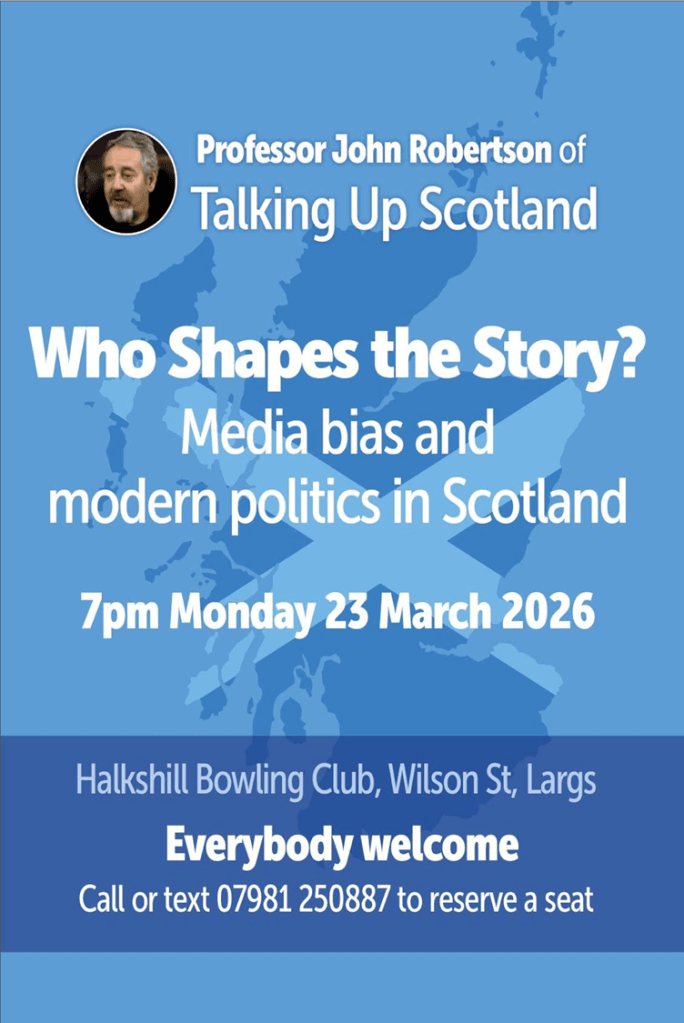
I hope this is not vanity but, just in case there’s a big crowd and you can’t see my PowerPoint presentation at the back, it’s all (apart from my talking which you will hear) here for you to scroll over.
Largs and Fairlie SNP 23 March 2026
Welcome words and outline
- Who shapes the story?
- Background
- Where we are now – polls and biases in polls
- Q and A
- Biased media in 2014 and in 2026 – has anything changed?
- Q and A
Who shapes the story?
- Unless you’re under 18, you know already
- The rich, interlocking elites, the corporations and the media, search engines, the social media, AI
- Thought control in Nazi Germany, the Soviet Union and in liberal democracies
- Repressive tolerance and tokenism, Ian McConnell, Ian Bell, Carole Cadwalladr and George Monbiot
Background
- Lifelong learning
- Chomsky with regrets
- Trade unions, the Arab world and my pals in Havana
- Robertson is too Scottish
- Referendum 2014 and burning bridges once you’ve crossed them
- Social media and the aging academic
Where are we now – polls and biases in polls
- Pollsters – Sir John Curtice and the 3rd Team Reserve at Elgin City; dogs in the fight, sampling the dead and the living, Shakespeare and Zahawi, MRP
- The current trends apparent in the polls – Ipsos no horse, no dog, Paris-based
- The most recent poll from Ipsos suggests, at a national level, SNP solid, Reform UK weakening and Labour climbing out of their trough, with:
- SNP: 36% (+1 point compared with Ipsos’ previous poll taken 27th November – 3rd December)
- Labour: 20% (+4)
- Reform UK: 16% (-2 points)
- Liberal Democrats: 10% (+1)
- Conservatives: 9% (-2)
- Scottish Green Party: 7% (-2)
- Other: 2% (no change)
- The same poll also suggests SNP supporters are far less likely to change their mind than Labour and Conservative voters. Might enough of them, as has been suggested elsewhere be prepared to vote SNP tactically, to keep Reform UK out?
- On their own, sub-polls have little meaning, we need several to even begin thinking they might, and regrettably few Holyrood polls have them.
- Looking at the regional figures in this most recent Ipsos poll, in South Scotland, it does look close at SNP 29%, Reform UK 28% but remember we’re talking about a sub-sample of only 133 folk and Reform UK only attracted 32 of them.
- In West Scotland, perhaps more like urban Ayr than the small towns and rural villages in South Scotland, Reform UK came 4th(!) with only 11%, after SNP 33%, Labour 31%, Lib Dems 12%.
- Ipsos for 12-18 June 2025, when Reform UK were stronger than they are now in UK polls, also had a regional breakdown.
- Reform UK was weak in both areas (14%, 13% compared to 16% nationally) 4th in South and 3rd in West.The SNP ahead was with 29% in South, 32% in West and 32% nationally.Labour were in 2nd place in both with 24% and 27% and 21% nationally.Cons were close in 3rd but only in the South at 22% and 10% nationally.
- There’s little sign here, I’d say, of a Reform UK surge to take Ayr, in any of that, and finally, on the 16th October 2025, in the North Ayr ward [predominantly working-class] local authority by-election, with Reform UK dominant in Westminster polls and Farage all over the media, Reform UK can only come 4th, well behind SNP and Labour.
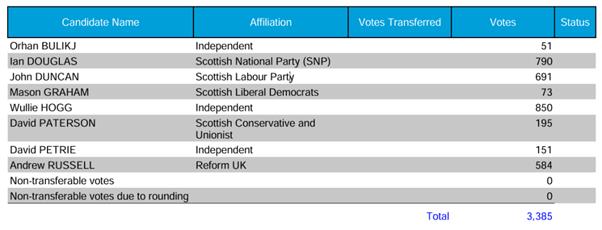
- MRP Stonehaven analysis
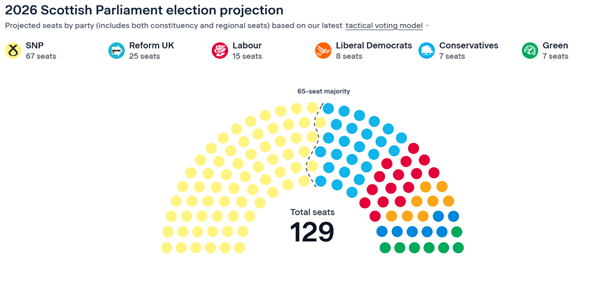
- MRP accurate in full UK polls but unproven in Scotland
- Small samples, dated unreliable local knowledge
Survation* 20-25 February Constituency and Regional votes
- SNP 37% and 33%!!!
- Labour 18% and 17%
- Reform UK 17% and 17%
- Cons 12% and 13%
- Lib Dems 9% and 9%
- Greens 6% and 9%
Giving
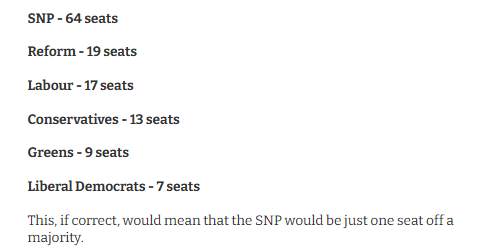
*Survation historically report lower SNP vote shares due to sampling based on 2014 result. Yet to see data tables for this to check
Q and A
Biased media in 2014 and in 2026 – has anything changed
2014
- Methods
- Grounded theory and honesty
- Content analysis
- Extent
- The team, Deacon Blue, keeping your distance and flawed research
- Principle Mahoney
- Results
- 3 to 2 – could have been far worse?
- Bad first good after you’ve lost interest
- Demonising Alex
- Trusting posh lads from London
- Response
- Prof Lindsay Paterson and the delaying tactic
- Newsnet Scotland and 100 000 in a week
- Retired
- Coverage
- Frankie Boyle, Irvine Welsh, YouTube video, and 100 interviews
- Sunday Herald and National first editor says it didn’t prove anything – Now SNP!
- Almost no MSM coverage
Q and A
2026
- 100 days from January to April 2026
- Extent – Scotland and Wales after Labour
- Team
- Focus – negativity and voting patterns; blame by association
- Results after 70 days
- 50% more reports
- 50 more negativity
- 6 times as likely to mention devolved government
- Nearly 3 times as likely to praise UK Government actions
- Effects? Audience?

Substantial research evidence linking heavy consumption of news media—particularly negative or distressing content—to increased symptoms of depression and anxiety. Multiple studies have found that frequent exposure to news, especially via television and social media, correlates with higher levels of emotional distress, stress, and mental health issues. https://pmc.ncbi.nlm.nih.gov/articles/PMC9135112/
Research links heightened sensitivity to fear, threat, or anxiety (as traits, not necessarily clinical depression) to conservative attitudes, such as greater amygdala activation in response to risks or a preference for stability over change. This suggests conservatives may be more reactive to threatening stimuli, potentially influencing their politics toward order and tradition https://www.nature.com/articles/s41598-020-72980-x
Research in media effects and framing theory provides evidence that mentioning the government in negative news contexts can influence audiences to attribute responsibility to it for the problem, even if the mention is not an explicit blame attribution. https://journals.sagepub.com/doi/10.1177/1940161220985241
Q & A
Discover more from Talking-up Scotland
Subscribe to get the latest posts sent to your email.
 Talking-up Scotland
Re “liberal democracies”
Any alleged expert or layperson who talks about “democracies” AS IF a real democracy ACTUALLY EXISTS ANYWHERE IN THE WORLD (or has existed at any time in ‘human civilization’) is evidently either a fool who’s repeating mindlessly and blindly the propaganda fed to them since they were a kid and/or is a member of the corrupt establishment minions whose job is to disseminate this total lie because any “democracy” of ‘human civilization’ has always been a covert structure of the rule of a few over the many operating behind the pretense name and facade of a “democracy”: https://www.rolf-hefti.com/covid-19-coronavirus.html
“There is no America. There is no democracy. There is only IBM and ITT and AT&T and DuPont, Dow, Union Carbide, and Exxon. Those are the nations of the world today. […]. We no longer live in a world of nations and ideologies […]. The world is a college of corporations, inexorably determined by the immutable laws of business. The world is a business […].” — from the 1976 movie “Network”
“We can either have democracy in this country or we can have great wealth concentrated in the hands of a few, but we can’t have both.” — Louis Brandeis, Supreme Court Justice
Watch this, https://www.youtube.com/watch?v=TC5EVkKfvbQ, to see for yourself that there’s zero democracy in the US empire (or any other imperial nations controlled by the US empire), and that a criminal gang of Jewish psychopaths rule globally.
Does anyone still not see how the deadly game on the foolish public is played … or still does not WANT to see it?
Isn’t it about time for anyone to wake up to the ULTIMATE DEPTH of the human rabbit hole?
“We’ll know our Disinformation Program is complete when everything the American public [and global public] believes is false.” —William Casey, a former CIA director=a leading psychopathic criminal of the genocidal US regime
“Elites are afraid of equality, they are afraid of real democracy, and they are afraid of justice.” —Scott Noble, filmmaker
LikeLike