Or direct bank transfer at Sort Code 08-91-04 Account - 12266421 Name - JOHN ROBERTSON
The Daily Record today, has the above and:
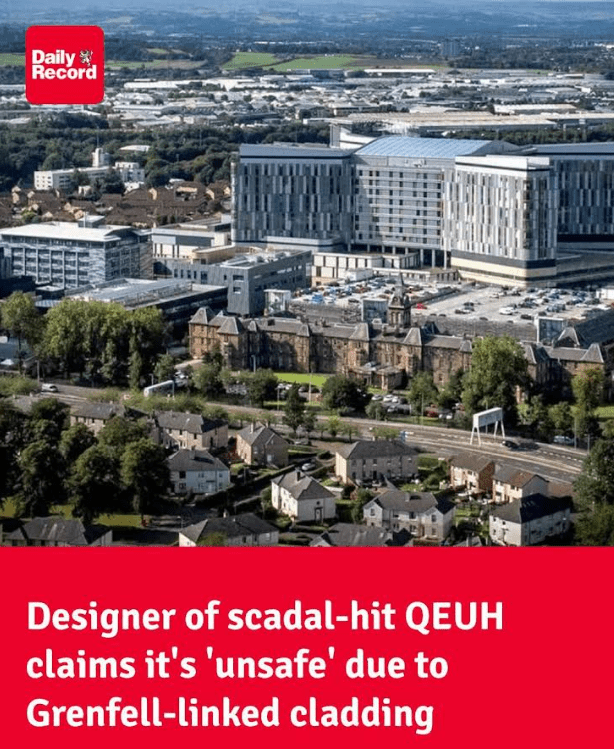
Robert Menzies, an architect who worked on the super-hospital, slammed the refusal of Scottish ministers to replace discredited Kingspan K15 cladding.
Robert Menzies played a part in the building’s design process as a consultant/architect involved in technical and review aspects, which would have encompassed safety considerations (including fire safety engineering elements he has since critiqued). But he was not the principal designer or a dedicated fire safety engineer; his contributions were advisory and part of a broader multidisciplinary team.
However, given the media stir he seems keen to help promote at this time we’d better address it.
Why there can be not Grenfell-like ‘towering inferno’ in the QEUH – 1. fire cavity barriers
Scottish media often use tower block fires to suggest that towering infernos of the kind we saw in Grenfell London in 2017 can happen here. With 72 deaths and the complete burning of the building, the links to the Irvine case are a bit stretched, even for our media.
In Scotland, action followed quickly:
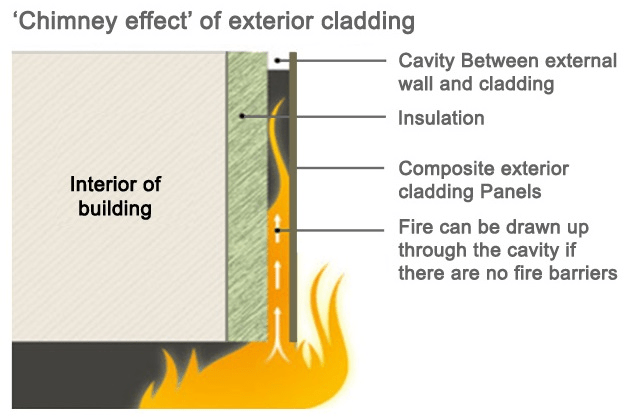
The Building (Scotland) Regulations 2004 require that buildings be designed and constructed to inhibit the spread of fire and smoke within cavities in the event of a fire. This is achieved by installing cavity barriers around the edges of cavities.
Cavity barriers are constructions that seal cavities against fire and smoke, or limit their movement. They should be installed in the following locations:
Around the head, jambs, and sill of external door or window openings
Why there will be not be a Grenfell-like ‘towering inferno’ in the QEUH – 2. regular inspections
In Scotland 2015/16, 9 827 safety audits were carried out. England has 10 times the population and so, all things being equal, might have been expected to have seen 98 270 fire safety audits. However, in 2017/18, England saw only 49 423 fire safety audits, just over half the number. Fire safety audits in Scotland were thus almost twice as common, per head of population, in Scotland as in England.



 Talking-up Scotland
One thought on “Three reasons why QEUH will never have a Grenfell-like ‘towering inferno’”