

Please Support Talking-up Scotland at:

https://www.crowdfunder.co.uk/p/support-talking-up-scotland

Click on the above.

Or direct bank transfer at Sort Code 08-91-04  Account - 12266421 Name - JOHN ROBERTSON
On the front page of Scotland on Sunday – Mothballed Hunterston B nuclear site may yet be revived.
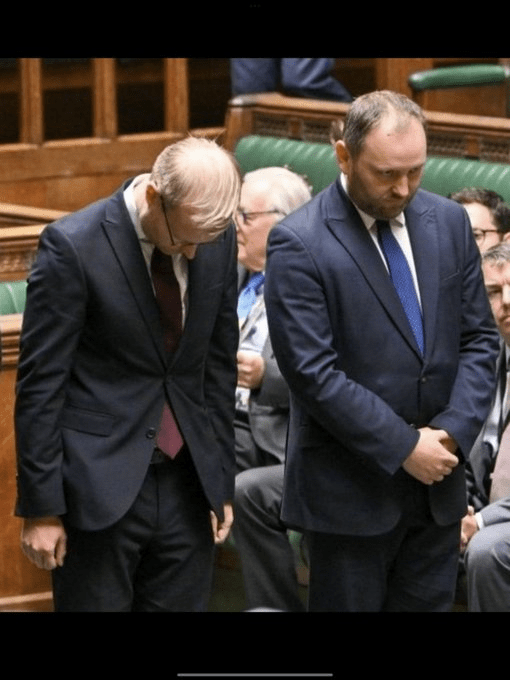
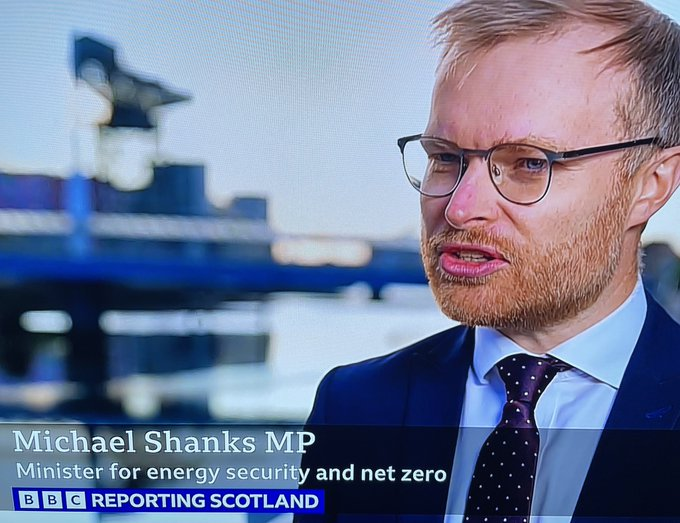
By whom? Junior Minister Michael Shanks (above left) of course.
Here's a reminder of Shanks' insignificance:
First, electricity costs
From stewartb in June 2025:
I fear that a majority of the electorate in Scotland still have NO IDEA of – (perhaps even conditioned to have no interest in?) – Scotland’s indigenous energy assets and their potential significance for their own lives and those of their children and grandchildren. Little or no awareness of the scale of value of offshore oil & gas assets in the recent past (and still remaining) – Scotland’s great missed opportunity of a generation – and the developing renewable electricity generation assets, their current and realisable potential value – the about to be great missed opportunity of another generation!
And NO IDEA how they and the young folk in their families would benefit from a Scotland having a government with the agency available to – and considered normal and essential in – independent nation-states like Norway and Denmark.
When it comes to energy, the opportunity costs of our present constitutional status are huge!
When marking the coming on stream of the Moray West offshore wind farm in April 2024 – a site with the capacity to generate (just) 882 MW of electricity – Ian Murray MP, Secretary of State for Scotland said: ‘.. Ocean Winds’ Moray West offshore wind farm – which will power 1.3 million homes – half the homes in Scotland’.
Source: https://www.offshorewindscotland.org.uk/news/2025/april/24/moray-west-becomes-fully-operational/
That’s from just one moderately sized offshore wind farm! amongst many operational and in the pipeline.
On the Western Link electricity transmission cable running from Hunterston to the England/Wales border, National Grid has stated: ‘Operational since 2017, the link supported over 450 jobs during planning and development and has transmitted over 30,000GWh of electricity during its first five years of operation – enough to power all the homes in Wales for the same period.’ Now that is a ‘fact’ that won’t get mainstream media coverage!
There are five additional offshore transmission cables of comparable capacity – Eastern Green Links 1 to 5 – under construction, in development or at the planning stage designed to exploit electricity generated by wind offshore Scotland. Each will have the capacity to transport 2 GW of electricity from Scotland: each will have the capacity to power c.2 million homes. Take Mr Murray’s statement: do the sums!
And whilst these energy transfers may be termed ‘exports’, they have none of the usual economic and fiscal benefits that come to an independent nation-state engaged in exporting something of value e.g. earning foreign currency and gaining the confidence of the International financial markets based on balance of trade factors.
Second, cancer risks from nuclear:
Top Science research journal reports 115 000, especially middle-aged women living near nuclear power stations are most at risk of cancer mortality and reinforces findings from UK research
Please Support Talking-up Scotland at:

https://www.crowdfunder.co.uk/p/support-talking-up-scotland

Click on the above.

Or direct bank transfer at Sort Code 08-91-04  Account - 12266421 Name - JOHN ROBERTSON
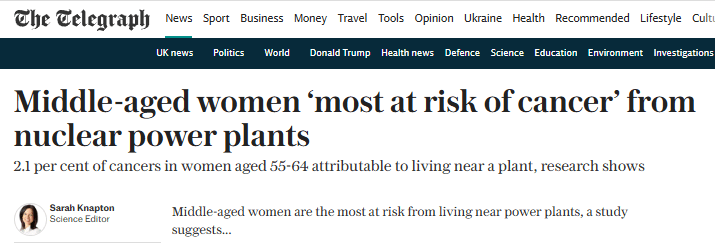
Even the Telegraph has reported this shocking new research suggesting serious concerns for those living near nuclear power stations. The Telegraph has a strong editorial policy to support new nuclear energy proposals1, so this is remarkable.
Their report is based on these comments in several high-status US news outlets including in Nature and Harvard:
Cancer mortality is higher across multiple age groups in both males and females, with the strongest associations among older adults, males aged 65–74 and females aged 55–64. While our findings cannot establish causality, they highlight the need for further research into potential exposure pathways, latency effects, and cancer-specific risks, emphasizing the importance of addressing these potentially substantial but overlooked risks to public health.2
The study found that U.S. counties located closer to nuclear power plants experienced higher cancer mortality rates, even after accounting for socioeconomic, environmental, and health care factors. The researchers estimated that over the course of the study period, roughly 115,000 cancer deaths across the U.S. (or about 6,400 deaths per year) were attributable to proximity to NPPs.3
Sources:
- https://www.carbonbrief.org/analysis-uk-newspaper-editorial-opposition-to-climate-action-overtakes-support-for-first-time/
- https://www.nature.com/articles/s41467-026-69285-4
- https://hsph.harvard.edu/news/proximity-to-nuclear-power-plants-associated-with-increased-cancer-mortality/
The UK Research finding similar facts:
Please Support Talking-up Scotland at:

https://www.crowdfunder.co.uk/p/support-talking-up-scotland

Click on the above.

Or direct bank transfer at Sort Code 08-91-04  Account - 12266421 Name - JOHN ROBERTSON
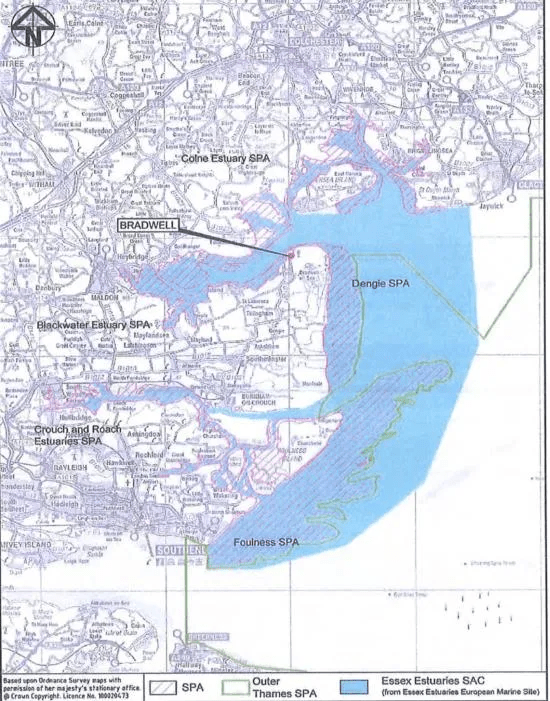
The Blackwater, Crouch, Roach and Colne Estuaries Marine Conservation Zone in Essex (see map below) was designated a MCZ in December 2013 on account, primarily, of its native oyster beds. The MCZ incorporates the Colne Estuary SPA (Colchester), the Blackwater SPA (Maldon) and the Crouch and Roach SPA (Burnham-on-Crouch/Rochford), as well as the Essex Estuaries Special Area of Conservation (SAC) and other SPA designations (Dengie and Foulness). At the head of the Blackwater Estuary lies the Bradwell Nuclear Power Station (its Magnox reactors are no longer operational, and it is the site for a proposed new build Chinese-designed nuclear reactor).
In March 2001, independent researchers, commissioned by local residents living near Bradwell nuclear power station, operational from 1962 to 2002, in Essex, published Cancer Mortality and Proximity to Bradwell Nuclear Power Station in Essex, 1995-99; Preliminary results showing:
substantial excess mortality risks, particularly from breast cancer in women who had lived in wards adjacent to the river Blackwater. This finding was similar to the findings of earlier studies on coastal populations near the Irish Sea and near the Hinkley Point nuclear site in Somerset.2
Soon after, local authority researchers criticised the above research and with access to statistics denied to the first group, insisted:
no evidence of any statistically significant increases in cancer in any ward in the study area and that the risks of cancer in populations living in annular areas described by circles around the nuclear site of radii 4, 10 and 17km around the plant showed no association with proximity to the plant.3
A year later, the first researchers revisited their findings and accepted some errors but stated:
there is no difference in the overall result, as we shall show.
Two results are immediate. First the corrected files make the estuary effect more apparent, since the Maldon wards now have more breast cancer deaths after the correction, and second, the effect is reinforced after the inclusion of the two extra years 2000 and 2001.4
and now claim:
Analysis of the corrected file for 1995-99 for the 26 ward area confirms the existence of significantly raised breast cancer mortality in wards which border the mud flats and creeks of the river Blackwater compared with wards which do not. This finding is reinforced slightly by the correction. Thus we see that the Blackwater estuary wards have (Table 4) 58% more breast cancer deaths than the non-Blackwater wards.5
In the full research report the authors reveal deliberate attempts by the local authority researchers to:
cover up a significant health problem and its source. 6
They conclude with damning comments which reinforce what I have written repeatedly about the importance of being deeply sceptical of official statements downplaying the risks of nuclear energy in Southern Scotland:
Ever since the 1983 discovery of the Sellafield (Seascale) leukaemia cluster it has become increasingly apparent to people living near nuclear sites that the epidemiological examination of radiation risk has been the subject of bias and cover-up at a very high level. It is also clear to these people that the reassurances they are given by the organisations who are paid to protect their health are worthless. If the truth about radiation and health is to be discovered, then accurate mortality and incidence data must be discovered, and statistical and epidemiological analysis should be undertaken by environmental groups funded by government, as well as by establishment groups. However, in recent years regional Cancer Registries have intensified restrictions on releasing incidence data, withholding figures which, according to their own Guidelines, ought to be available on request. The notable exception is that in 1995 the Wales Cancer Registry released its entire small area cancer incidence database to Green Audit – an event which was followed swiftly by closure of the WCR and a complex of data destruction and denial which COMARE signally failed to investigate in an even handed fashion.
There is not a level playing field in this debate. On one side there are small independent environmental research groups working under difficult conditions with inadequate information being attacked by the establishment and funded at a pathetic level by groups of local citizens. On the other side are the weighty government organisations with budgets of millions of pounds and departments full of qualified researchers.
It is to be welcomed that the opposition or ‘dialogical’ approach to examining risk in this area has now been accepted and partly put into practice in the new CERRIE committee. This approach has the capacity to deal with the scientific advice problem. However, the affair of breast cancer near Bradwell shows that there is a large trust deficit remaining in this area, associated with the internal operations of SAHSU, the Cancer Registries and COMARE. This is not an isolated affair: similar attacks, denials, cover-ups and shenanigans have occurred following Green Audit studies of cancer on the Welsh and Irish coasts and near Hinkley Point and Oldbury nuclear power stations. There is also the problem of the funding of citizen groups who wish to have an independent analysis of the situation, and the release of data to these groups to make such studies possible. The present situation is unacceptable.7
Sources:
- chrome-extension://efaidnbmnnnibpcajpcglclefindmkaj/https://llrc.org/llrc/health/subtopic/bradrep5.pdf
- ibid page 2
- ibid page 2
- ibid page 3
- ibid page 8
- ibid page 10
- ibid pages 10-11
Please Support Talking-up Scotland at:

https://www.crowdfunder.co.uk/p/support-talking-up-scotland

Click on the above.

Or direct bank transfer at Sort Code 08-91-04  Account - 12266421 Name - JOHN ROBERTSON
Discover more from Talking-up Scotland
Subscribe to get the latest posts sent to your email.
 Talking-up Scotland
Stewart b still spot on. Most have no idea of the extent of the resources or the rip-off.
LikeLiked by 2 people
Still no comment on the increasing opposition to wind turbines in Scotland?
LikeLike
For some Anon?
LikeLiked by 1 person
I prefer to comment anonymously.
But living in The Scottish Highlands, I have seen and heard increasing opposition to wind turbines, battery storage and other renewable projects in The Highlands, same goes for the Scottish Borders.
You may dismiss opposition as merely Facebook Groups, but I personally know a lot of local people who are on the groups.
If you have any alternative information or sources, a good place to start is communities B4 power companies.
Just to add I appreciate that you do a lot of work challenging narratives, and positive and polite engagement with groups who may not always agree is not a bad thing.
LikeLike
Thanks
I’ve heard opposition to wind farms too, locally but the TuS agenda is to push on for independence with a critique of media and let other platforms tackle other things.
John
LikeLike
Hi John,
Thanks for replying.
The point here is that The SNP are losing votes on this issue, I know a few people personally who support Scottish Independence, but oppose wind turbines and renewable energy.
The comment below from Arty Hetty mentions infrastructure, but again there is sizeable opposition, look at the Fanellan substation opposition in Beauly, Highland Council rejected the application, it is widely thought that The Scottish Government will overturn this.
There is also opposition to new pylons in The Angus area and Sutherland and Caithness.
An SNP minister for the North East caused problems with her descriptions of opponents, I will find the article later, you are welcome to find it yourself.
As I said above, this attitude does not help independence aims.
LikeLike
https://wastedwind.energy/2026-03-01
LikeLike
See my reply to John above
LikeLike
Labour are finished in Scotland. No one will vote for them. The Scottish Gov can twart these plans. No time for them to be implemented. Holyrood can oppose these dangerous Labour suggestions.
LikeLiked by 1 person