

Please Support Talking-up Scotland at:

https://www.crowdfunder.co.uk/p/support-talking-up-scotland

Click on the above.

Or direct bank transfer at Sort Code 08-91-04  Account - 12266421 Name - JOHN ROBERTSON
By stewartb
In NHS Scotland – ‘A&E performance around Christmas peak pressure suggests major improvements’ – not in NHS England it seems when it comes to the important ‘over 12 hour waits’ metric!
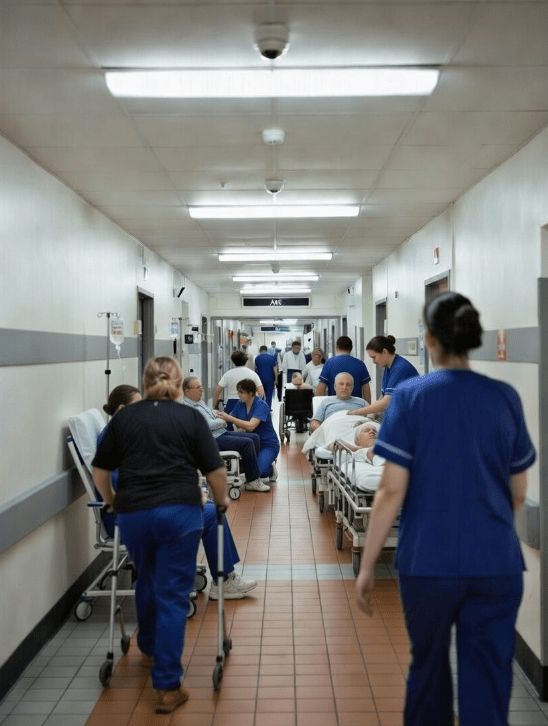
The Royal College of Emergency Medicine (RCEM) had this headline for a press release on February 12: ‘The wheels have come off’: predictably busy January exposes ‘fragile’ NHS system as A&Es swamped with patients needing beds’. That was its view following the publication of NHS England’s Emergency Department performance statistics for January 2026, and its ‘situation report’ for the week ending 8 February.
The RCEM states: ‘Today’s data showed that more than one in seven patients who attended a major ED in England last month were subject to a wait of more than 12 hours to be discharged, admitted or transferred: a total of 192,168 people.’ This we’re told is the second-worst month for 12-hour waits in Emergency Departments on record.
It adds: ‘The proportion of patients waiting less than four hours remained about the same as the previous January, from 57.7% to 57.3%.’ And: ‘A total of 71,517 of the sickest patients – those who were waiting for admission into a hospital bed – waited on trolleys in an ED for more than 12 hours after a decision to admit was made – the worst of any month on record.’ (My emphasis)
It also reports: ‘… the average number of beds occupied by patients who were medically fit to be discharged stood at 13,823 across England, the second-highest of any month on record.‘
By my reckoning, that’s two second worst months and one worst of any month on record achieved by an A&E system for which Labour in Westminster is responsible! Imagine this was happening in Scotland!
The official NHS England data release states:
‘Of the total attendances at Type 1 and Type 2 A&E Departments in January 2026, 192,168 spent over 12 hours in department from arrival to admission, discharge or transfer (13.1%), an average of 6,199 per day.’
‘Of the total attendances at Type 1 and Type 2 A&E Departments in December 2025, 154,018 spent over 12 hours in department from arrival to admission, discharge or transfer (10.5%), an average of 4,968 per day.’
That’s a remarkable deterioration in the over 12 hour metric between December and January! Imagine this had happened in Scotland!
When reporting on NHS England’s performance data released on February 12, the BBC News website opted for this headline: ‘NHS waiting list at lowest level in three years’. We’re told: ‘At the end of December 2025 there were 7.29 million patients waiting for treatments such as knee and hip operations. That is the lowest number since February 2023.’
On 20 January, 2026, the BBC News website had this headline’: ‘The hospitals where waiting times are getting worse. Is yours one of them?’. It reported that the waiting list in England had fallen to 7.31 million, the lowest level since February 2023. So some but slow progress in cutting this waiting list has been achieved over c. 2 years.
However, this positively framed headline for the February 12 article may seem a bit too positive when later in the piece one reads: ‘But while the waiting list did drop, performance against the 18-week target declined slightly. Some 61.5% of patients were waiting less than 18 weeks – compared to 61.8% in November. The target is 92%, which the government has promised to meet again by 2029.’
The BBC February 12 article does make reference to the same A&E performance data referred to in the RCEM press release , noting: ‘.. a record number of 12-hour trolley waits’ and ‘More than 71,500 patients spent longer than 12 hours in January 2026 waiting for a bed …. – the highest figure since it started being tracked in 2010.’
Anyone prepared to speculate which statistic the BBC would have chosen to headline if this had been happening in NHS Scotland – the slightly smaller waiting list or the worsening 12 hour metric for A&E?
The BBC article omits any mention of the 2.6 percentage point deterioration in the 12 hour waits statistic from December 2025 to January 2026. It omits to mention the difference in the average number of patients spending over 12 hours during December 2025 compared to January 2026 – a difference of over 1,200 patients each day!
These damning facts are not worthy of a BBC headline, unlike a marginal improvement in elective waiting list metric. Experience tells us the article would have been headlined and written quite differently if this had been happening in Scotland! And for the record, no opposition politician in Westminster was quoted making a critical comment and no Labour government minister was challenged in the BBC piece.
For perspective, in its report on performance of Scotland’s Type 1 emergency departments during the week ending February 8, 2026, Public Health Scotland had this: ‘2,095 (7.9%) patients spent more than 12 hours in a type 1 Department (compared to 2,088 (7.9%) the previous week, and 1,445 (5.3%) weekly average for 2025).’
Let’s hope that NHS Scotland can continue to improve its performance: let’s hope that through higher productivity and some way of accessing additional funding for staff and capital equipment it can do so substantially and soon. Let’s hope NHS England can do likewise.
The big difference is that the government responsible for NHS England has unfettered access to additional funds for investment in health and social care (and in every other devolved public service). Whatever Westminster decides England’s voters need and want in terms of health and social care provision impacts what Scotland, NI and Wales can afford to do.
Please Support Talking-up Scotland at:

https://www.crowdfunder.co.uk/p/support-talking-up-scotland

Click on the above.

Or direct bank transfer at Sort Code 08-91-04  Account - 12266421 Name - JOHN ROBERTSON
Discover more from Talking-up Scotland
Subscribe to get the latest posts sent to your email.
 Talking-up Scotland
Meanwhile, The Highlands and North East of Scotland get a raw deal again:
https://www.inverness-courier.co.uk/news/nhs-highland-won-t-say-if-vascular-service-changes-are-perma-427767/
https://www.johnogroat-journal.co.uk/news/no-room-for-evasiveness-campaigners-want-clear-statement-421712/
https://www.northern-scot.co.uk/news/moray-council-plans-4-5m-cuts-in-budget-amid-extra-costs-427798/
LikeLike