

Please Support Talking-up Scotland at:

https://www.crowdfunder.co.uk/p/support-talking-up-scotland

Click on the above.

Or direct bank transfer at Sort Code 08-91-04  Account - 12266421 Name - JOHN ROBERTSON
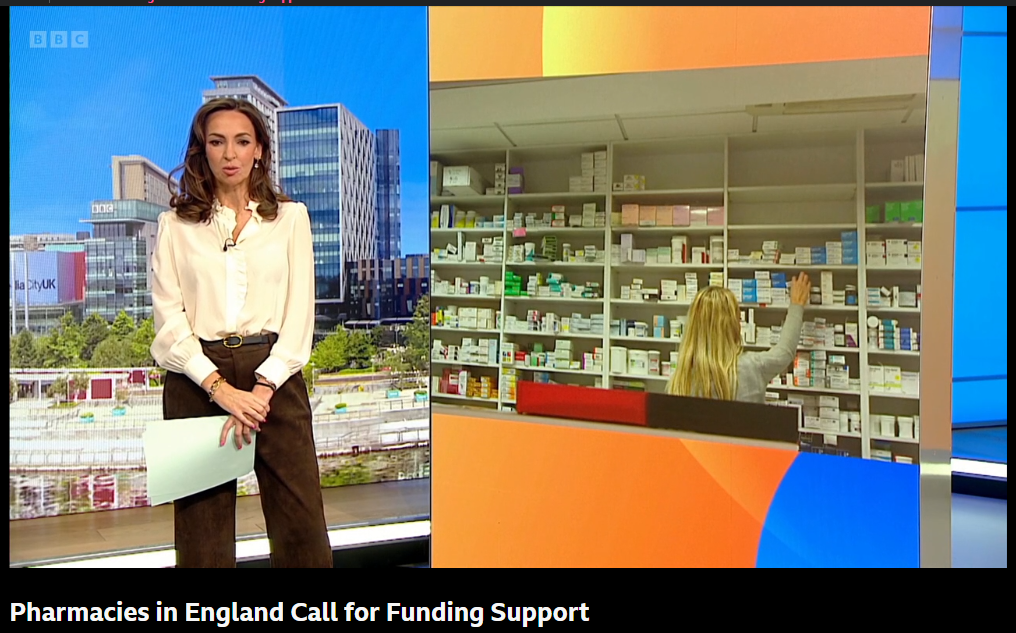
BBC UK is headlining the above serious problem, crisis, in the funding of local pharmacies, often a lifeline service in some communities. BBC Scotland, as we’ll see below, cannot just mirror this story but had to find something, anything:

BBC England, Wales and Northern Ireland do not have this story at all. It’s by BBC Scotland’s Glasgow and West reporter, Jonathan Geddes. Look how it opens:
Supplies of prescription-strength co-codamol will be limited until the summer, the Scottish government has confirmed. A UK-wide shortage of the strongest form of the painkiller – the 30/500mg dosage – is ongoing due to the Indian government delaying the authorisation to import ingredients required to make the drug there. The Scottish government told BBC Scotland News, alternative treatment options will be offered to those affected by the shortages.
Altogether, in a report about a Europe-wide shortage, a shortage over which the Scottish Government has no influence and which no other BBC site is covering, it gets 3 mentions to associate this negative with it, in the minds of readers.
I’ll come to the ‘look to Scotland’ claim, below, but first, see that ‘alternative treatment options?’ Here’s why:
One potential solution lies in affording community pharmacy greater latitude in altering prescriptions – a practice that could save immense amounts of NHS funds and ease the mounting pressure on pharmacy resources.
A change to medicines legislation is needed to enable pharmacists to speed up access to medicines. This would allow pharmacists to make minor adjustments to prescriptions to help alleviate some of the issues for patients and reduce burdens on primary care – with the added benefit of reducing the workload of GPs.
Pharmacists in hospital, and in community pharmacies in Scotland, already routinely alter prescriptions for the benefit of patients.
Also, in the same journal in August 2023:
Scotland’s model for pharmacy offers lessons for England’s future
As pharmacies in Scotland receive renewed government backing, Steve Anderson takes a look at the future of English pharmacy against the backdrop of a damning new report.
I must commend Scotland’s Pharmacy First model, which has set the standard for the delivery of patient services through pharmacies. With PHOENIX’s presence in 29 European countries, I can see that Scotland’s approach stands out for its reach and ambition. The key, however, to its success has been borne out of years of government investment and commitment to maintain a financially viable network based upon sustainable long-term funding.
Unlike in England, where community pharmacies have faced cumulative funding cuts of more than £750 million per year, Scotland’s investment has allowed pharmacies to focus on patient care without the constant financial pressures. Community pharmacies should not be viewed as disposable figures on a spreadsheet. Our pharmacy teams provide vital care in our communities, improving healthcare outcomes and helping to manage long-term conditions.
If England wishes to develop its own Pharmacy First approach, that is a key lesson it must learn. If Scotland had failed to offer a fair funding commitment to pharmacy, politicians in England would have been forgiven for thinking they could get away with a cut-price Pharmacy First model from a steadily shrinking number of pharmacies.
In Scotland, the outlook on community pharmacy is that it plays a crucial role in enhancinghealthcare outcomes and increasing patient access to essential care. Community pharmacies are an important part of the overall system, but one that clearly differs from that of a GP or hospital.
Community pharmacies do have the potential to reduce pressures on the NHS, particularly as healthcare demands increase, but further action is essential to enable community pharmacy to play an enhanced role delivering more patient care services. While funding is vital, the issue is not exclusively based on money.
The lesson from Scotland could not be clearer: invest in a robust and sustainable pharmacy network that increases patient access to essential NHS care. This in turn will reduce cost and demand pressures on other parts of the NHS, improving patient satisfaction and health outcomes.
Imagine Reporting Scotland wondering what they can make of the above?
England’s pharmacists ‘look to Scotland’
From May 2023, here’s why:
Scotland scheme ‘more patient-focused’
Pharmacists in England look to Scotland, where a scheme called Pharmacy First includes a contract between the sector and the Scottish government setting out what services are expected, with payment for every consultation.
These cover minor ailments and illnesses, some of which might once have been dealt with at GP practices. In England there is a less formal arrangement, with some consultations by pharmacists not remunerated. There is also more prescribing of medicines by pharmacists in Scotland.
George Romanes, who owns a chain of local pharmacies in the Scottish borders, believes the new structure works better than the arrangements south of the border.
“I used to have an English pharmacy but I sold it, and all the outlets we have now are in Scotland. I think the Scottish contract is much more patient-focused,” he said.
“The fact you can come in and see a pharmacist there and then as it were, rather than needing an appointment, is very beneficial for patients, they like to get a problem sorted as quick as they can.”https://www.bbc.co.uk/news/health-65481473
Mr Panesar [above] called for political leaders, including Prime Minister Rishi Sunak, whose mother ran a pharmacy, to visit local pharmacies to see first-hand the pressures they face.
“I’d love him to come and see what we do, how patients feel about what we offer and actually, that this is serious, and that the sector is crumbling, and is going to fall down like a stack of dominoes, if there’s not intervention urgently.
Please Support Talking-up Scotland at:

https://www.crowdfunder.co.uk/p/support-talking-up-scotland

Click on the above.

Or direct bank transfer at Sort Code 08-91-04  Account - 12266421 Name - JOHN ROBERTSON
 Talking-up Scotland