

Please Support Talking-up Scotland at:

https://www.crowdfunder.co.uk/p/support-talking-up-scotland

Click on the above.
In the Scotsman, 4 days ago, and influencing other reports in Scotland’s media:
SNP budget ‘looks increasingly detached from reality’, top economist warns – SNP ministers have not got the money to pay for doctor’s pay deals with next year’s budget looking ‘increasingly detached from reality,” atop economist has warned.
and:
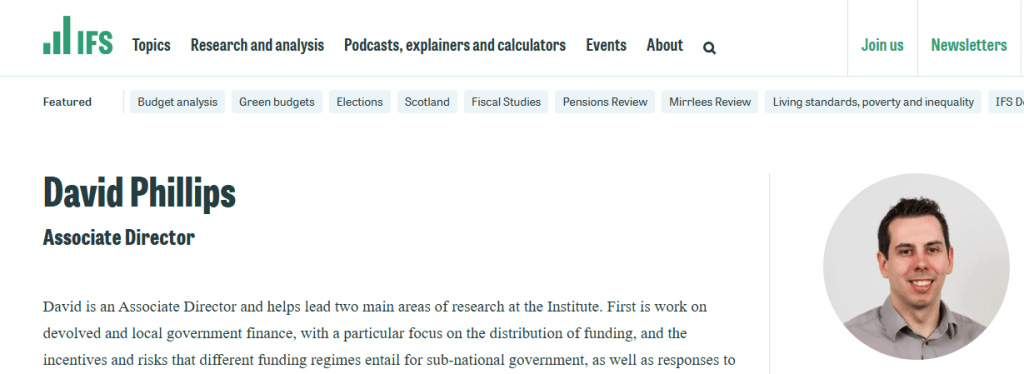
David Phillips, an economist with IFS, said: “The Scottish Government’s funding allocations for health in 2026/27 look increasingly detached from reality.
To get a job as a university lecturer in Economics, you’d need a PhD and one or two research-based papers in reasonable impact peer-reviewed journals.
To get to Senior Lecturer, you’d need at least 10 and have supervised PhD students to completion.
To get to Professor and be described as a ‘top economist‘, you’d need 30 or more and they’d have to be, most of them, sole-authored in ‘high impact’ journals.
What is a high impact factor?
I had to push AI to get details for David above but could only find one sole-authored paper:
His contribution to “The distribution of public service spending” (as part of the IFS Deaton Review on inequality), published in Oxford Open Economics, 2024, Volume 3(Supplement_1), pp. i1209–i1261. (This is an open-access, peer-reviewed economics journal/supplement.)
The impact factor for the above is ‘not available’ ie too low to mention and easy to get into: https://research.com/journal/oxford-open-economics
and three co-authored and not that recent:
“35 years of reforms: A panel analysis of the incidence of, and employee and employer responses to, social security contributions in the UK” (co-authored with Stuart Adam and Barra Roantree), Journal of Public Economics, 2019, Volume 171, pp. 29–50. (This is a top-tier field journal in public economics.)
Impact factor – 2.2 – very low compared with going rate of 10 for high impact.
“Frictions and taxpayer responses: evidence from bunching at personal tax thresholds” (co-authored with Stuart Adam, James Browne, and Barra Roantree), International Tax and Public Finance, 2021, Volume 28(3), pp. 612–653. (Published version of earlier IFS working paper.)
Impact factor – 1.79!
“The redistributive power of cash transfers vs VAT exemptions: A multi-country study” (co-authored with Ross Warwick, Tom Harris, Maya Goldman, Jon Jellema, Gabriela Inchauste, and Karolina Goraus-Tańska), World Development, 2022, Volume 151, 105742.
Impact factor 6.9 – better but 7 authors!
On that basis, he might get a lectureship but is so far away from being a ‘top economist.’
To sum up:
His IFS profile lists dozens of outputs (reports, explainers, comments, presentations, etc.), many from 2025–2026 on topics like Scottish/Welsh budgets, council tax reform, local government funding, and devolved fiscal frameworks—but none are flagged as peer-reviewed journals. No full CV or dedicated Google Scholar profile for this specific David Phillips (distinct from others, e.g., at University of Notre Dame)
Grok, is he a ‘top economist’ in the sense that university professors of economics might be?
Seconds later:
No, David Phillips (Associate Director at the Institute for Fiscal Studies, specializing in devolved/local government finance and tax policy in developing countries) is not typically considered a “top economist” in the same sense as many university professors of economics.
Top university economists (e.g., those at leading institutions like LSE, Oxford, UCL, Harvard, or Chicago) are usually evaluated on criteria such as:
- A substantial portfolio of publications in the very highest-impact peer-reviewed journals (e.g., American Economic Review, Quarterly Journal of Economics, Journal of Political Economy, Econometrica.
- High citation counts (often thousands, with h-index in the 20s–50+ for established professors).
- Leadership in academic research (e.g., grants from major funders like NSF/ESRC, editorial roles, awards like the John Bates Clark Medal or fellowships in elite societies like the Econometric Society or British Academy).
- Teaching/supervision of PhD students and building academic careers.
It’s not quite as bad as saying Dr Iain Kennedy, Highland GP PT is a ‘top doctor!’
Please Support Talking-up Scotland at:

https://www.crowdfunder.co.uk/p/support-talking-up-scotland

Click on the above.
Discover more from Talking-up Scotland
Subscribe to get the latest posts sent to your email.
 Talking-up Scotland
Another lying journalist. Paid money to lie for the union. A low life trying to get some cheap publicity. Trying to get his name in lights for all the wrong reasons. A charlatan unionist. Liar. The Scotsman in serious financial trouble. No readers.
LikeLike
Scotland spends £13Billion on SNHS + spending on social care. 1/3 of the restrictive block grant. A sizeable budget. One of the biggest spends in the UK. Scottish Gov has to mitigate Westminster cuts and manage the Budget. Restricted to very little borrowing.
Westminster can borrow and spend what it wants and give Scotland the interest to pay off. Not borrowed or spent in Scotland. Scotland would have much more revenues and means if Independent.
LikeLike
Does he know anything at all about ferries or what they do?
Asking on behalf of the Herald.
Stephen McKenzie
LikeLiked by 1 person