


Please Support Talking-up Scotland at:

https://www.crowdfunder.co.uk/p/support-talking-up-scotland

Click on the above.
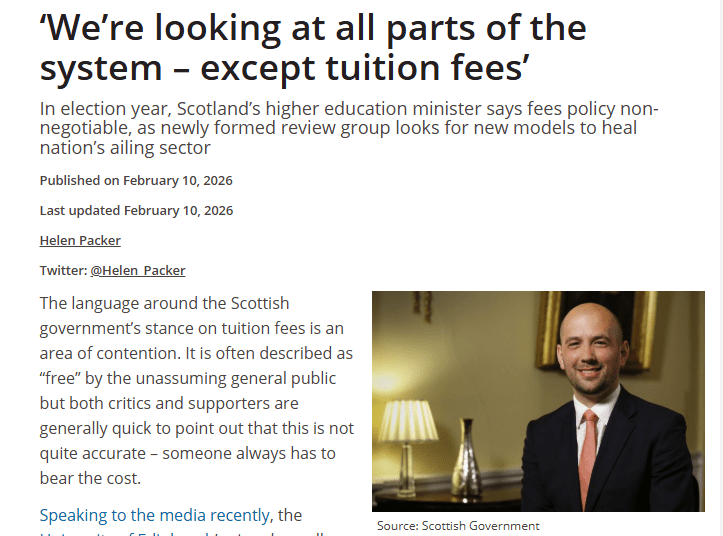
BBC Scotland today with London-based Institute [just a bunch of lads really] for Fiscal Studies doubting whether Scotland can continue to afford free higher education tuition for all and ignoring this from last week:
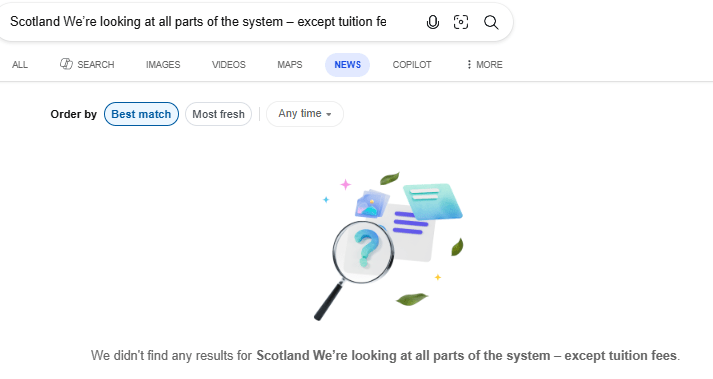
I searched for news media coverage to get only this response:
The Times Higher Education, read only by some academics, has this below but as you can see above this important news is being hidden from the electorate:
‘We’re looking at all parts of the system – except tuition fees’
https://www.timeshighereducation.com/news/were-looking-all-parts-system-except-tuition-fees
The THE article by Helen Packer is actually not at all supportive of the Scottish Government, foregrounding the views of critics so, even hear the SNP election campaign is being questioned.
How does Scotland’s free university tuition system compare with other systems charging students thousands in fees in terms of wider societal and economic benefits?
Scotland’s system shines in reducing financial barriers and debt-related harms, fostering broader participation (especially via colleges) and a societal ethos of education as a right. It likely delivers net positives for social cohesion, mental health, and consumption-driven growth, with graduates freer to contribute flexibly to society. Grok AI
Sources:
Reduced Financial Barriers and Debt-Related Harms
- Lower graduate debt in Scotland (typically £15,000–£18,000 vs. £45,000+ in England, mostly maintenance loans only):
- Institute for Fiscal Studies (IFS) on Scottish universities and students under pressure: https://ifs.org.uk/articles/scottish-universities-and-students-are-under-pressure-and-so-scottish-budget
- Recent analysis showing £35,000+ debt gap widening (Scottish graduates at ~£18,000 vs. English at ~£53,000): https://www.heraldscotland.com/news/25792940.snp-labour-clash-tuition-fees-debt-gap-widens
- Scottish Government Student Finance and Wellbeing Study literature review (noting lower overall debt due to no fees): https://www.gov.scot/publications/literature-review-student-finance-wellbeing-study-scotland-2023-24/pages/7
- Vox overview of Scotland’s free tuition lessons (applications rose, debt lower, enabling freer post-grad choices): https://www.vox.com/2015/10/22/9592460/college-tuition-free-scotland
- Relief from fees and debt aversion (qualitative relief, affordability, no “decades of debt”):
- Scottish Government Student Finance and Wellbeing Study findings (students report relief at fees paid, making study more affordable): https://www.gov.scot/publications/student-finance-wellbeing-study-sfws-scotland-2023-2024-research-findings-summary/pages/3
- Political framing (education based on ability to learn, not pay; graduates “tens of thousands better off” for careers, homes, families): https://www.facebook.com/ChristineGrahameMSP/posts/in-scotland-we-believe-access-to-education-should-depend-on-the-ability-to-learn/1279309497352513
Broader Participation (Especially via Colleges)
- Increased applications/participation post-fee abolition (24% rise in Scotland vs. drop in England):
- Vox citing Filipa Sá research: https://www.vox.com/2015/10/22/9592460/college-tuition-free-scotland
- College routes key for disadvantaged growth (90% of disadvantaged entry growth via sub-degree college programs; broader tertiary inclusion):
- Sutton Trust report on access in Scotland (higher overall HE participation including colleges, though university gaps persist): https://www.suttontrust.com/wp-content/uploads/2020/01/Access-in-Scotland_May2016.pdf
- Royal Society of Edinburgh on tertiary funding (colleges critical for social mobility, inclusion, skills, and economic prosperity): https://rse.org.uk/programme/advice-paper/funding-of-tertiary-education-in-scotland-report
Societal Ethos of Education as a Right / Social Contract
- Free tuition as part of devolution’s “social contract” (ability to learn, not pay; commitment to equity/access):
- King’s College London on number controls and free HE: https://www.kcl.ac.uk/news/the-cost-of-free-higher-education-university-number-controls-in-scotland
- Wonkhe / Carnegie Trust on free fees as hallmark of modern Scotland and social contract: https://wonkhe.com/blogs/tuition-fees-are-a-social-contract-with-small-print (or similar Carnegie link)
Net Positives for Social Cohesion, Mental Health, and Consumption-Driven Growth
- Mental health / wellbeing links (lower debt reduces stress; fee relief aids affordability/mental relief, though living costs remain):
- Scottish Government Student Finance and Wellbeing Study (broader financial experiences, relief from fees): https://www.gov.scot/publications/student-finance-wellbeing-study-sfws-scotland-2023-2024-main-report/pages/18
- Inferred from debt comparisons (lower burdens enable better mental health outcomes vs. high-debt systems): https://www.gov.scot/publications/literature-review-student-finance-wellbeing-study-scotland-2023-24/pages/7
- Consumption / flexible contribution (lower debt supports earlier milestones like homeownership/family, freer career choices including lower-paid public service roles):
- Political/government statements (graduates better off for building futures without debt burden): https://www.facebook.com/ChristineGrahameMSP/posts/in-scotland-we-believe-access-to-education-should-depend-on-the-ability-to-learn/1279309497352513
- Broader economic framing (education investment for societal wellbeing, growth via skilled workforce): https://rse.org.uk/programme/advice-paper/funding-of-tertiary-education-in-scotland-report
These sources provide a mix of empirical data (debt levels, participation trends) and policy/qualitative insights (ethos, relief, societal benefits). Some critiques note regressive elements or funding strains, but the positives on debt reduction and access ethos are consistently highlighted in pro-policy sources.
Please Support Talking-up Scotland at:

https://www.crowdfunder.co.uk/p/support-talking-up-scotland

Click on the above.
 Talking-up Scotland
It would appear that English universities, in spite of their fees, are struggling financially. So maybe government support isn’t a bad thing?
LikeLiked by 1 person
Sadly, a high proportion of the academic staff in Scotland’s universities have a background in English school education, often in the private sector.
There is a long and dishonourable ‘tradition’ of discriminating against Scottish Higher Grades in favour of English A Levels.
Last century, I was part of a group developing changes to the Higher Grades and the introduction of Advanced Higher Grades. We had a meeting in St Andrew’s with the University Admissions group for Scotland to make them aware of forthcoming changes to discuss how the proposed Advanced Higher Grades would be considered when processing applications. The body language of some members on the University side indicated a degree of disdain and one asked, “You are speaking about SCOTTISH qualifications. We do not know much about these or if they are as good as A Levels. We prefer candidates to have A Levels.”
My daughter studied Modern Languages at Glasgow University. She had 5 Higher Grades passes at grade A, plus an Advanced Higher Grade French at Grade A. In the opening week the new undergraduates were split into three groups and those in the lowest ranked group were all of those with Scottish qualifications – from those who had a C pass at Higher to those with A passes at Advanced Higher! Immediately, they took their case to the Student Representative Vouncil who contacted the University mananagement, who, to their credit, were well versed in Scottish school qualifications. A meeting was held with the French Department who stated that they did not know what Highers were! The groups were promptly reorganised. My daughter graduated with a First and was also the top student in the Faculty of Arts!
I think it is this English background, both in English schools and English Universities, that influences how the Scottish University system is viewed by some in the senior ranks of Scottish Universities. The tuition fees are a major source of income in English universities. The reduction in tenured posts in universities and the increase in short term contracts has led to a very stratified management structure, with a few staff at senior levels receiving very high remuneration. For other staff, pay and employment are insecure. A classmate of my daughter, now in her 40s has never had a long term contract.
I think that the hostility to the principle of no tuition fees for students whose homes are in Scotland and the requirements to widen the social class of entrants is what underlies the THE article, the IFS report and the BBC Scotland decision to report IFS, but not report the SG decision. It is greed which is the motivator. The Universities want to have more fully fee-paying students. Keep the riff-raff out, as we have seen in the discrimination faced by Scottish students at Edinburgh University
LikeLike
Thank you for explaining what’s going on in Scotland’s Universities. St. Andrew’s is well kent for its preference for English students, but I didn’t realise that all universities are incentified to favour English students because of the funds they bring.
You sound very proud of your daughter, and rightly so.
LikeLike
It is wrong to assume that all Scottish Universities prefer English qualifications like A Levels. If I gave that impression I apologise. My point is that within the universities there are significant numbers of staff who have no experience of the Scottish educational system, Scottish qualifications and the fact that Scottish education operates under a separate legal framework.
This can lead to individual departments within universities exhibiting a, probably, unintentional, bias towards English qualifications because senior staff are unaware of the Scottish system. I dare say there are some, like the St Andrew’s University staff member I encountered around 30 years ago whose body language and demeanour indicated he thought Scottish qualifications were just too ridiculous to contemplate.
LikeLike