

Please Support Talking-up Scotland at:

https://www.crowdfunder.co.uk/p/support-talking-up-scotland

Click on the above.
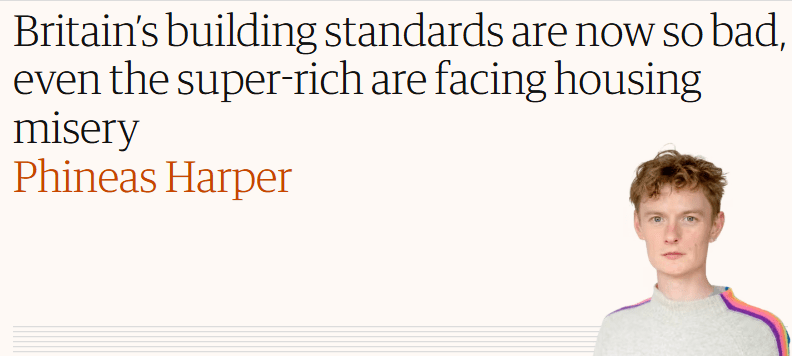
In the Guardian today:
Even multimillionaires can’t escape Britain’s cowboy builders, it seems. Last week, residents of One Hyde Park, the UK’s most expensive flats, won a £35m court case against the contractor that built their homes. The high court ordered the construction company Laing O’Rourke to fix defective pipework that was discovered to be causing problems in 2014, only three years after the luxury development was completed.
At the other end of the economy, tens of thousands of families are facing damp and mould issues also caused by botched building works. A National Audit Office investigation revealed in October last year that a staggering 98% of external insulation fitted under the previous government’s home-improvement schemes was installed so ineptly that it will have to be repaired or replaced.
https://www.theguardian.com/commentisfree/2026/feb/11/uk-housing-building-standards-one-hyde-park
The author, on Linkedin, describes himself as: ‘Phineas Harper is an innovative leader in developing sustainable cultural programmes that… ‘
Phineas mentions the UK, 11 times and Britain 7 times but Scotland, not once.
Why should he have mentioned Scotland. AI can do quick thorough answers to well-put answers like this:
Are building standards and regulations more strict or demanding in Scotland than in England?
Yes, building standards regulations in Scotland are generally more strict and demanding than those in England in several key areas, though the differences vary by topic and have evolved over time (especially post-Grenfell Tower fire in 2017, which prompted updates in both nations).Scotland’s system operates under the Building (Scotland) Act 2003 and associated Building Standards (with sections like 6 for energy, etc.), while England’s falls under the Building Regulations 2010 (as amended, including via the Building Safety Act 2022) with Approved Documents.Here are the main areas where comparisons often highlight Scotland as stricter:
- Fire safety: Scotland has traditionally been more stringent. For example, it required automatic fire suppression systems (e.g., sprinklers) in new high-rise flats earlier (from around 2021) and applies robust rules to a broader range of buildings. Scotland also extended cladding bans and strict fire safety measures to more building types (e.g., certain hotels and overnight accommodations in recent 2025/2026 updates). Post-Grenfell reforms in Scotland were often described as more comprehensive or advanced than initial English changes, with lower height thresholds for some high-risk requirements (e.g., 11m vs higher in England initially).
- Energy efficiency and environmental standards: Scotland tends to have higher requirements, influenced by its colder climate and more ambitious net-zero target (2045 vs England’s 2050). This includes stricter insulation (U-values for walls/roofs often more demanding), air tightness, heating systems, and overall building performance in many cases. Scottish standards emphasize climate resilience and sustainability more strongly.
- Acoustic (noise) performance: Scottish standards (Section 5) are notably stricter, e.g., higher airborne sound insulation (≥56 dB vs ≥45 dB in England for new builds) and better impact sound requirements for floors, partly due to the climate and housing types.
- Other aspects: Scotland’s approach is often more pre-emptive (verification at design and construction stages), and some sources note broader application of strict rules or more hurdles for developers in certain contexts.
Sources:
England has significantly strengthened rules via the Building Safety Act 2022 and updates (e.g., second staircases, higher-risk building regimes), narrowing some gaps, especially for high-rises over 18m. However, industry sources (e.g., Brodies LLP on 2025 Scottish changes, academic comparisons in MDPI journals) and government consultations continue to highlight Scotland’s approach as more stringent overall in key safety and sustainability areas.
For the most precise application to a project, consult the latest official sources:
- Scottish: gov.scot/building-standards and Technical Handbooks (2022 domestic/non-domestic, with 2025 amendments).
- English: gov.uk/government/collections/approved-documents and Building Regulations 2010 (as amended).
Footnote – Back in the day watching a student teacher, I heard a pupil sitting at a computer, spell checking her report on the explorer Phileas Fogg, shout out ‘Miss what’s a phallus?‘
Indeed.
Please Support Talking-up Scotland at:

https://www.crowdfunder.co.uk/p/support-talking-up-scotland

Click on the above.
Discover more from Talking-up Scotland
Subscribe to get the latest posts sent to your email.
 Talking-up Scotland