


In the Guardian today:
Helen Lambert borrowed £57,000 to go to university and began repaying her student loan in 2021 after starting work as an NHS nurse. Since then she has repaid more than £5,000, typically having about £145 a month taken from her pay packet. But everything she hands over is dwarfed by the £400-plus of interest that is added to her debt every month, thanks to rates that have been as high as 8%.
Her total outstanding debt had ballooned to more than £77,000 by the end of November, and it is set to get a lot bigger as there are another 25 years left of the 30-year repayment period. Lambert does not think her studies should have been free, but she says: “It is so disheartening to have this level of debt hanging over you with no achievable way to clear it or even reduce it while they add on upwards of £400 a month in interest.”
https://www.theguardian.com/money/2026/jan/23/student-loans-graduates-plan-2-interest-rates
You probably know that nurse training IS free AND attracts a bursary in Scotland so how is that affecting levels?
The Scotsman in February 2025 was front-paging Alarm over fresh drop in applicants for nurses course based on a 2% reduction in applications, from 4 650 to 4 560, six months before ‘clearing’ processes in the week and months before courses start, can fill the missing places.
The ‘alarm’ is from a union rep and, evidence-free, the fall in applications is explained by poor working conditions, which in turn, is based upon a small sample, self-selecting (squeaky wheel) survey.
Not mentioned, of course, is how this level of nurse training compares with other parts of the UK.
So, if Scotland is training 4 560 how many might NHS England be expected to be training? At ten times the population, around 45 000?
It’s 26 3301, not much over half the number you might expect they’d need.
Why is this?
From the British journal of Nursing in April 2024:
This UCAS data are more than just numbers; they reflect the changing dynamics in healthcare education and broader societal trends. The decrease in applications and acceptances could be attributed to various factors, including the intense pressures that health professionals have faced during the pandemic, which might deter potential applicants. The psychological and physical toll of the pandemic on healthcare workers has been widely publicised, possibly influencing the decision-making of those considering the profession.2
What is the Scottish Government doing to encourage applications?
Only in Scotland:
The Scottish Government will pay your tuition fees. Graduates may need to check if the government will pay their fees. The bursary is £10,000, which isn’t means-tested. Funding covers the whole year (52 weeks). If you’re studying an honours degree, you’ll get 75% of the bursary in your fourth year. The bursary includes £5 for daily travel but you can claim for placement expenses above this. You’re expected to use the cheapest public transport. (In Scotland, bus travel is free for Scottish residents under 22 years old). If costs are more than £30 per day, you should stay in local accommodation if possible. In your first year, there’s also a £60 initial expenses allowance.
Additional allowances include: Dependents Allowances – if you have a partner or spouse with a low income; Single Parents’ Allowance; Childcare Allowance – for registered childcare costs; Disabled Students’ Allowance. A discretionary fund is available for students in severe financial hardship.3
Sources:
- https://www.britishjournalofnursing.com/content/regulars/trends-in-nursing-applications#:~:text=Some%2026%20330%20applicants%20were%20accepted%20onto%20undergraduate,landscape%20and%20perhaps%20a%20higher%20calibre%20of%20applicants.
- https://www.britishjournalofnursing.com/content/regulars/trends-in-nursing-applications#:~:text=Some%2026%20330%20applicants%20were%20accepted%20onto%20undergraduate,landscape%20and%20perhaps%20a%20higher%20calibre%20of%20applicants.
- https://www.thecompleteuniversityguide.co.uk/student-advice/finance/nhs-bursary#ParamedicNursingandMidwiferyStudentBursaryinScotland
How is the level of training in Scotland then helping with the overall position in Scotland’s hospitals?
With 50% more registered nurses, no Scottish health board has scarily high mortality rates due to use of unqualified staff increasingly common in NHS England
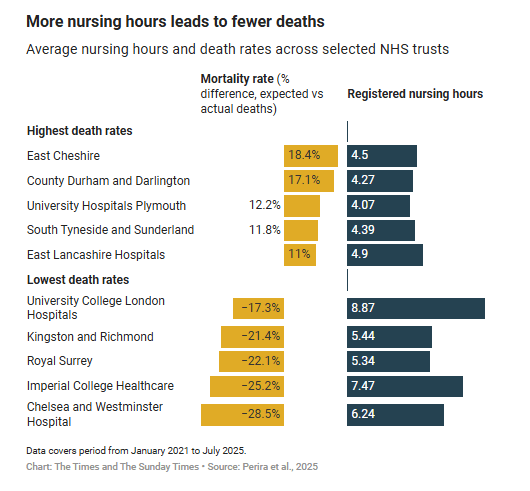
From the Times, three days ago, the above graph reveals that those health trusts in England which are increasingly using less qualified staff rather than fully registered nurses to care for patients, have been responsible for higher death rates than they should have, in clear contrast to those trusts which have not done so.
Hospitals which have cut registered nurses or replaced them with lower-paid staff have seen a surge in death rates, a major study has revealed. The research, which analysed staffing at 122 NHS trusts over four years, revealed dangerous variations.
Nicola Ranger, chief executive of the Royal College of Nursing, said it proved degree-educated registered nurses were essential to patients’ safety and she called for NHS England to investigate trusts where deaths had risen. She demanded the government boost nurses’ pay and career progression, warning “the clock is ticking” for ministers to act.
The study showed a trend where hospitals that cut nursing care since 2020 experienced an increase in deaths. Other trusts which invested in nurses saw death rates fall. Where hospitals tried to plug nursing gaps with lower-paid staff they still saw higher deaths.
Directly comparable data with Scotland is not available, as far as I can see but these are and they matter in the same way:
NHS England has 8.2 nurses per 1 000 population but Scotland has 12.3, a shocking 50% more.1
Consequences? Returning to the table at the top and comparing with NHS Scotland data, no large Scottish board (excluding tiny statistically outlying areas like the Western and Northern Isles), only NHS Lanarkshire at 8% and Lothian at 4%, had more deaths than predicted. All of the others had fewer.2
Sources:
- https://www.ons.gov.uk/peoplepopulationandcommunity/healthandsocialcare/healthcaresystem/articles/thehealthcareworkforceacrosstheuk/2024
- https://www.publichealthscotland.scot/publications/hospital-standardised-mortality-ratios/hospital-standardised-mortality-ratios-july-2024-to-june-2025/
Discover more from Talking-up Scotland
Subscribe to get the latest posts sent to your email.
 Talking-up Scotland
The other great thing about our young people joining the workforce debt free is that they can contribute to our economy, buying houses, cars, going shopping and so on. Charging for education is a false economy.
On another note my understanding is that UK student debt is exactly that – UK debt meaning Scotland gets charged to cover English defaults on their debt.
Another union dividend.
LikeLiked by 3 people
Student in Scotland do not leave Uni debt free. Sure they don’t have tuition fees but many will have gone to Uni and stayed in Student Residences. The monthly rental cost of rooms in those residences is eye-watering. Now days the Halls of Residence for students are often built and run by private companies. Need I say more?
Students in Scotland will certainly graduate with less debt than students in England but what debt they do have is not negligible. Today’s Herald has an article on its front page about student debt.
LikeLike
How is this – see below – for a clunky 1st paragraph from the Herald article I mentioned above?
“”STUDENTS in Scotland are graduating with more than £35,000 less debt than their counterparts in England, analysis shows.””
If you read it quickly scanning the paper in a supermarket say what would be the message you are likely to get from it?
LikeLiked by 1 person
£35,000 less, at least…some students in England have tuition fee debts of £50k.
LikeLike
£50k when they leave Uni in England but even when paying the debt off it often increases because of the interest rates on their loans. The result is it will be a millstone round their necks pretty well for the rest of their working lives.
LikeLike