

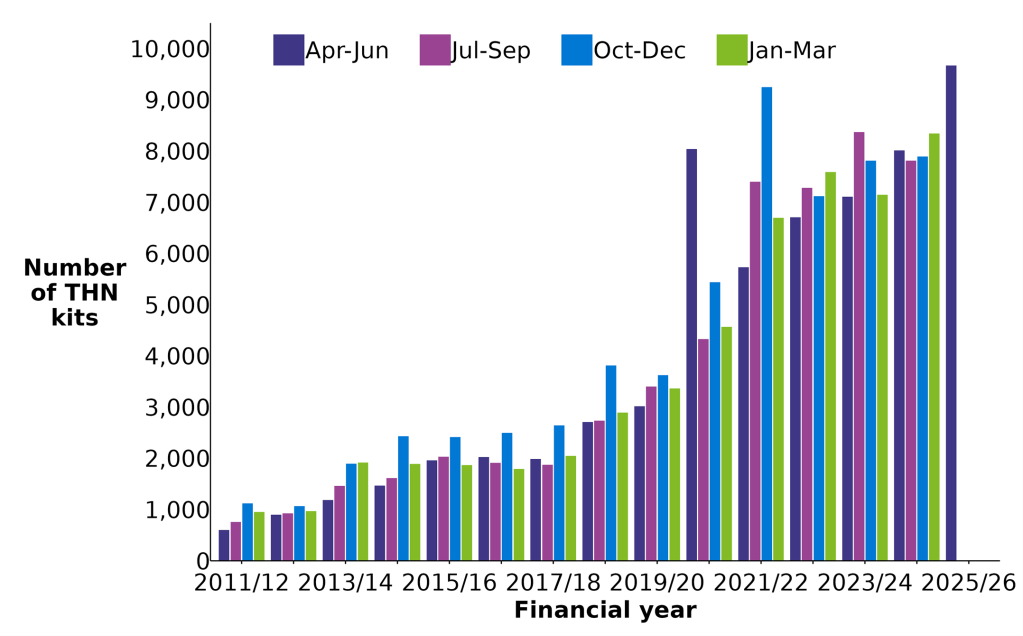
From the National naloxone programme Scotland – Quarterly monitoring bulletin Quarterly Monitoring Bulletin April to June (Q1) 2025/26 published today:
The overall aim of Scotland’s NNP is to prevent fatal opioid overdoses. Administration of naloxone provides time for emergency services to arrive and for further treatment to be given. Following suitable training, THN kits are issued to people at risk of opioid overdose, their friends and family and service workers in order to help prevent overdose deaths.
Drug-related hospital admissions plummet for third year in a row after Scottish Government’s ‘world-first’ opioid overdose reversal Naloxone initiative but are not being reported by media.
During 2025/26 Quarter 1 (1 April 2025 to 30 June 2025):
- 9,672 Take-Home Naloxone (THN) kits were issued.
- 7,724 THN kits were issued by services based in the community:
- 4,722 kits supplied by drug treatment services;
- 1,149 kits supplied by Scottish Families Affected by Alcohol and Drugs (SFAD);
- 1,049 kits supplied by other non-drug treatment services.
- 437 kits were issued by prisons in Scotland.
- 1,045 kits were supplied via prescriptions dispensed by community pharmacies.
- 441 THN kits were provided by SAS.
- A total of 600 kits (318 in prisons and 282 in the community) were supplied by peers (a trained champion/mentor that provides training and a THN kit to others who may witness an overdose).
At the end of 2025/26 Quarter 1, the ‘reach’ of the NNP (percentage of people at risk of opioid overdose who have been supplied with THN) was estimated to be 84.0%, an increase of 1.8 percentage points compared to 2024/25 Quarter 4 (82.2%).1
What have been the effects of this programme?

From Public Health Scotland‘s Drug-related hospital statistics Scotland 2022 to 2023 on 16 April 2024 (Latest release):
There were 9,663 drug-related hospital stays. The European Age-sex Standardised Rate (EASR) of drug-related hospital stays was 182 stays per 100,000 population. This rate decreased for a third consecutive year, from a peak of 283 per 100,000 population in 2019/20.
The highest substance-specific stay rate (81 per 100,000 population) was for opioids (drugs similar to heroin). This rate decreased for a third consecutive year, from a peak of 141 per 100,000 population in 2019/20.2
What is the Naxolone Initiative?
After a pilot phase ending in 2018, the Scottish Government began to embed Naloxone opioid overdose reversal kits across NHS Scotland. Shortly after, the kits which can be administered by anyone, were adopted by Police Scotland, ambulances and prisons, and made available to libraries, community centres, taxi drivers and to the friends and relatives of users.
Scotland was the first country in the world to introduce a national naloxone programme, empowering individuals, families, friends and communities to reverse an opiate overdose.
Anyone in Scotland can now order a free naloxone kit from national charity Scottish Families Affected by Alcohol & Drugs (SFAD) and be trained in its use.
Opioids such as those found in prescription painkillers are now responsible for 81% of all drug deaths in Scotland.
Why are Scotland’s drug deaths not falling faster given the Naloxone scheme’s impact?
County Lines gangs seek new markets along public transport lines, in small towns and rural areas where local dealers can be dominated with threats of extreme violence and a property can be taken over. Using their scale of operations, these gangs can transport and sell more powerful drugs, more cheaply, using couriers as young as 11, to users unused to the low costs and higher strength. Increased drug deaths is a simple and predictable consequence. These same gangs, entirely from English cities, were first reported in Scottish towns, up the east cast rail lines to places such as Aberdeen, Fraserburgh, Inverness and Wick, around 2019, just as Scotland’s drug deaths had begun to plateau and, in 2021, fall.
Sources:
- https://www.publichealthscotland.scot/publications/national-naloxone-programme-scotland-quarterly-monitoring-bulletin/national-naloxone-programme-scotland-quarterly-monitoring-bulletin-april-to-june-q1-202526/
- https://www.publichealthscotland.scot/publications/drug-related-hospital-statistics/drug-related-hospital-statistics-scotland-2022-to-2023/
Discover more from Talking-up Scotland
Subscribe to get the latest posts sent to your email.
 Talking-up Scotland