

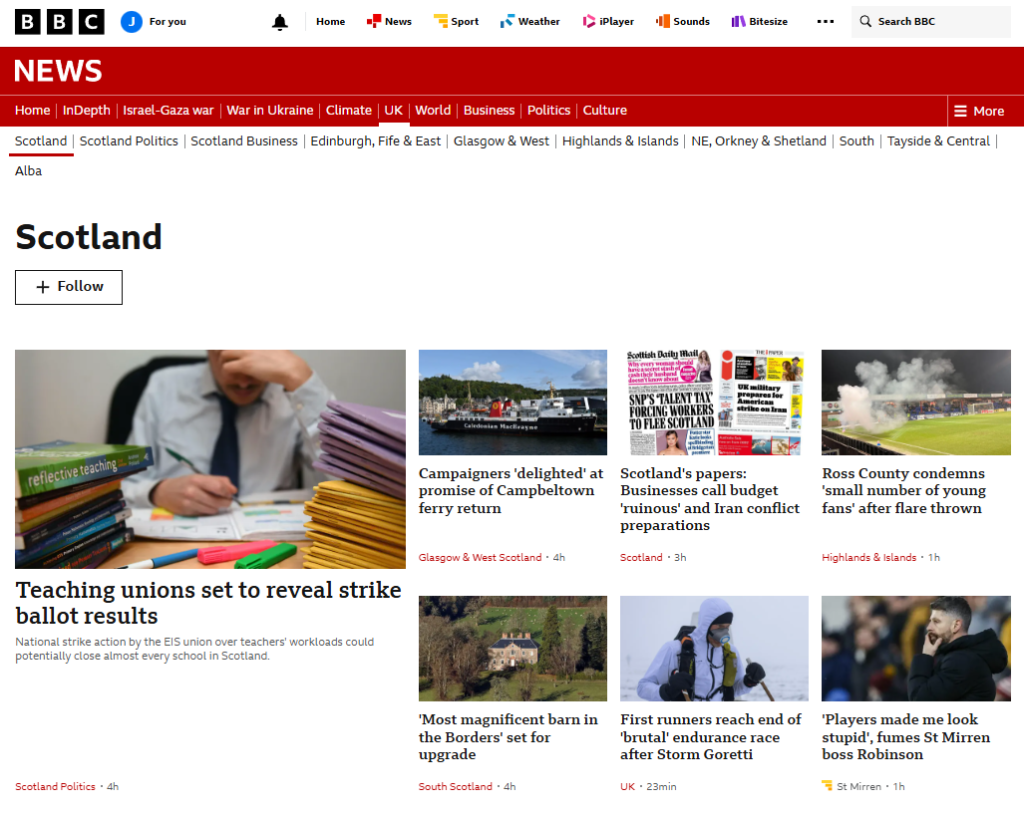
Yesterday BBC Scotland and the teachers union leaders were willing on the vote for a teachers’ strike ,then in the early afternoon today, they saw this:
Workload Ballot Falls Foul of Soon-to-be Repealed Thresholds: EIS to Re-Ballot Members for Strike
Created on: 16 Jan 2026
The EIS announced that its recent statutory industrial action ballot on teacher workload has become a victim of soon-to-be repealed elements of UK anti-trade union laws, having fallen short of the strict thresholds set in that Tory-era legislation.
Workload Ballot Falls Foul of Soon-to-be Repealed Thresholds? Until 2007, that’d be ‘Teachers vote against strike action.’
Then 14 paragraphs later, they had to tell us:
Members voting YES to Action Short of Strike: 93.10%
Members voting NO to Action Short of Strike: 6.9%Members voting YES to Strike Action: 85.94%
Members voting NO so Strike Action: 14.06%Ballot Turnout: 46.57% https://www.eis.org.uk/latest-news/ballotresult160126
It’s a bit underwhelming if they’re all so burned out.
Only 40% of EIS members could bothered to vote for a strike. Don’t they realise their leaders expect career development in the Labour Party or in institutions it would control? ‘Ungrateful’ says Lord George Foulkes.
BBC Scotland helped out with this headline and text:
Teachers in Scotland’s largest education union are to be balloted again on whether to go on strike over their workload. A ballot which closed on Wednesday failed to give the EIS union a legal mandate to go on strike because the turnout was too low.
Only 46.57% of those entitled to vote took part. However, an overwhelming majority – 93.10% – of those who did vote backed strike action.
On Thursday morning the NASUWT also confirmed that fewer than half of its ballot papers were returned before Wednesday’s deadline.
See that 93.10%? Wrong, 85.94% in the EIS report above. 93% sound better to BBC Scotland editors? They have plenty of staff to proofread. Note also, the often more militant NAS/UWT couldn’t work upan y interest in a strike in their members.
Why might the EIS members be less militant than their leaders and pals in Labour wish for? These reasons?
 Talking-up Scotland
Doctors, teachers–don’t want to lose “money for Anas”, tut, tut!
But its OK, Scotland’s very own “Barclay Brothers” are available, after secret talks from a year ago–Sarwar being such a hotshot business genius and all round whizz….who knew?
What do they get in return? Kevin doesn’t say! Surprise, not!
gavinochiltree
LikeLike
BBC .STV. AND ALL CORRUPT MEDIA SHOULD BE TAKEN TO TASK FOR THIS
TOTAL UNACCEPTABLE ‘reporting’
‘THE GENERAL PUBLIC’ DO NOT WANT LIES AND CORRUPTION
USED TO CORRUPT POLITICS
LikeLike