

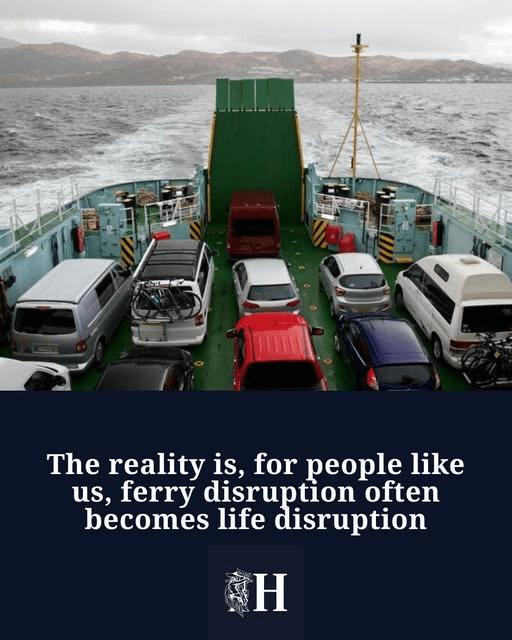
Another ferry ‘fiasco report’ (placing the ‘ there makes it clear that the reporting is a fiasco in journalism) today.
The facts hidden every time they write this rancid garbage:
There’s a very significant background story never told of just how much this SNP Government has done to transform life on the islands, funded by the rest of us living often in less pleasant places and with never the suggestion of compensation because of limited public transport services.
Here it is:
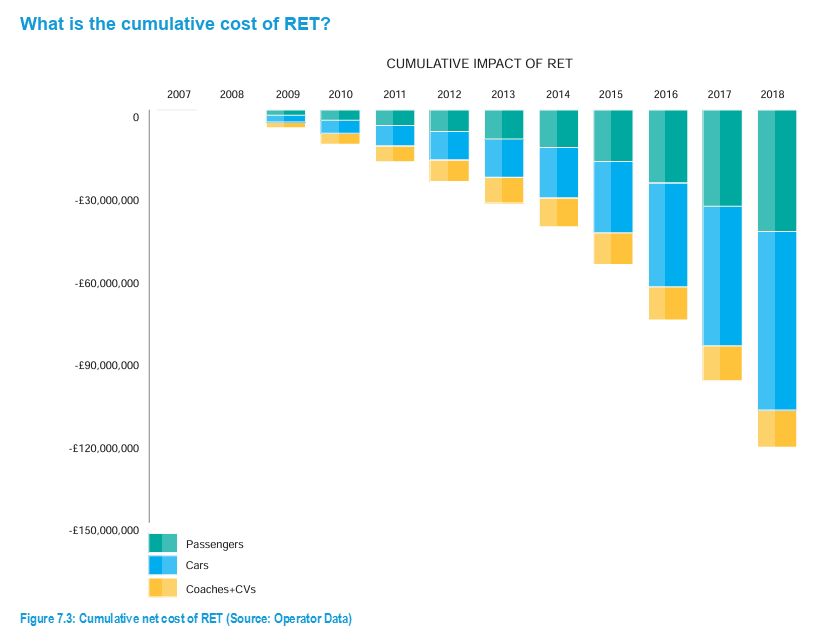
The above chart from the Evaluation of Road Equivalent Tariff [RET] on the Clyde and Hebridean Network Prepared for Transport Scotland March 2020 reveals a massive increase in ferry usage to the islands with a consequent economic boost, but increasing costs for the taxpayer in lost revenue. The comparison is based on ticket sales only and takes no account of retail revenue, which is likely to have increased as a result of the increased numbers of passengers.
What is the RET?
In October 2008, Transport Scotland introduced the Road Equivalent Tariff (RET) fares policy as a pilot on routes to the Outer Hebrides, Coll and Tiree (and made permanent in 2012). The principle of RET is that ferry fares should be set on the basis of travelling an equivalent distance by road plus a fixed fare element aimed at cost recovery. RET was intended to reduce the cost disadvantage faced by island communities and promote the islands as places to live, work, visit, invest and conduct business. In 2012, the policy was extended to cover Colonsay, Gigha and Islay. It was then further extended to the two Arran routes and Campbelltown in 2014. Finally, in October 2015, RET was rolled-out to all remaining routes, including the high-volume routes of Oban – Craignure, Wemyss Bay – Rothesay and Largs – Cumbrae.
How much has RET cost the Scottish Government in revenue foregone?
RET is now costing the Scottish Government around £25m per annum in revenue support, around two thirds of which is supporting reductions in car fares.1
What has the RET achieved?
Increase demand for ferry services by making ferry travel more affordable and accessible. Increase tourism and supporting existing tourism markets. Enhance local economies and the wider national economy.
Do the so-called representatives of the islanders ever recognise this?
Nope.
As well as this subsidy in the form of lost tax revenue, the Scottish Government directly subsidises CalMac, by £3.7 billion over ten years.2
What would happen without these subsidies and a privatised ferry service? Something like this:
Sources:
- https://www.transport.gov.scot/media/49397/evaluation-of-road-equivalent-tariff-on-the-clyde-and-hebridean-network.pdf
- https://www.gov.uk/government/publications/report-on-the-proposed-subsidy-to-calmac-ferries-limited-by-transport-scotland
Discover more from Talking-up Scotland
Subscribe to get the latest posts sent to your email.
 Talking-up Scotland
Aye, for perspective on ‘For people like us, ferry disruption often becomes life disruption’ – ” Elle Duffy is a former Herald journalist who is now living and writing from the Isle of Rum “, population 31 – https://archive.ph/O9ylg
LikeLike
Clearly Ms Duffy as a former Herald journalist was not aware of the potential travel difficulties involved in deciding to live on an island which required a two and a half hour ferry commute to the mainland .
The facts of living on an island with a population of 31 must not have dawned on her as she assumed that popping down to the dentist from Rum would be the same as if living on Byres Road in Glasgow .
Perhaps the Scottish Government should require potential migrants to Scottish islands declare that they actually understand that living on an island involves possible travel disruption at certain times of the year .
LikeLiked by 2 people