

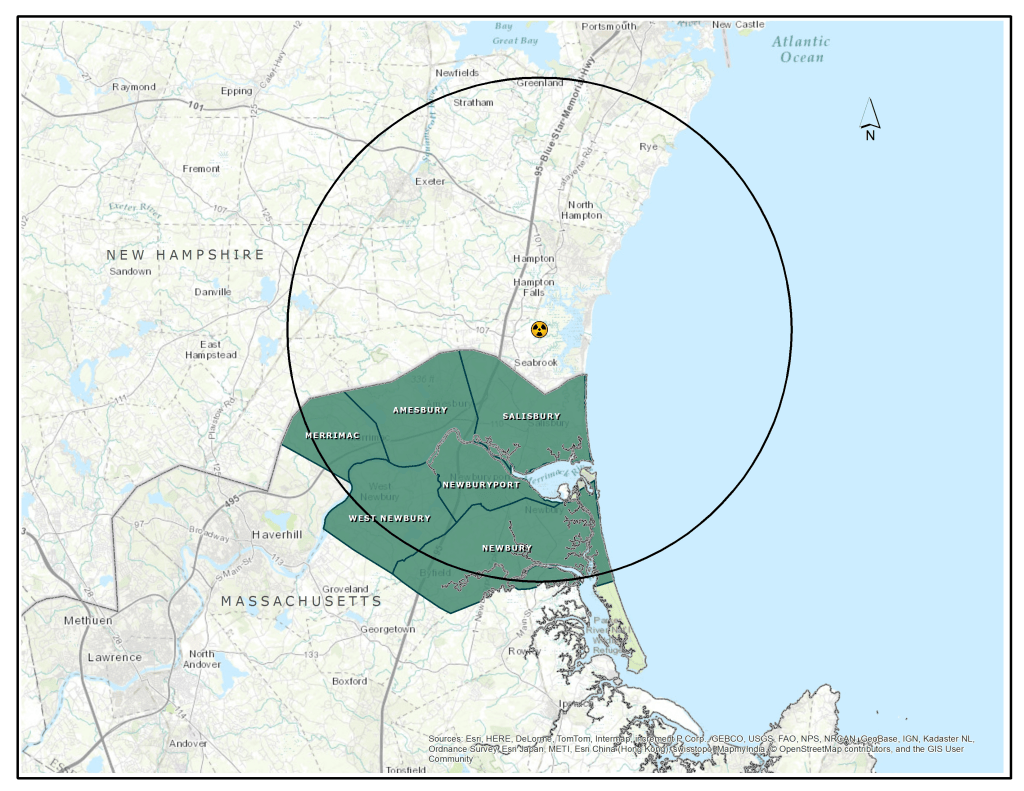
From the actual state government of Massachusetts:
The Seabrook Nuclear Power Station (“Seabrook”) is located in Seabrook, New Hampshire. The area that is approximately 10 miles around Seabrook is called the Emergency Planning Zone (EPZ). Massachusetts communities in the EPZ are: Amesbury, Merrimac, Newbury, Newburyport, Salisbury, and West Newbury. People that live, work, or vacation within the 10 mile EPZ should be prepared for an emergency at Seabrook and be familiar with the EPZ’s emergency plans and procedures.
There’s much more detail at: https://www.mass.gov/info-details/seabrook-station-nuclear-power-plant
Why are they taking things so seriously?
From Portsmouth Herald yesterday
From 2010 to 2013, I lived in the Marshall Islands. And between 2015 and 2020, I returned to conduct research. I worked with communities still suffering from the impact of policy decisions made decades ago and thousands of miles away by people they’d never met or even seen. This is part of the legacy of U.S. nuclear power.
From 1946 to 1958, the U.S. tested 67 nuclear weapons in the Marshall Islands. Generations later, Marshallese people are continuing to deal with the aftermath, including cancer and struggles with pregnancy complicated by radiation-related birth defects. Living in the Marshall Islands offers a lesson that “half-life” is more than a scientific term; it is a metaphor for the ways reckless policymakers can rob generations of the right to a full and vibrant life.
I didn’t have to travel thousands of miles to learn this lesson. Activists who waded into the marshes of Seabrook and Hampton before I was born worried about the risks posed by nuclear radiation right here on the Seacoast.
A recent study led by researchers at the Harvard T.H Chan School of Public Health found that living closer to a nuclear power plant is associated with higher cancer rates, with risk increasing with age and decreasing the farther from these plants people live. The study examined data from seven nuclear power plants located within 120km of Massachusetts zip codes, including Seabrook Station in New Hampshire. As the Trump administration rushes to eliminate regulation and oversight of the nuclear industry and extract personal profit by inking a $6 billion deal between his social media platform and a company that is attempting to develop nuclear fusion technology, these findings underscore a critical need to examine public health risks alongside energy policy decisions.
That’s why I’m calling on the state of New Hampshire and the University of New Hampshire to promptly review this study and conduct an independent assessment of cancer risks and other potential health impacts associated with the Seabrook Station. I am also calling on the Trump administration to halt efforts to weaken nuclear safety oversight and ensure that health risk monitoring keeps pace with plant operations and scientific evidence. Finally, I call on members of Congress to investigate financial ties between the president and members of his administration and the nuclear power industry to ensure that public servants don’t put personal profit over public health.
Imagine another coast, in Scotland, with the sea to the West this time and prevailing westerly currents and winds, where Scottish Labour would like to force another new nuclear power plant on the locals:
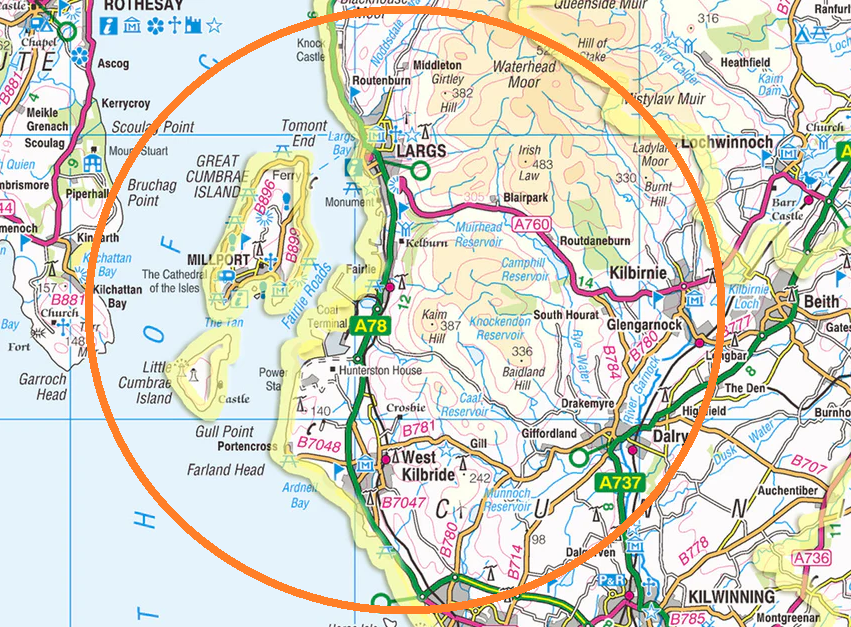
Multiple research studies suggest that folk living within the above 10km radius of the Hunterston B nuclear site which Scottish Labour and their GMB union funders would like to see are at serious increased risk of cancers but the risk is even wider and greater than that and the evidence could be more reliable.
Top 1% US researchers find ‘significantly increased cancer incidence’ for those living near nuclear power plants at a level that would mean an additional 10 000 avoidable cancer cases 30km around Hunterston if Scottish Labour get their way

Professor John Robertson OBA
From the highly-rated Harvard T H Chan School of Public Health in the USA yesterday:
In Massachusetts, residential proximity to a nuclear power plant (NPP) was associated with significantly increased cancer incidence, with risk declining by distance, according to a new study led by Harvard T.H. Chan School of Public Health.
The study was published Dec. 17 in Environmental Health. It was conducted by researchers in the Department of Environmental Health, including corresponding author Yazan Alwadi, PhD student, and senior author Petros Koutrakis, professor of environmental sciences.
Despite widespread—and potentially expanding—reliance on nuclear power in the U.S., epidemiologic research investigating the health impacts of NPPs remains limited. Meanwhile, the results of studies conducted internationally vary significantly. To broaden the evidence base, the researchers assessed proximity of Massachusetts zip codes to nuclear power plants and 2000-2018 cancer incidence data collected by the Massachusetts Cancer Registry. They controlled for confounders such as air pollution and sociodemographic factors.
The researchers estimated that about 20,600 cancer cases in the state—roughly 3.3% of all the cases included in the study—were attributable to living near an NPP, with risk declining sharply beyond roughly 30 kilometers from a facility. The risk of developing cancer attributable to living near an NPP generally increased with age.
According to the researchers, the findings highlight the importance of acknowledging and addressing nuclear energy’s health impacts, particularly at a time when its expansion is being promoted as a solution to climate change.
https://hsph.harvard.edu/news/cancer-risk-may-increase-with-proximity-to-nuclear-power-plants/
How many people live within 30km from the Hunterston site in North Ayrshire where Scottish Labour want to see a new nuclear power station built? 300-400 000. 3.3% as per the above study – 9 900 avoidable cancers
Link to full report – https://link.springer.com/article/10.1186/s12940-025-01248-6
Sometimes research finding similar evidence in the UK has been discounted by the media simply because it was funded by activist groups. This cannot be considered for these researchers:
Twenty-four faculty members or researchers affiliated with Harvard T.H. Chan School of Public Health were named to Clarivate Analytic’s 2025 list of Highly Cited Researchers. The annual list includes researchers from around the world whose papers have been cited most often by their peers—in the top 1% of citations for a chosen field or fields.
https://hsph.harvard.edu/news/harvard-chan-school-researchers-among-worlds-most-highly-cited/
Discover more from Talking-up Scotland
Subscribe to get the latest posts sent to your email.
 Talking-up Scotland