

Professor John Robertson OBA
From the Guardian on 31 December 2025:
The number of violent offences involving an adolescent attacking their parents or step-parents has increased by more than 60% in the past decade, according to figures recorded by the UK’s biggest police force. Data released by Scotland Yard reveals that there were 1,886 such offences recorded in 2015 but this increased to 3,091 in the first 10 months of 2025 alone.
The offences involved a suspect aged between 10, the age of criminal responsibility in England, Wales and Northern Ireland, and 17 who had been recorded as being the child or stepchild of the alleged victim.
No comparable data for Scotland nor for any of its police divisions is published. In May 2023, a freedom of information request, to Police Scotland, has requested this in but it was refused on cost grounds.
What we do have and little reported in Scotland is this:
Murder by minors increases four fold in England and Wales but plummets to a quarter in Scotland after 18 years of SNP administration
From ITN on 1 May 2025:
ITN Productions’ new 1 x 90’ documentary for 5, looks at the rise in murder convictions for 12-17-year-olds in the UK, from those affected by these harrowing crimes and experts offering insight and analysis.
Stuart Stephens [pictured], father of Olly Stephens who was killed in 2021 aged 13, shares heart-wrenching memories of his son, whose attack was planned on social media. Stuart subsequently started to campaign for tougher online safety measures.
Rohan Shand’s son, Rohan Shand jr who was known as Fred, was stabbed to death on his way home from school in 2023. Rohan snr talks powerfully about the emotional impact of knife crime on him and his family.
Hayley Ryall, mother of teenager Mikey Roynon who was tragically killed at a house party in 2023 also speaks out about her devasting loss and setting up the charity Mikey’s World to install specialist emergency bleed kits in her son’s hometown of Bristol.The nation is facing a chilling new reality: a shocking rise in child killers—and their victims—is gripping Britain. Murder convictions for minors in England and Wales have quadrupled since 2016. This gripping documentary investigates the disturbing rise in youth violence, asking: what’s driving this deadly trend? Through expert insight and heart-wrenching real-life stories, we uncover a toxic mix of online feuds, social media pressure, and deadly weapons.
https://www.itn.co.uk/media-centre/5-documentary-talks-families-children-murdered-their-peers
The above does not give the actual figures but I must assume the quadrupling claim is reliable.
Some may find this too sensitive a topic but I feel I must clarify the situation, any trend, in Scotland as a counter ready for the likes of the Scottish opposition leaders or ‘our’ dreadful media, ever ready to paint a dark portrait of life in Scotland under the SNP.
The trend is clearly and definitively the other way.
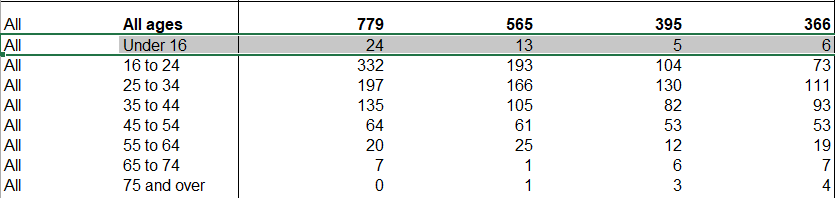
Above, the official data reveal a steady, statistically significant, falling trend in the number of homicides by minors, over four 5 years sets (more reliable than 1 year changes), plummeting from 24 under Labour to 6 under the SNP, in recent years.
and this:
There is a marked overall decline in youth violence in Scotland but a surge from 2012 in England as Tory austerity kicked in
What is the long-term youth violence trend in Scotland?
Overview of Youth Violence in ScotlandYouth violence in Scotland typically refers to violent incidents (e.g., assaults, robberies, or homicides) involving individuals under 18 as victims, perpetrators, or both. Data comes from sources like the Scottish Crime and Justice Survey (SCJS, a victimization survey), Recorded Crime in Scotland (police data), and cohort studies such as the Edinburgh Study of Youth Transitions and Crime (ESYTC) and Growing Up in Scotland (GUS). Long-term trends (roughly 2000–2025) show a marked overall decline, driven by public health interventions like the Scottish Violence Reduction Unit (SVRU, established 2005). However, recent years (post-2020) indicate a partial reversal, with rises in certain metrics, possibly linked to COVID-19 disruptions, social media influences, and cuts to youth services.Key Long-Term Trends
- Victimization Rates (SCJS Data): The proportion of 16–24-year-olds experiencing violence fell by 75% from 12.0% in 2008/09 to 3.0% in 2021/22. Overall violent victimization among adults (including youth) dropped from 4.1% in 2008/09 to 1.7% in 2021/22, with the estimated volume of violent crimes decreasing by 58% over the same period. By 2023/24, the rate stabilized at 2.6% for assaults (unchanged from pre-COVID 2019/20 levels). Trends for under-18s are similar but less granular, showing stable or decreasing rates of sharp-object injuries from 2012–2017.
- Offending and Perpetration Rates: Cohort studies reveal dramatic reductions in youth offending behavior. Comparing ESYTC (1998/99 cohort, aged 12) and GUS (2010s cohort, aged 12–14), the prevalence of violent or antisocial acts dropped sharply—e.g., from ~70% of 12-year-olds engaging in at least one offense in the late 1990s to far lower rates today (specific reductions: boys ~50–60%, girls >80%). Police-recorded serious assaults/attempted murders by under-18s remained stable at ~550 annually from 2008/09 to 2017/18. Broader violent crime convictions fell most among young men, explaining much of Scotland’s overall crime drop since the early 2000s.
Sources at: https://x.com/i/grok?conversation=1998660120302026957
In England?
Youth violence in England (primarily tracked for ages 10–24) encompasses physical assaults, knife-related offences, homicides, and related serious violence. Data sources include the Crime Survey for England and Wales (CSEW) for victimisation trends, police-recorded crime for offences, and hospital admissions for injuries. Overall, long-term trends (2000–2025) show a U-shaped pattern: steady declines in general violence from the early 2000s to around 2012 [two years into Tory austerity] , followed by rises in serious youth violence (particularly knife-enabled incidents) from 2013 onward, with some recent stabilisations or modest declines in 2024–2025. This rise contrasts with broader crime reductions, driven by factors like reduced youth services funding (halved since 2012/13) and socioeconomic pressures in urban areas. https://x.com/i/grok?conversation=1998660120302026957
Discover more from Talking-up Scotland
Subscribe to get the latest posts sent to your email.
 Talking-up Scotland