Or direct bank transfer at Sort Code 08-91-04 Account - 12266421 Name - JOHN ROBERTSON
Notice anything about that tower block fire? No towering inferno, again
From BBC Glasgow & West yesterday:
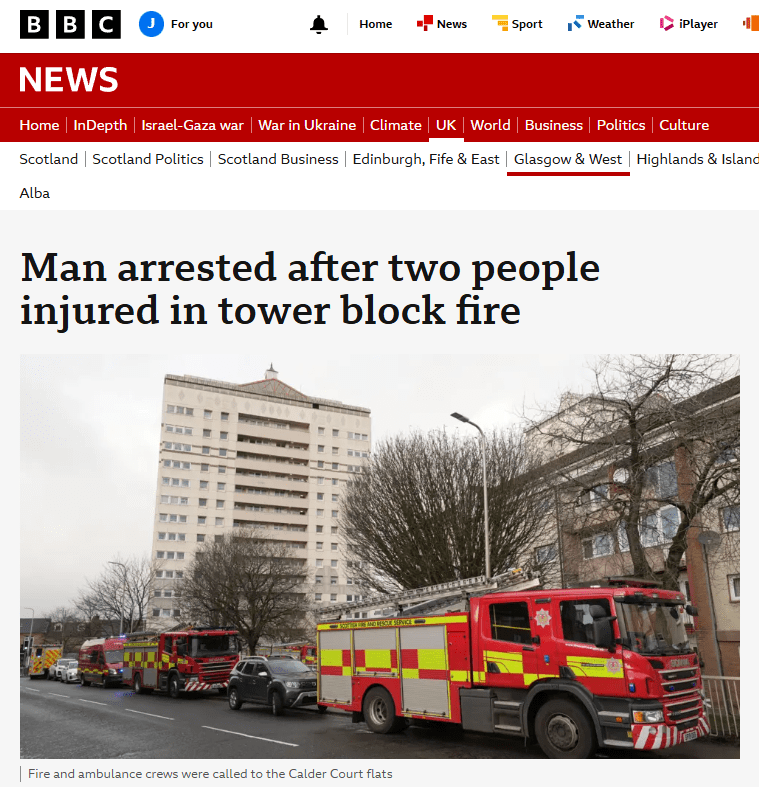
A 19-year-old man has been arrested in connection with a fire in a flat at a tower block in Coatbridge. Two people were treated by ambulance crews following the blaze at Calder Court in Whifflet which was reported at about 06:45.
The Scottish Fire and Rescue Service said crews in 11 fire engines and one height vehicle were working to extinguish the fire. A spokesperson said: “Two casualties are in the care of the Scottish Ambulance Service and crews are currently still at the scene.”
Why hasn’t the whole block gone up like Grenfell? I fee sure that SNP Council hasn’t replaced the flammable cladding yet.
Here’s why:
Thanks to Iain AF Fleming @LegalWeasel for alerting me to this.
In June 1999, a fire spread up external cladding in a block of flats in Irvine. There was one death.
Scottish media often use this case to suggest that towering infernos of the kind we saw in Grenfell London in 2017 can happen here. With 72 deaths and the complete burning of the building, the links to the Irvine case are a bit stretched, even for our media.
In Scotland, action followed quickly:
The Building (Scotland) Regulations 2004 require that buildings be designed and constructed to inhibit the spread of fire and smoke within cavities in the event of a fire. This is achieved by installing cavity barriers around the edges of cavities.
Cavity barriers are constructions that seal cavities against fire and smoke, or limit their movement. They should be installed in the following locations:
Around the head, jambs, and sill of external door or window openings
Before this latest, there had been four fires in tower blocks in Scotland since then – Glasgow Knightswood in 2021, Glasgow Shawlands in 2022, Breadalbane Street Edinburgh in early 2024 and Cambuslang Glasgow in August 2024. All four fires were contained on one floor and there were no deaths.
In March 2021:
Christopher Mort, technical officer for fire, at cavity barrier manufacturer Siderise, was asked to inspect those that remained on the tower in July 2018, a year after the fire.
He said he found examples of areas where cavity barriers should have been with no holes drilled for fixing, leading him to conclude they had “not been installed at all” or fixed to the wall with silicone instead of a bracket.
He also found gaps of up to 140mm, well in excess of the 25mm which the barriers were designed to close, meaning they would have been unable to prevent the spread of smoke and flame in the cavity.
Vertical barriers were also installed incorrectly, with the bracket meant to hold them piercing the barrier and gaps left where there should not have been any, which would have allowed “fire, flame and smoke to travel behind the cladding”.
Asked how serious these errors were, he said: “It was some of the worst I have ever seen.”
He added: “There’s no grey area when it comes to inspection – it’s either right or wrong… If it’s significantly wrong like these barriers were, they have to be removed and replaced with new material.”
“Would it be fair to say these were fundamental errors which no reasonable installer should have been making?” asked Kate Grange QC, counsel to the inquiry.
The Grenfell inquiry has cast the blame quite widely. Doesn’t the above suggest the contractor is entirely to blame?
A Tory donor’s private equity firm was a major investor in the construction company accused of saving £5,000 by fitting cheaper and more flammable cladding to Grenfell Tower.
Finally, from statistics around the time of Grenfell
In Scotland 2015/16, 9 827 safety audits were carried out. England has 10 times the population and so, all things being equal, might have been expected to have seen 98 270 fire safety audits. However, in 2017/18, England saw only 49 423 fire safety audits, just over half the number. Fire safety audits in Scotland were thus almost twice as common, per head of population, in Scotland as in England.



 Talking-up Scotland
One thought on “There have now been 5 tower block fires in Scotland since 2000 and none have gone up like Grenfell – here’s why, for the 5th time”