

Professor John Robertson OBA
BBC Scotland, today, in their BBC Breakfast TV insert but not on their website so just another report feed to the Pacific Quay team of a no news-value story on supposed hardship for island businesses.
What’s the problem with it?
There’s a very significant background story never told of just how much this SNP Government has done to transform life on the islands, funded by the rest of us living often in less pleasant places and with never the suggestion of compensation because of limited public transport services.
Here it is:
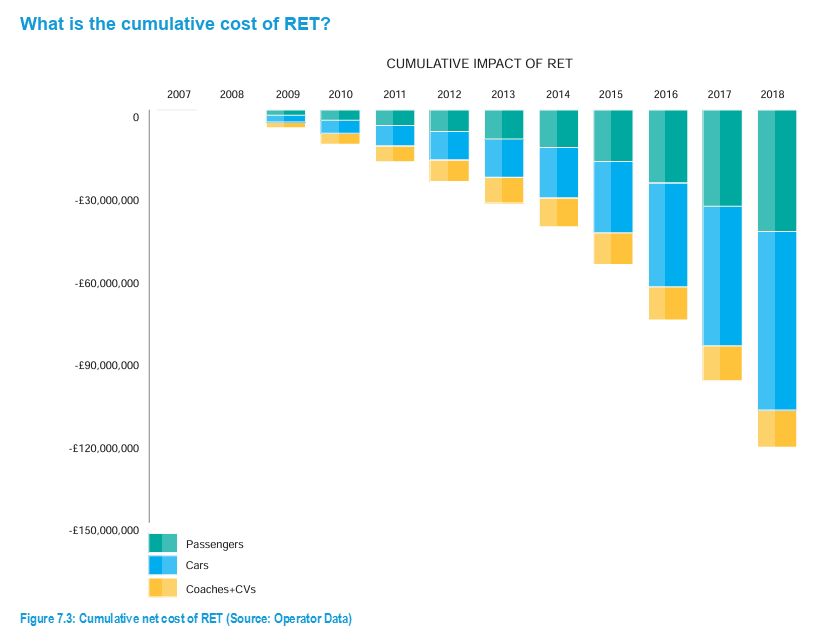
The above chart from the Evaluation of Road Equivalent Tariff [RET] on the Clyde and Hebridean Network Prepared for Transport Scotland March 2020 reveals a massive increase in ferry usage to the islands with a consequent economic boost, but increasing costs for the taxpayer in lost revenue. The comparison is based on ticket sales only and takes no account of retail revenue, which is likely to have increased as a result of the increased numbers of passengers.
What is the RET?
In October 2008, Transport Scotland introduced the Road Equivalent Tariff (RET) fares policy as a pilot on routes to the Outer Hebrides, Coll and Tiree (and made permanent in 2012). The principle of RET is that ferry fares should be set on the basis of travelling an equivalent distance by road plus a fixed fare element aimed at cost recovery. RET was intended to reduce the cost disadvantage faced by island communities and promote the islands as places to live, work, visit, invest and conduct business. In 2012, the policy was extended to cover Colonsay, Gigha and Islay. It was then further extended to the two Arran routes and Campbelltown in 2014. Finally, in October 2015, RET was rolled-out to all remaining routes, including the high-volume routes of Oban – Craignure, Wemyss Bay – Rothesay and Largs – Cumbrae.
How much has RET cost the Scottish Government in revenue foregone?
RET is now costing the Scottish Government around £25m per annum in revenue support, around two thirds of which is supporting reductions in car fares.1
What has the RET achieved?
Increase demand for ferry services by making ferry travel more affordable and accessible. Increase tourism and supporting existing tourism markets. Enhance local economies and the wider national economy.
Do the so-called representatives of the islanders ever recognise this?
Nope.
As well as this subsidy in the form of lost tax revenue, the Scottish Government directly subsidises CalMac, by £3.7 billion over ten years.2
What would happen without these subsidies and a privatised ferry service? Something like this:
Sources:
- https://www.transport.gov.scot/media/49397/evaluation-of-road-equivalent-tariff-on-the-clyde-and-hebridean-network.pdf
- https://www.gov.uk/government/publications/report-on-the-proposed-subsidy-to-calmac-ferries-limited-by-transport-scotland
Discover more from Talking-up Scotland
Subscribe to get the latest posts sent to your email.
 Talking-up Scotland
I wonder how many of those complaining about the ”poor” island service are incomers from the mainland .
Did they move to the islands without anyone explaining that they would be on a landmass surrounded by water ? Were they unaware that ferry transport was affected by factors , such as weather , which were beyond human control ?
Are they aware of the enormous subsidy which the Scottish Government provides to the islands making the cost of living far cheaper than it was 20 years ago under non-SNP Governments ?
LikeLiked by 2 people
White Settlers and the Colonial Mejah!
And the Brit Nats complain of Putin’s interference?
gavinochiltree
LikeLiked by 2 people