


EBARGOED UNTIL 15 Dec 2025 00:01
Professor John Robertson OBA
From BBC Scotland, three days ago:
In East Lothian, council leader Norman Hampshire has asked UK ministers to draw up a “characterisation” of the Torness power station site in the hope that it could still be considered for a replacement. The Labour councillor says the closure of Torness without a replacement would be devastating to the community in Dunbar and across Scotland.
“There’s a lot of jobs… and all of that feeds into the local economy. So, if Torness isn’t there it’s going to be a huge blow and there’s not the other jobs to replace these jobs here locally,” he said. Although we support a lot of renewables here within East Lothian, both onshore and offshore, we know the wind doesn’t blow all the time and when that power drops you need something to back up these turbines. Nuclear is the only baseload that we have available.”
How often do we hear that line about the wind not blowing all the time? The increased presence of battery farms to store electricity seems not to be enough to counter it, so far, but from the UK Research and Innovation (UKRI) Science and Technologies Facilities Council, by email to me on 13th December 2025:
I’m writing to share details of a story we’re releasing at 00.01 15 December 2025 about a new approach to one of the UK’s renewable energy challenges.
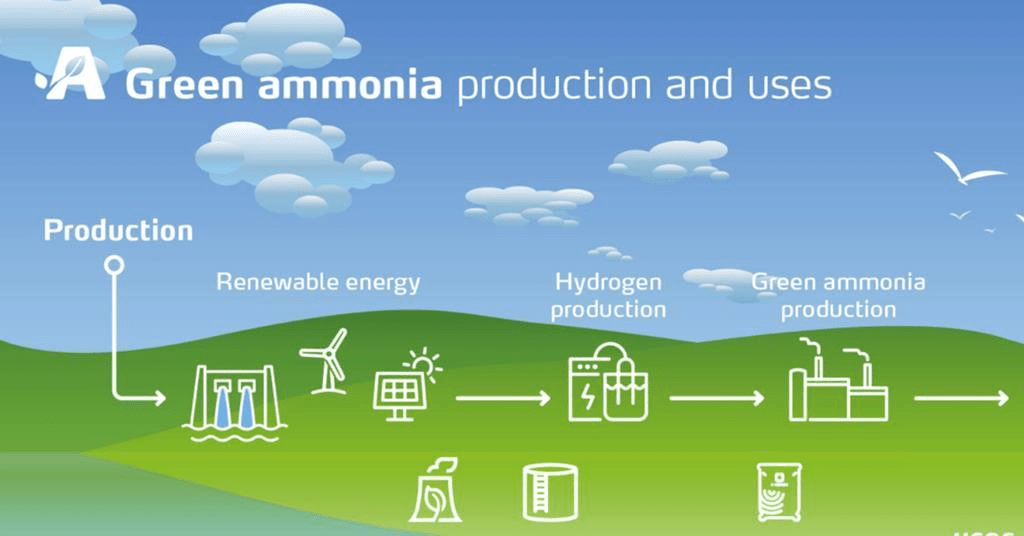
In 2024, about one-tenth of all wind-generated power in Great Britain was produced but not used. Engineers at the Science and Technology Facilities Council have just switched on a prototype facility that converts this otherwise unused wind energy into ammonia, effectively storing renewable energy for later use.
The ASPIRE plant demonstrates a technology that could help address the mismatch between when wind energy is generated and when it’s needed, while also producing a chemical essential for fertilisers and other industries without the carbon emissions of conventional production.
Released today, the full report, beginning with:
Green ammonia plant prototype powers up to tackle energy storage challenge

Image: The sun is setting on wasted wind energy. Credit: Pixabay
- Ammonia is perhaps the most influential chemical of the last 100 years. Uses for ammonia include the production of fertilisers, plastics, synthetic fibres, dyes, and pharmaceuticals.
- Green ammonia can be made from air, water and renewable electricity and has no direct carbon emissions. In storage, it acts as a reservoir of hydrogen available for future use as an energy source.
- In 2024, about one-tenth of all wind generation in Great Britain was produced but not used, representing a critical need for energy storage solutions.
Engineers at the Science and Technology Facilities Council’s (STFC) Energy Research Unit have switched on a new prototype facility that is designed to manufacture ammonia using renewable electricity, marking a significant advancement in the UK’s green energy landscape.
The process offers a way to store previously unused generated energy in the form of hydrogen molecules within the ammonia. The hydrogen in the ammonia can later be extracted and used to generate electricity at a more useful and convenient time.
Full report at: https://ukri-newsroom.prgloo.com/news/green-ammonia-plant-prototype-powers-up-to-tackle-energy-storage-challenge
Discover more from Talking-up Scotland
Subscribe to get the latest posts sent to your email.
 Talking-up Scotland
Hydrogen on its own works fine. No need to turn it into ammonia.
LikeLike
Neither gas is particularly safe although ammonia does need a higher ignition energy before bursting into flames. Hydrogen a spark will do it. Remember the Hindenburg. If either gas is to be used then stringent safety protocols have to be in place.
LikeLike
Unsurprisingly the industry has moved on since the Hindenburg and is now already subject to standards that ensure safety.
LikeLike
I am sure it has moved on and safety measures will be in place especially when hydrogen is being used to generate electricity. However, there is also talk of using hydrogen as a transport fuel eg for cars. That sends alarm bells ringing for me because that is a less controlled situation than an industrial power plant.
LikeLike
Hydrogen has been widely used in Japan for decades without much issue. Hindenburg was a century ago, in case you can’t count. Hydrogen’s risk isn’t explosion, it’s leakage.
LikeLike
There is a huge difference between variable wind power generated and none – The former does happen but the latter never has, despite claims by some of weeks of doldrums over thousands of square miles – Installed capacity in 2023 was more than double Scotland’s requirements, before the latest additions, the problems as ever lie with grid capacity, no matter how it is being generated or where…
Lots going on over offline storage, the compressed ‘air’ plant at Hunterston is just one such example, but the power still has to get there, again the grid…
There have been several interesting pieces on the web over what the Oz government has been doing in a country where solar has gone from strength to strength, the problem being it is variable, and it strains the grid, but you don’t hear them calling for nuclear as a solution, it’s just plain daft….
Mr Hampshire is rightly concerned over lost jobs in his area, but being a Labour man he joins in on the ‘SMR’ chorus… – If power wasn’t so damned expensive in Scotland, businesses would be queuing at his door and his concerns allayed – Perhaps have a word in Millipede’s ear….
An interesting piece from Dave Borland on the latest Oz government initiative over power storage, while the UK government fails to organise the traditional pissups in breweries…
LikeLiked by 2 people
Super Capacitors have already proven that their capacity to store and deliver electricity when need . This allows the Turbines more down time and therefore less maintenance. A win will. Situation. Though the ongoing tech for electrical storage is very encouraging.
LikeLike
surely the energy used to make hydrogen and then to make ammonia and, further, to reconvert to hydrogen can be replaced by cheap mass battery storage? CATL is in the process of producing batteries using sodium technology with an energy density better than the BYD Blade battery (lithium based) at roughly 50% (currently) of the price of lithium batteries.
locally produced sodium based batteries using widely available, cheap elements that work through a wider temperature range, have a longer life, charge at higher speeds can provide local network resilience. Of course, the major problem is the National Grid that provides a ‘top down’ structure and provides no encouragement for local communities to design and own their own local energy networks. Tie this to land reform and the allocation of Scottish government funds to prevent the continuation of energy and resources only controlled by small numbers of rich people.
sorry. Rant over.
LikeLiked by 1 person
Any chemical formulation using electrical power has inherent losses – IIRC electrolysis of hydrogen from totally pure (and that’s important and crucial to the process and economics) from H2o is ca 55% – In short you’ve dumped half the energy value.
The hydrogen generation test site on Orkney was never intended to be efficient, but made best use of spare energy which could no be exported because some blonde idiot (not the wacky Truss) in Westminster decided to block grid and interconnect upgrades and new ones to Norway from Scotland to teach those picts a thing or two over who was in charge, what ho… ( the last one you hired sir ) – It’s all of it London politics, money laundering central…
LikeLiked by 1 person
O/T
MSM Monitor posted this today:
“There’s an absolutely huge civil war raging between the UK and Welsh Labour Govts over the UK Internal Market Act and the fact Starmer is continuing the Tory policy of by-passing the Welsh Senedd and spending what the Tories used to call ‘Levelling Up’ cash as London sees fit“.
“You’ll never get Sarwar and his band of House Jocks questioning the Internal Market Act like this despite Labour pledging to repeal it. You’ll also never get anyone from BBC Scotland asking why Welsh Labour is standing up to Starmer on this issue but Scottish Labour isn’t“.
BBC website Wales page have a headline
“Should Westminster or Senedd decide town spending”?
(Well the wee question of devolution might help answer that one).
“A law which gives the UK government the power to intervene in areas that are the responsibility of the Welsh government should be “removed from the statute book”, according to Mark Drakeford“
“The Westminster government will decide how cash from the second phase of its scheme for town centre improvements is spent in Wales through the UK Internal Market Act “
“Earlier this month, 11 Labour Senedd politicians had written to the prime minister to complain the Pride in Place scheme rolled back devolution”.
“When Drakeford was first minister, he took the last Conservative UK government to court over the UKIMA, It was argued that the act undermined the devolution settlement and was “an unwarranted attack on devolution”, but it was ultimately dismissed by the High Court in 2022″.
The same Labour UK government are also enforcing this con upon the Scottish devolved government also, though the silence from Sarwar and others is deafening.
In fact it seems as if the UK government, be it Tory or Labour, just want to ride roughshod over devolution and use the (weak) excuse that it is the UK Internal Market Act at play……….
I take it if anything goes wrong with this process then the buck will stop with the UK government and not be attributed to, as in the buck passed onto , the devolved governments in Scotland & Wales.
Well the problem with assuming the UK government will be accountable to any problems with this , is that both they and media will twist it should a problem arise, and they both will make it seem as if the Scottish government are responsible in some way.
So.
Brexit and the UK Internal Market Act
Or
Scottish independence and EU membership.
Which one will we prosper with ?
I think we all know the answer to that, as already we are suffering under Brexit and the UKIMA.
Liz S
LikeLiked by 2 people
There are no hydrogen molecules in ammonia. Ammonia can be burned directly and is much easier to store as a liquid than hydrogen. Battery storage, however, is far more efficient than any chemical route.
LikeLike