

Professor John Robertson OBA
In the Guardian today the above and:
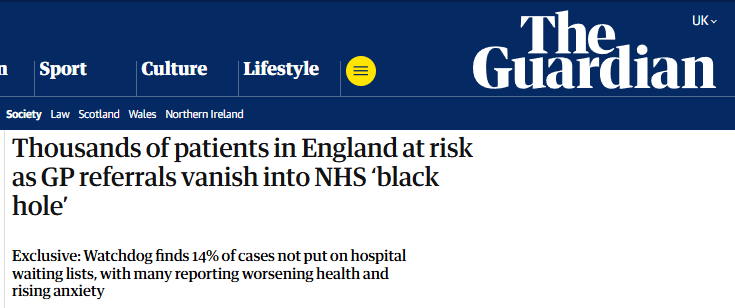
One in seven people in England who need hospital care are not receiving it because their GP referral is lost, rejected or delayed, the NHS’s patient watchdog has found.
Three-quarters (75%) of those trapped in this “referrals black hole” suffer harm to their physical or mental health as a result of not being added to the waiting list for tests or treatment.
Communication with patients is so unreliable that seven in 10 (70%) only discover they have not been put on a waiting list after chasing up the NHS because they have not been told a hold-up has occurred. In some cases referrals that GPs have agreed to make do not even get sent from their surgery to the hospital, Healthwatch England’s findings show.
There are no reports of comparable, deliberate, inaccuracies in Scotland where the pressure of managerialism and privatisation which makes such behaviour more likely does not exist.
It’s not a one of.
In 2019 and in 2022, the Royal College of Emergency Medicine wrote to NHS England to request that they accurately report 12 hour A&E waits:
Current 12hour performance figures published by NHS England represent just the tip of the iceberg as they are measured from when the DTA a patient was made rather than their TOA at the ED. NHS Digital data that we have collected as part of our Tip of the Iceberg Freedom of Information (FOI) campaign shows that far greater numbers of patients wait 12 hours or more if you start the clock at the patient’s TOA in an ED [NHS Scotland has always done so]. There is a substantial discrepancy between the two metrics, with thousands of patients falling through the gap. This discrepancy is significant as these metrics inform our understanding of how many people experience unnecessarily long waits in EDs, with consequences for harm and mortality.
https://rcem.ac.uk/wp-content/uploads/2023/02/RCEM_Explains_long_waits_and_excess_mortality.pdf
In 2024 the National Audit Office reported:
When the NAO audited the records of 650 orthopaedic patients… records were complete and accurate in only 281 (43%) of them… There was a tendency for misrecording data to hide delays rather than exaggerate waiting times.”
https://www.nao.org.uk/reports/nhs-waiting-times-elective-care-england-2/
In 2025, the House of Commons Public Accounts Committee wrote:
£3.4bn spent on elective recovery yielded poor results; targets missed due to flawed monitoring/digital weaknesses.
https://committees.parliament.uk/publications/50242/documents/271529/default/
Also in 2025, the Nuffield Trust wrote:
Over the two previous complete financial years… there have been on average 244,578 unreported removals a month… The planned care waiting list will continue to be a misleading indicator of how the NHS is dealing with demand.
Finally in 2024, NHS England itself admitted:
If trusts cannot accurately track all their patients, then there is a risk that some will become lost in the system... High ‘disappearance’ rates and follow-up tracking failures as clinical risks.”
https://www.insource.co.uk/nhs-england-updates-waiting-list-quality-improvement-guide/
I cannot find any Scottish examples and neither can AI but there’s an even surer sign that this does not happen in Scotland – BBC Scotland cannot find any to report.
Discover more from Talking-up Scotland
Subscribe to get the latest posts sent to your email.
 Talking-up Scotland