


Professor John Robertson OBA
In the Guardian, yesterday, the above and:
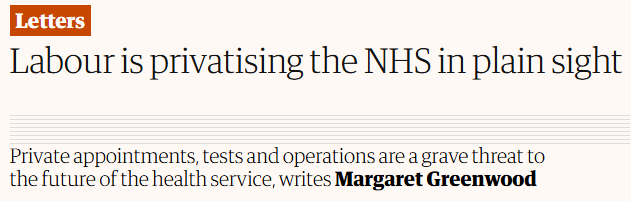
There are other threats to the delivery of NHS services too. The privatisation of the NHS is happening in plain sight. Last month, the government proudly announced that “A total of 6.15 million appointments, tests and operations were delivered by independent providers for NHS patients this year”, an almost 500,000 increase on last year, which it says is “helping to cut waiting times [and] free up NHS capacity”.
How can this be so? There’s a finite number of doctors, nurses and surgeons in the country. If medical staff increase their work in the private sector, they decrease their availability for NHS work.
https://www.theguardian.com/society/2025/nov/19/labour-is-privatising-the-nhs-in-plain-sight
Will Scotland’s media be discussing the privatisation of the NHS here, much?
No and here’s why:
First, NHS England more than 100 times, 10 times per head, more privatised than NHS Scotland
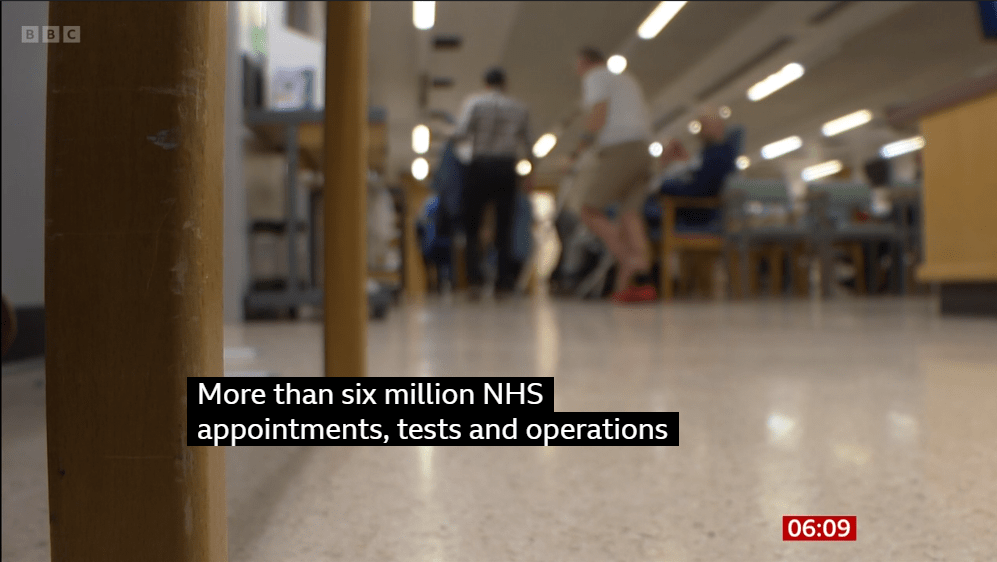
in England were delivered by private hospitals and clinics in the last 12 months – that’s almost 500 000 higher than the previous year. The Health Secretary….[was not criticised for the obvious evidence of failures in NHS England.]
The figure, 6.15 million comes from the private sector – David Hare, Independent Healthcare Providers Network.
Scotland, you ask?
From Grok AI:
NHS Scotland’s policy prioritizes public sector delivery for elective care, with limited reliance on the independent (private) sector compared to other UK nations. Use of private hospitals and clinics is targeted at specific backlogs (e.g., orthopaedics, ophthalmology, endoscopy) and is often short-term or regionally focused. Exact aggregate figures for NHS-funded activity in private facilities over the precise period of October 26, 2024, to October 26, 2025, are not publicly available in official statistics as of the current date (the most recent comprehensive data covers up to Q3 2024, with partial updates for 2024-25). However, based on Scottish Government reports, Audit Scotland data, and health board disclosures, I estimate approximately 50,000 to 70,000 appointments, tests, and operations were delivered in private hospitals and clinics for NHS Scotland patients in the last 12 months. This is derived from expenditure trends, procedure volumes, and historical patterns.
This is an estimate, as is, given it’s diversity of ownership, the private sector figure but, all things being equal, you might expect the NHS England figure to be 10 times greater, at 500 000 to 600 000. It is, however, at least, 100 times greater at 6 150 000.
This dramatic contrast can be seen in the distribution of private health care providers across the UK:

The above from September 2023, shows private healthcare providers (red) and MPs taking money from them to push their interests (blue £), notably then only one in Scotland – Ian Murray, Edinburgh South (Labour).
Second, recent Oxford University research PROVES Labour’s privatised health strategy WILL lead to ‘worse patient care’
An expansion of private healthcare is now a central strategy to cut waiting lists in England, from a party where many of its leaders, have received large donations from private healthcare firms, yet less than a year earlier Oxford University’s PROVED research UK Labour’s privatised health strategy WILL lead to ‘worse patient care.’
From Oxford University researchers reported in The Lancet, on 29 February 2024:
A new review has concluded that hospitals that are privatised typically deliver worse quality care after converting from public ownership. The study, led by University of Oxford researchers, has been published in The Lancet Public Health. The researchers carried out a meta-analysis based on evidence from 13 longitudinal studies, covering a range of high-income countries.* Each study assessed quality of healthcare measures for patients before and after health service privatisation, at either the hospital or regional level. The studies included measured indicators of care quality which included staffing levels, patient mix by insurance type, the number of services provided, workload for doctors, and health outcomes for patients such as avoidable hospitalisations.
Key findings:
- Increases in privatisation generally corresponded with worse quality of care, with no studies included in the review finding unequivocally positive effects on health outcomes.
- Hospitals converting from public to private ownership status tended to make higher profits. This was mainly achieved by reducing staff levels and reducing the proportion of patients with limited health insurance coverage.
- Privatisation generally corresponded with fewer cleaning staff employed per patient, and higher rates of patient infections.
- In some studies, higher levels of hospital privatisation corresponded with higher rates of avoidable deaths.
- However, in some cases (e.g. Croatia), privatisation led to some benefits for patient access, through more precise appointments and new means of care delivery, such as out-of-hours telephone calls.
According to the researchers, the results challenge the theory that privatisation can improve the quality of healthcare through increased market competition, and by enabling a more flexible and patient-centred approach.
Watch a report here:
Footnote – In case it’s not obvious, this is very high quality rigorous independent research. You can trust them.
 Talking-up Scotland