

Professor John Robertson OBA
In the Guardian yesterday, the above and:
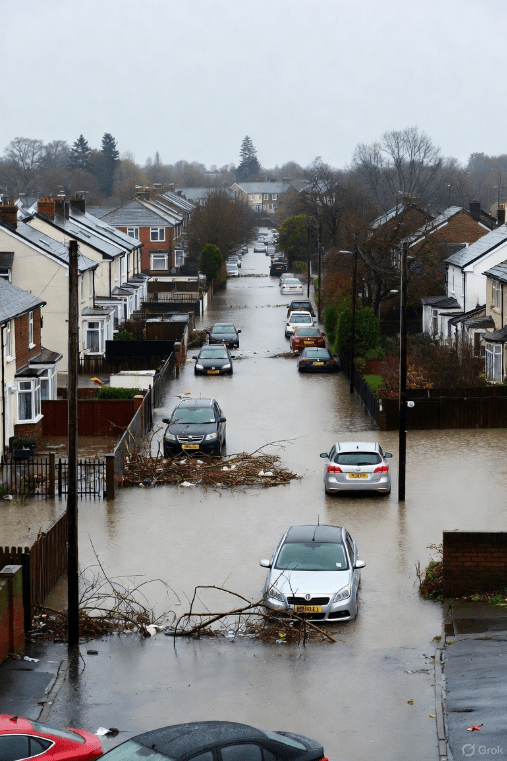
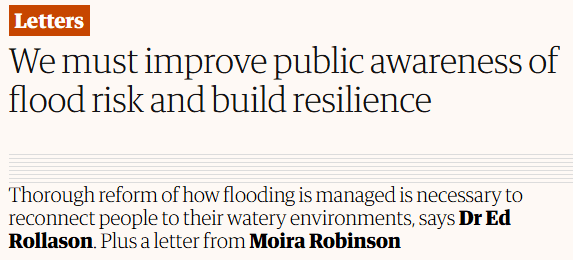
John Harris correctly identifies that the UK is hopelessly unprepared for flooding, but is wrong to suggest that the public is not told about the threat (Flooded and forgotten: the UK’s waters are rising and we’re being kept in the dark, 16 November).
Is there a comparable problem in Scotland?
Nope
After 14 years of Tory rule in England and 17 of SNP rule in Scotland, 22 times as many properties at risk of flooding….in England, of course
In the Independent and others, today, a warning that 6.3 million homes and businesses in England are at serious risk of flooding.
According to Sepa, the figure in Scotland is 284 000:
Crudely, 22.2 times as many, but with 10 times the population, all things being equal, you might expect there to be around 2.8 million homes and businesses at risk of flooding in England but it’s 6.3, on the way to three times as many.
Why might this be?
As far back as 2006, researchers at the English College of Estates Management, whose patron was HRH Prince of Wales, made a number of highly encouraging comments about the achievements of the Labour-run Scottish Executive, SEPA and the Local Authorities:
As far as flood protection is concerned, unlike in England, the 1 in 200-year standard of protection is ‘universal’ for all new buildings, with a 1,000-year standard for such vulnerable uses as old people’s homes, schools, hospitals etc. In addition, construction in flood hazard areas has almost completely ended. Crichton (2003: 26) estimates that “the active flood management programme currently in progress will result in almost all high-risk properties being protected against the 200-year flood within the next three years, taking climate change into account.” It is also interesting to note that the Scottish Executive grants for flood defences have never been refused on the grounds of budget restraints and there is no rationing of flood defence spending.
It is clear, however, that the more stringent building standards which are applied in Scotland ensure that severe storms result in much less property damage than comparable events in England. Also, the level of flood protection and the commitment of funding to achieve flood protection are higher in Scotland than in England.’
College of Estates Management at: https://www.cem.ac.uk/media/28193/flooding.pdf
More recently, with SNP leadership, the favourable comparison still seems to hold. Published research from the esteemed Joseph Rowntree Foundation, in 2012, seems to support my first impressions quite strongly:
‘Where English planning regulations permit building in flood plains where there is no alternative, Scottish Planning Policy does not permit building in areas in which ‘the flood risk exceeds the 200-year return period’, i.e. where in any year there is a greater than 0.5 per cent probability of flooding. Scotland has stronger regulations governing the capacity of sewage and drainage systems for new building. It also has stronger minimum standards for flood defences. Building regulations ensuring flood resilience in the housing stock are more developed. Scottish planners, through Flood Liaison and Advice Groups, are engaged with local communities, the emergency services, insurers and other interested parties in drawing up flood plans. The differences in regulatory regimes between England and Scotland are reflected in the number of households that are at risk of flooding, and the resilience of communities in responding to those risks.’
The level of investment will be one factor in these differences. In recent years, spending in England and Wales has declined seriously after significant increases under Labour in 1997 to 2010, as revealed in a UK Parliament Briefing Paper from 2015:
‘Central Government spending on flood defence in 2010-11 was cut soon after the Coalition Government was formed. Spending was reduced in one year by £30 million or 5%. In the 2010 Comprehensive Spending Review (2011-12 to 2014-15), a total of £2.17 billion in central government funding was provided for flood and coastal defence. This represented “a six percent fall in central government funding”, The Committee on Climate Change calculated that this represented a real term cut of around 20% compared to the previous spending period.’
In sharp contrast, for Scotland, we see in a Scottish Parliament Committee Paper for 2014-2015, evidence of increasing investment:
‘With regard to flood protection and alleviation, the Committee welcomes the cash terms increases in the funding available to SEPA, and to the Natural Assets and Flooding budget, both of which sit in the RAE portfolio. The Committee believes that, due to climate change, severe weather events will become increasingly likely in Scotland in years to come, and it is therefore essential that flood forecasting and warning systems be as accurate and robust as possible. The Committee welcomes the increased funding for flood forecasting and warning in the RAE portfolio and recommends that the Scottish Government continue to ensure sufficient funding is available to improve flood forecasting and warning systems, to ensure greater consistency across the whole of Scotland.’
As for more recent evidence of superiority in the Scottish system, see this at the Scottish government site and little (surprise, surprise) MSM coverage of it at the time:
‘£42 million a year plan over the next decade.
More than 10,000 families are to benefit from a ten year strategy to protect homes in many of Scotland’s most flood-prone communities. The plan is the result of grant funding totalling £420 million and follows an agreement reached between the Scottish Government and COSLA. The cash will be used to deliver 40 new flood protection projects and support local flood risk management plans. More than 130 flood protection studies will be carried out to help find potential solutions for another 26,000 residential properties currently at risk. The announcement came as the First Minister, Nicola Sturgeon, fulfilled her pledge to return to Newton Stewart following an earlier visit in the aftermath of flooding at Hogmanay.’
So, unlike the UK Government, the Scottish Government has maintained or bettered the investment and the sophistication in flood prevention here. Had I been writing in 2006, the Labour-controlled Scottish Executive would have rightly claimed any credit for performance north of the border. In 2016, the SNP-controlled Scottish Parliament can do the same. Will BBC Scotland allow them to do it? They clearly didn’t in the run-up to General Election in 2016 so I doubt it.
There you have it, my attempt to shore up our defence plans against a flood of BBC bias (See what I did there, again, again?).
Sources:
http://www.bbc.co.uk/news/science-environment-37306094
http://news.sky.com/story/16312m-flood-defence-plan-an-elastoplast-say-victims-10569571
http://www.gov.scot/Topics/Environment/Water/Flooding
College of Estates Management at:https://www.cem.ac.uk/media/28193/flooding.pdf
UK Parliament Briefing Paper at: http://webcache.googleusercontent.com/search?q=cache:tGK3kUO-iKEJ:www.parliament.uk/briefing-papers/sn05755.pdf+&cd=4&hl=en&ct=clnk&gl=uk
Scottish Parliament Paper at:http://www.scottish.parliament.uk/parliamentarybusiness/CurrentCommittees/70875.aspx
Scottish Act on Control of Flood water at:http://www.gov.scot/Resource/Doc/1057/0094052.pdf
WWF Report at: http://nationalfloodforum.org.uk/wp-content/uploads/floodplanner_web.pdf
Discover more from Talking-up Scotland
Subscribe to get the latest posts sent to your email.
 Talking-up Scotland
London area going to be under water? Thames
LikeLike
Slack river gradients cause much of England’s flooding issues – Changed rainfall patterns exacerbate the problem, but rising sea levels will change absolutely everything in England….
There are fewer such prone areas in Scotland, but all it takes is a 5cm rise in sea level or another 10 minutes of rain to completely change the picture….
LikeLike