

Professor John Robertson OBA
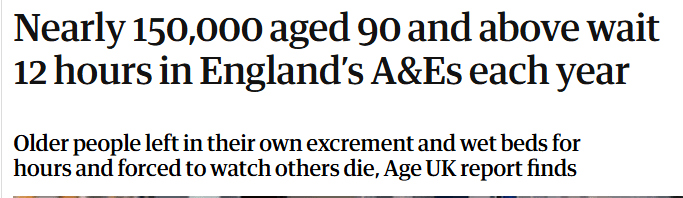
BBC UK’s Breakfast show is covering an Age UK report suggesting a corridor care crisis in ‘NHS’ hospitals and the Guardian, above, is reporting Nearly 150,000 aged 90 and above wait 12 hours in England’s A&Es each year increasing serious harm for them. NHS Scotland figures are not mentioned.
Scotland’s media today are, of course, only front-paging Andrew Mountbatten Windsor and Rachel Reeves. Age UK‘s report is nowhere on the BBC News websites.
They are unlikely to get round to the long waits for over 90’s in Scottish hospitals for this simple reason.
From a Freedom of Information request analysed by the Royal College of Emergency Medicine (RCEM) and the Royal College of Physicians of Edinburgh (RCPE), we can see that, in 2024, around 1 100 over 90-year-olds waited more than 12 hours in NHS Scotland A&E departments.
https://rcem.ac.uk/news/shocking-waits-in-scotlands-aes-foi-2024/ https://www.rcpe.ac.uk/news/51400-older-people-endured-dangerous-12-hour-waits-scotlands-aes-last-year
All things being equal then, with ten times the population, you might expect NS England to have had around 110 000 over 90s waiting 12 or more hours, but they had ‘nearly‘ 150 000, 36% more.
As for corridor care, there are no directly comparable or reliable data but an AI survey of thousands of sources across the UK was revealing. It found that media framing in English new outlets found corridor to be a year-round issue and a ‘crisis in plain sight‘ whereas in Scotland it was framed as isolated incidents and not the ‘new normal.‘
https://x.com/i/grok?conversation=1984187603701145733
Discover more from Talking-up Scotland
Subscribe to get the latest posts sent to your email.
 Talking-up Scotland
I wouldn’t be too sure about them, B.B.C Scotland News, not getting around to reporting this statistic, but only of course once they have twisted the facts to make the S.N.H.S look bad. Remember, it’s only the headline that counts.
LikeLiked by 1 person
I believe that a number of hospitals have located units for geriatric patients close to A&E and that elderly patients can be moved to these units.
However, staff in A&E have specific equipment and expertise and there might be circumstances where remains in A&E is the best action.
Given the multiple issues elderly people can often have, then it might not be appropriate to move them.
LikeLike
My father’s 93, & had a stroke around four weeks ago.
I called the ambulance, which was there within 5-10 minutes, & he was taken to hospital & in the ICU within the hour.
an hour & a half later he was stable enough for me to sit with him as he was moved into a side ward, & an hour later he was in a bed, in the acute section of the stroke ward.
Just over three hours from calling the ambulance to admission to the ward.
That is what I call service, thank you very much Scottish Ambulance Service, & all the staff at the Edinburgh Royal Infirmary.
He is now recovering at home, & doing very well indeed.
LikeLiked by 1 person
Very best wishes to you dad.
John
LikeLike
When comparing statistics on long periods spent in A&E in England with those in Scotland, it is always important to check the exact nature of the metric being used.
For NHS Scotland, it is always likely to be time spent since arrival up to admission, discharge or transfer.
For NHS England the metric in use could be the same as the latter but it could also be time spent AFTER a decision to admit has been made. There is a significant difference between these metrics and 12 hour in A&E measured from the time of a decision to admit is made is time IN ADDITION to that spent from time of arrival up to that decision.
From a quick read of the Age UK report, it’s not always clear which metric is being used: given that much of the report’s focus is on ‘corridor care’, it may be the ‘time from decision to admit’ metric. If so, the contrast between NHS England and NHS Scotland may be even more stark, in the latter’s favour.
LikeLiked by 1 person
Many expert commentators argue that long waits in A&E are caused – to a substantial degree – by delays in discharging hospital in-patients when medically ready for discharge and that this is caused by deficiencies on social care.
It doesn’t look as if the British Labour Party government in Westminster – despite its campaigning rhetoric – will bring about reform to England’s social care sector and its financial resourcing anytime soon.
The Health Foundation think tank published a blog post on October 22 entitled: ‘Social care: a year in, what prospects for reform?’
It included these statements. First for context: ‘Labour was elected on a manifesto with a headline pledge to implement England’s first Fair Pay Agreement (FPA), establish a ‘National Care Service’ and a pledge by health secretary Wes Streeting to implement a cap on social care costs and more generous means testing.’
Then this: ‘.. the timeline of policy work so far might be better described as glacial rather than transformational. It took 6 months to announce the Casey Commission. 9 months on, its modus operandi and programme remain unclear – and it will not issue its final report until 2028. What a National Care Service means in practice therefore is likely to remain hazy. Consultation on the FPA has begun but this enormous set of changes to policy, legislation and practice is unlikely to be applied to workers’ contracts before 2028. Together these timelines feel too distant for a system under acute, sustained and growing pressure. The government’s approach has an Augustinian feel – it does want to reform social care … but not yet.’ (my emphasis)
‘Then there is the money. The £4bn extra a year in 2028/29 already announced for social care in the Spending Review was better than expected given the grim fiscal context. But much of it will come out from local council taxpayers rather than Treasury coffers.’
And later: ‘Then there is implementation of the 10-Year Health Plan, where the proposed shift towards neighbourhood care will surely be impossible without adequately resourced social care.’
Doesn’t look as if the governments in Belfast, Cardiff and Edinburgh operating with only devolved powers are going to get much financial assistance from Westminster any time soon to enable much needed reform of social care – unless of course these devolved governments ‘rob Peter to pay Paul’ in their budget allocations.
LikeLiked by 1 person