

Professor John Robertson OBA
Thanks to Frances McKie for alerting us to this again, as she did in March 2025.
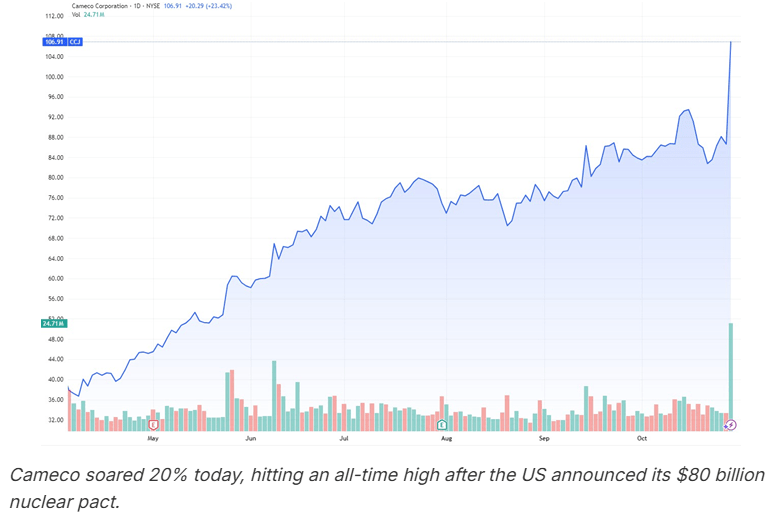
In Investing.com, two days ago, the above graph and:
When the U.S. government announced an $80 billion commitment to build new nuclear reactors, Cameco Corp (NYSE:CCJ) became the talk of Wall Street. The stock skyrocketed 20% in a single day, adding $9 billion to its value and reaching an all-time high of $106.91. Analysts gushed. Investors piled in. It was the obvious winner.
But here’s what almost nobody noticed: America is about to need far more uranium than it can get, and the companies actually building the mines to supply it are trading like the party hasn’t even started.
https://www.investing.com/analysis/the-uranium-rush-nobodys-talking-about-200669260
Why should this worry us?
Well, Labour has the very same plans to build new nuclear power stations, including in Scotland.
Where might the UK government look for that uranium?
Orkney has deposits and a Labour UK government authorised a search there in 1975.
Here’s what happened then.
In 1975, not much reported at the time, as far as I can remember, the residents of the Orkney Islands faced and fought off a dark threat. From Beyond Nuclear International in April 2021:
The Orkneys were being surveyed for a potentially valuable deposit of uranium ore. The South Scottish Electricity Board had already persuaded local farmers, unaware of the health risks, to allow bore hole drilling on their land. By 1977, the entire local population on Orkney opposed uranium exploitation there. Among those opponents was Max [The composer Maxwell Davies]. A Public Examiner was appointed to examine both sides of the case for and against uranium mining in Orkney.
The Public Examiner recommended the plan be abandoned. As Bevan, [Islander Archie Bevan] who died in 2015, recounts it, the Orkney population universally opposed the uranium plan “not only from the fear of pollution itself, with the gravest consequences for the second principal town of the islands, but also from the point of view of the psychological damage and disastrous social and economic implications of uranium extraction on Orcadian fishing, dairy farming and tourism.” 1
What was the risk to locals who might have worked in uranium mines?
There are now many high quality research reports on the risks to uranium miners but Lifetime excess absolute risk for lung cancer due to exposure to radon: results of the pooled uranium miners cohort study PUMA published in January 2024, based on seven cohorts from Canada, the Czech Republic, France, Germany, and USA, is ‘gold standard.’2
The report is highly technical and with unclear, to me, measures of the cancer death rate of uranium miners. However, it does list simply the number of miners in each cohort and the number of cancer deaths
The average, across all the cohorts, from the research data: 1 in every 15.4 miners died from lung cancer.
Let’s be sure we learn this lesson from history.
Sources:
 Talking-up Scotland
I would suggest some different lessons, maths etc. 3959 is the number of Scottish deaths **in one year**. The 1 in 15.4 value is proportion of deaths by miners. These are not comparable values. But you’ve compared them, incorrectly.
To compare them you see that there are 69,478 deaths in scotland in 2021. 3,959 makes 1 in 17.5 as the proportion. So extremely similar, not 100 times the risk.
Now ask yourself if miners smoke more than Scottish children who die etc… Because the scottish lung cancer deaths number includes ALL demographics, not just people who have worked in uranium mines.
Males for example, using the data you used to get the scottish values, had a higher incidence than women and presumeably are a greater share of the uranium miners than they are general Scottish population.
LikeLike
Thanks Anon.
You’re correct.
I must have got a bit carried away when I first wrote this. I need to slow down and think more.
It wasn’t even necessary for the case.
Best wishes,
John
LikeLike