

Professor John Robertson OBA
From Brian Goodall, three days ago on Facebook:
Babcock’s and MOD asked to think again on nuclear submarine dismantling process at Rosyth Dockyard.
This morning at a meeting of the Rosyth Dockyard Local Liaison Committee in the Dockyard I repeated my long held view that the proposed second stage of the nuclear submarine dismantling demonstrator project, that is about to start, is a stage too far, and I ask for a rethink.
The next step will see Babcock cutting out the reactor pressure vessel from the reactor compartment of the decommissioned nuclear submarine Swiftsure, in an experimental process that has never been done anywhere in the world before. This part of the submarine dismantling project has required Babcock’s to seek an increase in the limits to the levels of radioactivity they are allowed to discharge into the environment around the area.
Full text at: https://www.facebook.com/groups/595098243953732/
What is the alternative to the method preferred by Babcock and the MOD?
From Grok AI:
US approach: The entire reactor compartment (including the RPV) is cut out intact, sealed, and buried as low-level waste at sites like Hanford, Washington.
How much safer is it?
The US approach—cutting out the entire reactor compartment (RC) intact and burying it as a sealed, low-level waste (LLW) package—is substantially safer than cutting out the reactor pressure vessel (RPV) alone from the compartment. Below is a quantitative and qualitative comparison of safety margins, risk reduction, and real-world outcomes.
| Metric | US Intact RC Removal | RPV-Only Cutting | Safety Advantage (US) |
|---|---|---|---|
| Criticality Risk | ~0 (geometry fixed, fuel removed) | 10⁻⁶ to 10⁻⁵ per cut (if geometry disrupted) | >1,000× lower |
| Worker Dose (mSv/year) | <2 mSv (remote, no cutting near core) | 5–20 mSv (close-in cutting, dust) | ~5–10× lower |
| Contamination Release Risk | <10⁻⁸ per operation | 10⁻⁴ to 10⁻³ (aerosols, coolant leaks) | >1,000× lower |
| Environmental Impact | Negligible (sealed burial) | Low but non-zero (potential leaks) | >100× lower |
| Operational Complexity | Low (one lift, seal, ship) | High (precision cuts, multiple steps) | ~3–5× simpler |
Bottom Line: The US method is ~1,000× safer in terms of criticality and release risk, 5–10× safer for worker exposure, and orders of magnitude simpler.
Why the US Method Is Safer
| Factor | US Intact RC Removal | RPV-Only Cutting (e.g., UK SDP, French) | Safety Impact |
|---|---|---|---|
| 1. No Cutting Near Activated Core | No cuts within 1–2 meters of RPV. All work is remote, outside shielding. | Requires close-in plasma/torch/mechanical cutting directly on or near RPV. | Eliminates aerosolized Co-60, Ni-63, Fe-55 (major dose contributors). |
| 2. Geometry Control | Reactor internals remain in safe, fixed geometry — no risk of reconfiguring fissile material. | Cutting can dislodge control rods, grid plates, risking local criticality if water present. | US method: criticality probability ≈ 0 post-fuel removal. |
| 3. Containment Integrity | RC is a robust, pre-engineered containment (6–12 inch steel + concrete shielding). | Cutting breaches multiple barriers; relies on temporary enclosures. | US: triple containment (RPV → RC → burial overpack). |
| 4. Dust & Airborne Contamination | Zero cutting in activated zone → no airborne particulates. | Cutting generates radioactive dust (requires HEPA filtration, respirators). | US avoids ALARA violations from inhalation hazards. |
| 5. Coolant & Residual Water | RC is drained and dried before lift; no liquid pathways. | Cutting may encounter trapped coolant, tritium, or activated corrosion products. | US eliminates tritium release and steam explosion risk. |
Sources:
https://www.energy.gov/sites/prod/files/2015/09/f26/NNPP_Reactor_Compartment_Disposal.pdf
https://www.hanford.gov/files.cfm/2023_Hanford_Annual_Report.pdf
https://www-pub.iaea.org/MTCD/Publications/PDF/TE-1793_web.pdf
What are the risks to the surrounding communities?
Official sources, of course, rate these negligible but the vested interests of researchers and public research bdies funded by the state must be set against other views.
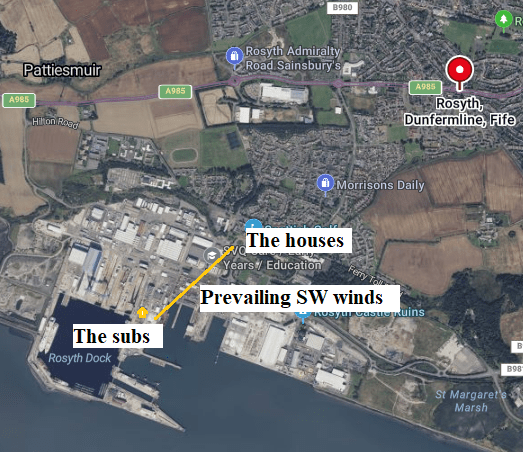
One of the radioactive elements likely to be released into the air and thus easily spread on the wind, is Tritium.
This is extremely dangerous as we have already pointed out in reference to increased releases from the active submarines in the Clyde:
Radioactive tritium emissions around Clyde nuclear sub base which ‘smash into’ your DNA, DOUBLE as cancer cases surge yet smoking rates plummet
From the CND, in January 2025:
Radioactive air emissions have been increasing year-on-year at Coulport one of Britain’s nuclear submarine bases in Scotland. This development is of some concern as it would lead to increased health risks wherever the emissions were inhaled.
Investigations by The Ferret and The National newspaper found that emissions of radioactive tritiated water vapour had doubled at the Royal Navy’s nuclear weapons storage depot at Coulport on Loch Long between 2018 and 2023. According to the Scottish Pollution Release Inventory, tritiated water vapour emissions at Coulport were 1.7 billion becquerels (units of radioactivity) in 2018, rising steadily to 4.2 billion units in 2023. Tritiated water vapour is harmful when inhaled, ingested or absorbed through the skin as its radiation causes cancer and cardiovascular diseases including strokes.
The investigation also found that eight miles from Coulport at Faslane, where Britain’s nuclear submarines are based, tritiated water containing over 50 billion units of radioactivity had been dumped into the Gareloch. The level of dumping peaked in 2020, when 16.6 billion units were discharged.
The Ferret noted that in 2019, the Scottish Environment Protection Agency (SEPA) “changed the rules to allow certain tritium-contaminated effluents from nuclear submarines at Faslane to be discharged into the Gareloch.” Both SEPA and the MoD claim these emissions are within official safety limits.
However Dr Ian Fairlie, CND’s science advisor, states that these limits are unreliable, as official estimated doses from tritium contain “large uncertainties.”
CND General Secretary Sophie Bolt said:
“From faulty nuclear-armed subs on dangerously extended patrols to crumbling nuclear waste sites, Britain’s nuclear industry is putting us all at great risk. Instead of enforcing the highest levels of environmental standards, the government is just redefining what ‘acceptable risk’ means. All so it can allow the dumping of radioactive water, putting local people at greater risk of cancer. This is beyond reckless. It’s time to scrap Trident and its replacement, and decommission the nuclear industry.”
https://cnduk.org/radioactive-pollution-is-increasing-at-britains-nuclear-bases/
At the same time Cancer incidence in the under-50s has dramatically increased.
From the Health Foundation in September 2024:
Growing numbers of adults under 50 years [more likely to be exposed at work, in education or outdoor recreation including swimming than over 50s] are experiencing a cancer diagnosis (often known as early or young-onset cancer).
This is a developing field, but evidence is mounting that rates of young-onset cancer incidence are increasing, particularly in high-income countries in the global north. A study looking at global trends focusing on 29 types of cancer in people aged 14–49 years, found incidence of these cancers increased by around 79% between 1990 and 2019, with around 3.3 million cases globally in 2019 and countries in more economically developed regions particularly affected.
In the UK, cancer incidence rates among people aged 25–49 years increased by roughly 22% between 1993–95 and 2016–18 (while incidence rates among those aged 75 years and older increased by around 9%).
Scottish Labour is, of course, committed to the Trident programme.
No doubt, someone will blame the locals for smoking-induced lung cancer but but smoking rates have been in steep decline for decades:
Smoking prevalence is similar in males and females, with a decline observed in both sexes over time; from 2003 to 2021, prevalence fell from 28% to 11% in females and from 29% to 12% in males.
The big C Cancer is the main risk from humans ingesting tritium.
Finally on the tritium now being dumped in the Clyde in billions of units. From Scientific American in 2014:
The big C Cancer is the main risk from humans ingesting tritium. When tritium decays it spits out a low-energy electron (roughly 18,000 electron volts) that escapes and slams into DNA, a ribosome or some other biologically important molecule. And, unlike other radionuclides, tritium is usually part of water, so it ends up in all parts of the body and therefore can, in theory, promote any kind of cancer.
Some evidence suggests the kind of radiation emitted by tritium—a so-called beta particle—is actually more effective at causing cancer than the high-energy radiation such as gamma rays, even though skin can block a beta particle. The theory is that the low-energy electron actually produces a greater impact because it doesn’t have the energy to travel as far and spread its impact out. At the end of its atomic-scale trip it delivers most of its ionizing energy in one relatively confined track rather than shedding energy all along its path like a higher-energy particle. This is known as density of ionization, and has been shown with the similar form of radiation called an alpha particle.
Ionization is what makes radiation dangerous for human health. Essentially, the radioactive particle smashes into the atom or molecule and pushes out an electron or other particle, leaving that atom or molecule in a charged or ionized state. These charged molecules can then cause other damage as they interact with other atoms and molecules. That includes damage to DNA, genes and other cellular mechanisms. Over time this DNA instability results in a higher chance of cancer. As a result, scientists work under the assumption that any amount of radiation poses a health risk.
Also, from a more recent research paper, Biological Consequences of Exposure to Radioactive Hydrogen (Tritium): A Comprehensive Survey of the Literature, SSRN, by researchers in the USA:
…contrary to some popular notions that tritium is a relatively benign radiation source, the vast majority of published studies indicate that exposures, especially those related to internal exposures, can have significant biological consequences including damage to DNA, impaired physiology and development, reduced fertility and longevity, and can lead to elevated risks of diseases including cancer. Our principal message is that tritium is a highly underrated environmental toxin that deserves much greater scrutiny.
 Talking-up Scotland
am thinking there’s some dodgy fuckers working for SEPA.
LikeLiked by 2 people
You could look up see who their CEO is…quite often these organisations are headed by folk who just happen to be from outwith Scotland, usually England…same in the arts re big galleries etc and indeed the sciences and top university jobs in Scotland. It’s almost as if Scotland has no qualified or experienced people to take up important positions in Scotland’s organisations.
LikeLiked by 2 people
I think CEO is Scottish but a Labour councillor previously far as I can see..hard to find out background really.
LikeLiked by 1 person
I’ve asked them so many times to intervene on the man made erosion disaster at Montrose,
time and time again they tell me the erosion here is nothing to do with them,
the environment is disappearing in front of our eyes and they are silent.
LikeLike
‘unrelated Falkirk Labour councillor Siobhan Paterson?’
Grok only found professional links.
John
LikeLike
I asked Grok for evidence of bias and got only –
There is no direct evidence of systemic anti-SNP bias within SEPA—meaning deliberate opposition to SNP policies or personnel for partisan reasons. However, multiple reports highlight operational conflicts between SEPA and the Scottish Government (led by the SNP since 2007), primarily around funding shortfalls, regulatory enforcement, and perceived under-prioritization of environmental protection. These suggest SEPA has at times challenged or been constrained by government decisions, which could be interpreted as resistance rather than bias.
LikeLike
SEPA will intervene and block a house being built if they think it might get flooded, but here at Montrose they wont intervene, despite the town at risk of destruction by the North Sea.
They are a key project partner of Angus Council’s, Montrose Coastal Erosion Project, and yet are silent on the man made disaster here.
The Scots Gov are being led up the garden path and are calling the disaster a ‘Climate Emergency’.
It’s simple common sense, that if you dredge and dump the sand that gets washed into the harbour area, into the North Sea for over 50 years, removing millions of tons of sand from the system, eventually there will not be enough sand to defend the town, well, a class of primary school children would understand that, but our very own agency set up to protect our land is silent on the issue.
LikeLike