

Professor John Robertson OBA
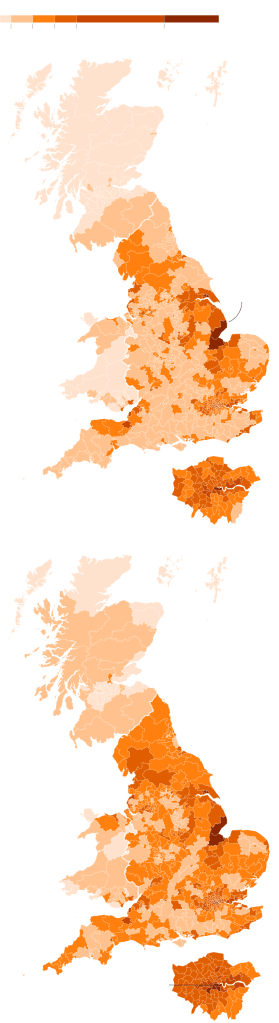
In the Guardian today, the above maps showing only two wee bits of Scotland with a 25% risk and the Highland and Borders moving up to 15%, of serious flooding by 2080. You’ll see that a huge part of England will be in deep water by then.
Nevertheless, the Guardian manages to claim:
Towns may have to be abandoned due to floods with millions more homes in Great Britain at risk Every constituency projected to be at greater risk, with many areas likely to be uninsurable, Guardian investigation finds
Millions more homes in England, Scotland and Wales face devastating floods, and some towns may have to be abandoned as climate breakdown makes many areas uninsurable, a Guardian investigation has found.
Aviva analysed every parliamentary constituency in England, Scotland and Wales to assess how vulnerable they were to flooding.
Every constituency in Great Britain is projected to have increased flood risk in future. In England, 69% of constituencies are likely to have an increase of more than 25% in the number of properties facing flood risk by mid-century. In Wales and Scotland, every area is projected to have a similar rise with many being much worse hit.
Are they looking at the same maps as me? Commonly, the Guardian totally ignores Scotland in reports on the ‘UK’. This time they’ve included us for some reason I don’t get.
Back to those two wee blobs, darkening ominously by 2080. They look to be on either side of the Kincardine bridge linking Falkirk/Grangemouth to Kincardineshire/Fife so, based on my personal memories of flooding in the dock area of Grangemouth in the early 1960s, I offer the Guardian a Scottish town that will be at serious risk of flooding by 2080 but it’ll be the only one. I remember at the time as we looked out on the flood from our first floor (lucky) tenement window in the dock area of Grangemouth, his apparent pleasure at being able to tell me that where we lived was, uniquely, below sea level. He had the same tone of perverse pride when he told me of how his regiment (KOSB) would typically take more casualties than those ‘soft’ English regiments.
I’m not worried. Why?
Well, I live up a hill and at 74 now seem unlikely to make 2080, but also we’ve been here before, in 2016, as major flooding of homes in England was desperately linked by ‘our’ media to a few cases in Scotland and supposed SNP failures.
Why are homes in Scotland not flooding despite massive rainfall?
As far back as 2006, researchers at the English College of Estates Management, whose patron was HRH Prince of Wales, made a number of highly encouraging comments about the achievements of the Labour-run Scottish Executive, SEPA and the Local Authorities:
As far as flood protection is concerned, unlike in England, the 1 in 200-year standard of protection is ‘universal’ for all new buildings, with a 1,000-year standard for such vulnerable uses as old people’s homes, schools, hospitals etc. In addition, construction in flood hazard areas has almost completely ended. Crichton (2003: 26) estimates that “the active flood management programme currently in progress will result in almost all high-risk properties being protected against the 200-year flood within the next three years, taking climate change into account.” It is also interesting to note that the Scottish Executive grants for flood defences have never been refused on the grounds of budget restraints and there is no rationing of flood defence spending.
It is clear, however, that the more stringent building standards which are applied in Scotland ensure that severe storms result in much less property damage than comparable events in England. Also, the level of flood protection and the commitment of funding to achieve flood protection are higher in Scotland than in England.’
College of Estates Management at: https://www.cem.ac.uk/media/28193/flooding.pdf
More recently, with SNP leadership, the favourable comparison still seems to hold. Published research from the esteemed Joseph Rowntree Foundation, in 2012, seems to support my first impressions quite strongly:
‘Where English planning regulations permit building in flood plains where there is no alternative, Scottish Planning Policy does not permit building in areas in which ‘the flood risk exceeds the 200-year return period’, i.e. where in any year there is a greater than 0.5 per cent probability of flooding. Scotland has stronger regulations governing the capacity of sewage and drainage systems for new building. It also has stronger minimum standards for flood defences. Building regulations ensuring flood resilience in the housing stock are more developed. Scottish planners, through Flood Liaison and Advice Groups, are engaged with local communities, the emergency services, insurers and other interested parties in drawing up flood plans. The differences in regulatory regimes between England and Scotland are reflected in the number of households that are at risk of flooding, and the resilience of communities in responding to those risks.’
The level of investment will be one factor in these differences. In recent years, spending in England and Wales has declined seriously after significant increases under Labour in 1997 to 2010, as revealed in a UK Parliament Briefing Paper from 2015:
‘Central Government spending on flood defence in 2010-11 was cut soon after the Coalition Government was formed. Spending was reduced in one year by £30 million or 5%. In the 2010 Comprehensive Spending Review (2011-12 to 2014-15), a total of £2.17 billion in central government funding was provided for flood and coastal defence. This represented “a six percent fall in central government funding”, The Committee on Climate Change calculated that this represented a real term cut of around 20% compared to the previous spending period.’
In sharp contrast, for Scotland, we see in a Scottish Parliament Committee Paper for 2014-2015, evidence of increasing investment:
‘With regard to flood protection and alleviation, the Committee welcomes the cash terms increases in the funding available to SEPA, and to the Natural Assets and Flooding budget, both of which sit in the RAE portfolio. The Committee believes that, due to climate change, severe weather events will become increasingly likely in Scotland in years to come, and it is therefore essential that flood forecasting and warning systems be as accurate and robust as possible. The Committee welcomes the increased funding for flood forecasting and warning in the RAE portfolio and recommends that the Scottish Government continue to ensure sufficient funding is available to improve flood forecasting and warning systems, to ensure greater consistency across the whole of Scotland.’
As for more recent evidence of superiority in the Scottish system, see this at the Scottish government site and little (surprise, surprise) MSM coverage of it at the time:
‘£42 million a year plan over the next decade.
More than 10,000 families are to benefit from a ten year strategy to protect homes in many of Scotland’s most flood-prone communities. The plan is the result of grant funding totalling £420 million and follows an agreement reached between the Scottish Government and COSLA. The cash will be used to deliver 40 new flood protection projects and support local flood risk management plans. More than 130 flood protection studies will be carried out to help find potential solutions for another 26,000 residential properties currently at risk. The announcement came as the First Minister, Nicola Sturgeon, fulfilled her pledge to return to Newton Stewart following an earlier visit in the aftermath of flooding at Hogmanay.’
So, unlike the UK Government, the Scottish Government has maintained or bettered the investment and the sophistication in flood prevention here. Had I been writing in 2006, the Labour-controlled Scottish Executive would have rightly claimed any credit for performance north of the border. In 2016, the SNP-controlled Scottish Parliament can do the same. Will BBC Scotland allow them to do it? They clearly didn’t in the run-up to General Election in 2016 so I doubt it.
There you have it, my attempt to shore up our defence plans against a flood of BBC bias (See what I did there, again, again?).
Sources:
http://www.bbc.co.uk/news/science-environment-37306094
http://news.sky.com/story/16312m-flood-defence-plan-an-elastoplast-say-victims-10569571
http://www.gov.scot/Topics/Environment/Water/Flooding
College of Estates Management at:https://www.cem.ac.uk/media/28193/flooding.pdf
UK Parliament Briefing Paper at: http://webcache.googleusercontent.com/search?q=cache:tGK3kUO-iKEJ:www.parliament.uk/briefing-papers/sn05755.pdf+&cd=4&hl=en&ct=clnk&gl=uk
Scottish Parliament Paper at:http://www.scottish.parliament.uk/parliamentarybusiness/CurrentCommittees/70875.aspx
Scottish Act on Control of Flood water at:http://www.gov.scot/Resource/Doc/1057/0094052.pdf
WWF Report at: http://nationalfloodforum.org.uk/wp-content/uploads/floodplanner_web.pdf
You can support Talking-up Scotland at: https://www.crowdfunder.co.uk/checkout/help-talking-up-scotland-tell-truth-about-scotland/payment/nBQxjVzq/details or by direct bank transfer method - Bernadette/John Robertson, Sort code 08-91-04, Account 12266421
Discover more from Talking-up Scotland
Subscribe to get the latest posts sent to your email.
 Talking-up Scotland
You have trained us well John, I was just reading the original Aviva report (www.aviva.com/newsroom/news-releases/2025/10/uks-iconic-landmarks-at-risk-from-climate-change-by-2050-according-to-new-report/) checking out what was actually said because you have written before about the work Scotland has done to reduce risks. I’m struggling to get too alarmed about the increased risk of surface flooding at Edinburgh Castle (do they know it’s on a hill?) and even Dumfries doesn’t get a mention despite past floods. As my elderly neighbour used to say there’ll be a lot dead before the floods get us!
LikeLiked by 1 person
Too kind Brenda
Edinburgh Castle floods? I wish
John
LikeLike
Scotland has considerably more trees than England and Wales with much more planting planned. However, NOT, as was used a couple of decades ago by tax dodging ‘celebrities’ planting woodland in the ‘Flow Country’ of Caithness and Sutherland. This is natural bog which is very good at controlling carbon dioxide and flooding. Such land must not be used by ‘developers’.
Glasgow has the ‘Smart Canal’ system which uses the Forth and Clyde Canal to store water at times when there are high tides in the Clyde.
LikeLiked by 1 person
Great job.
LikeLiked by 1 person
There is probably no doubt that flooding will occur in the lowland areas of Scotland. Professor T C Smout, in his book on the Firth of Forth, describes the Laurentide ice sheet that covered Canada and parts of the USA, when it melted there was a rush of water on the west coast.
LikeLike
There is probably no doubt that flooding will occur in the lowland areas of Scotland. Professor T C Smout, in his book on the Firth of Forth, describes the Laurentide ice sheet that covered Canada and parts of the USA, when it melted there was a rush of water on the west coast.
LikeLike
There is probably no doubt that flooding will occur in the lowland areas of Scotland. Professor T C Smout, in his book on the Firth of Forth, describes the Laurentide ice sheet that covered Canada and parts of the USA, when it melted there was a rush of water on the west coast.
LikeLike
There is probably no doubt that flooding will occur in the lowland areas of Scotland. Professor T C Smout, in his book on the Firth of Forth, describes the Laurentide ice sheet that covered Canada and parts of the USA, when it melted there was a rush of water on the west coast.
LikeLike
There is probably no doubt that flooding will occur in the lowland areas of Scotland. Professor T C Smout, in his book on the Firth of Forth, describes the Laurentide ice sheet that covered Canada and parts of the USA, when it melted there was a rush of water on the west coast.
LikeLike
Gotcha
LikeLike
This resulted in Loch Lomond becoming a sea loch and the North Sea was only about ten miles from the Clyde. Whale skeletons were discovered further up the river than Stirling, at least 16. Could we be flooded again, absolutely but it may take a few thousand years so no need for us auld yins tae panic.
LikeLike
mibbes England should introduce beavers to create natural river dams allow the flow to slow down through and create the natural wetlands instead of rushing it down through the river track and overflowing.
This would encourage trees to grow and soak up the moisture in the ground too.
it all helps
LikeLiked by 2 people
there’s a major problem at Montrose, the town is under threat from the North Sea, the problem is well known, but the Scots Gov and it’s advisory bodies are trying to pin the blame on Climate Change.
Here’s what AI has said.
The long-term erosion at Montrose Bay, driven by ongoing dredging for the port, is a clear example of a coastal system that is both dynamic and in a state of sustained disequilibrium due to human interference. The normal dynamic processes of the bay have been fundamentally and continuously altered, preventing it from reaching a new, stable equilibrium.
How dredging at
Montrose Port created sustained disequilibrium
The core problem lies in the disruption of the bay’s natural sediment budget—the balance between sediment coming in and sediment leaving the system.
The consequences of chronic disequilibrium at
Montrose
This prolonged state of disequilibrium has had severe consequences for the bay and the adjacent town, moving beyond natural coastal dynamics to a chronic problem of erosion and flood risk.
The difficult search for a new equilibrium
The Montrose case shows how human activity can create a problem that is difficult to fix, even with significant investment.
LikeLike
or:
Full report at: https://parkswatchscotland.co.uk/2023/10/27/storm-babet-the-angus-grouse-moors-and-the-flood-destruction-in-brechin/
LikeLiked by 1 person
aye the grouse beaters, have contributed to the Brechin flooding, the skies over Angus were black wi reek coming from the burning heather last week.
the main cause tho at Brechin is the shingle build up in the river and the river itself only half the width it was 100 years ago, and that is not being addressed by the Scots Gov and their so called experts.
LikeLike
Not that I am an expert. But is Scotland not slowly rising due to having being compressed during a long ice age. Whereas, England is slowly tilting the other way?
In the short term, the introduction of wild beavers seems to be a sensible way forward as well as diverse woodlands.
LikeLike