


Professor John Robertson OBA
I asked the Elicit AI for scientific research which claims to help researchers be 10x more evidence-based:
How dangerous is it to live 5km from a nuclear power station?
After more than 5 minutes, it responded:
Studies show mixed results on living within 5km of nuclear power plants, with some European research finding roughly doubled childhood leukemia risk while studies from other regions generally show no significant overall cancer risk.
Which regions?
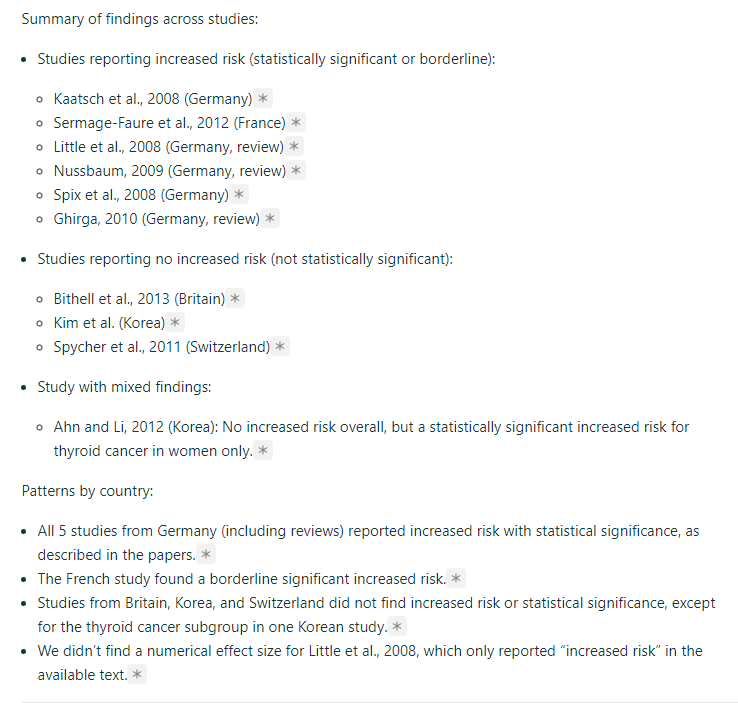
This is stark. Why do 5 German research groups all find statistically significant risks to health in living within 5km of a nuclear power station and why is there only one recent British study and it finds no risk?
I take it no one thinks German nuclear power stations were intrinsically more dangerous than British ones and so the only tenable explanation is that German researchers, where nuclear energy production is no longer government policy, are more free of the inhibitions making it difficult for those in Britain and France, where it is still policy, to present research findings that might undermine the industry. That Britain and France also maintain nuclear weapons dependent on having nuclear power stations to produce plutonium and tritium, will be a powerful presence in the minds of those directing research there.
Now, that the Germans find risk and the others do not does not leave the matter unresolved. It means that living within 5km of a nuclear power station is dangerous and that you cannot trust British or French researchers to have the courage to apply methods that might reveal that.
Discover more from Talking-up Scotland
Subscribe to get the latest posts sent to your email.
 Talking-up Scotland
I listened to a discussion on Radio 5 Live the other day about the proposed Small Modular Reactor for Anglesey and the nuclear expert invited to participate was a university professor who was beside himself with excitement about the huge employment opportunities for the UK which would become a ‘world leader’ in supplying these SMRs, according to him.
Not only would thousands of jobs be created in the industry itself but in the factories springing up ‘all over the UK’ required to build the modules to house the reactors for domestic use and export.
At no time did he discuss the dangers to human health or the environment, and only at the end of the piece was the subject of waste brought up. He seemed not too phased or particularly interested, I thought. It will require to be buried deep underground, but, naturally, no one knows where yet. We shouldn’t worry our wee heads about that, I suppose. He was asked about the true final cost of these projects and how long it would really take given Britain’s track record on ‘major projects’, but his focus was on the ‘opportunities’ for local economies.
According to the journalist also contributing, the only person not happy about this is, it seems, the US Ambassador because the development work and supply will be by Rolls Royce and not Westinghouse. Oh dear.
I should say I am not an expert on any of this, simply picking up bits of info here and there.
No one ever talks about the dangers of mining for the raw materials for nuclear projects. Does anyone have any info or statistics or even care?
J & J
LikeLiked by 1 person
Interesting conflict of interest for British researchers. The Atomic industry has a track record of lying. When Salter wanted to create wave power with his “ducks” after research at Edinburgh University the British Government allowed the Atomic Industry to evaluate it and they simply altered the numbers to show it was too costly.
The grant making body failed to pay out the research grant.
Salter’s duck – Wikipedia
Over 50 years later…
LikeLike