


With only 2 days left, support Talking-up Scotland's work to counter the lies and get you the facts, daily, at: https://www.crowdfunder.co.uk/checkout/help-talking-up-scotland-tell-truth-about-scotland/payment/nBQxjVzq/details or by direct bank transfer method - John Robertson, Sort code 08-91-04, Account 12266421
Professor John Robertson OBA
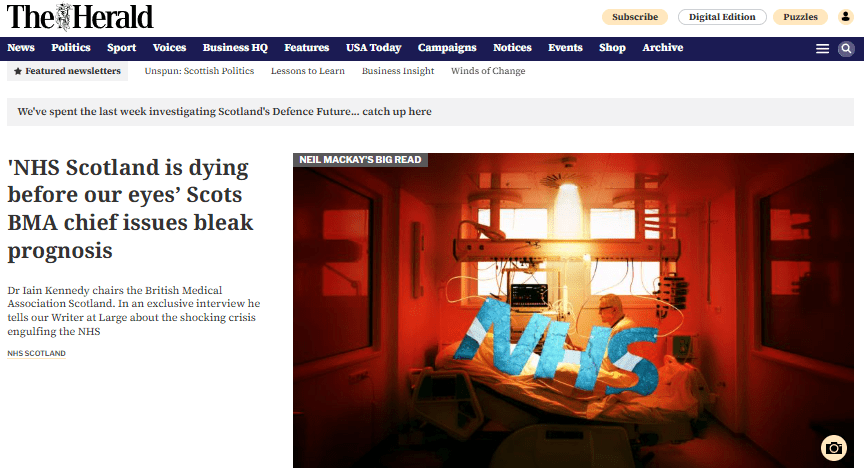
In an NHS demonstrably superior, on almost every count, than that in which the BMA UK has to operate, Dr Iain Findlay of the Scottish branch peddles the same lies. I’ll come back specifically at these later but first on the strange phenomenon of a union whose HQ praises the Scottish Government but whose Scottish branch head regularly lies about the situation here.
In June 2025 stewartb wrote
The BMA may be a more serious, objective trade union than its lead in Scotland – based on his highly politicised statements using language designed for use in headlines by mainstream media opposed to the present Scottish Government – makes it appear!
Below are some of its analysis and insights on the state of NHS England. Not a positive picture but even. so I can’t find a BMA spokesperson claiming that NHS England is ‘dying’ – and for the avoidance of doubt, England has long had a substantial number of people using private healthcare, a number which is increasing (see market data from the Private Healthcare Information Network’s website.)
BMA (April 10, 2025) ‘NHS backlog analysis’ (See the BMA.org website.):
‘The backlog in secondary care consists of the care that the NHS would normally have delivered but which was disrupted as COVID-19 impacted service delivery.’ And: ‘It will take years to clear the backlog. The ongoing need for stringent infection prevention control measures and workforce shortages mean it will take even longer to work through as demand continues to rise.’
On consultant-led elective care: ‘High waits for treatment are not new. Prior to the pandemic in February 2020 there were already 4.57 million cases on a waiting list for consultant-led care. At the beginning of the pandemic, the combination of suspension of non-urgent services and changes to individuals’ behaviour meant that the number of people joining the waiting list initially dropped. However, this has since been rising – and despite some improvements earlier in the year, waiting times remain far higher than pre-COVID.’
On cancer treatment targets: ‘The percentage of patients receiving their first cancer treatment within two months (62-days) of an urgent referral decreased from 71.4% in March 2025 to 69.9% in April 2025. This is significantly below the operational standard of 85%. NHS England aims to reach 75% performance against the 62-day target by March 2026.
‘The poor performance against these key operational standards illustrates the level of pressure the system is under, and is a clear sign that significant investment in capacity is needed. ‘
On A&E waits: ‘The number of patients waiting over 12 hours for an emergency admission in May 2025 was about 103 times higher than in May 2019 – pre-pandemic. Note that this number represents an underestimate of actual waiting times, as patients will have been waiting for additional time before a ‘decision to admit’ was made.
‘These long waiting times are, in part, due to poor patient flow. General and acute bed occupancy has consistently been at over 90% since September 2021, and patients regularly remain in hospital despite being fit for discharge because there is no capacity for them in social care.’
On GP referrals: ‘The number of GP referrals to consultant-led outpatient services that have been unsuccessful because there are no slots available has jumped from 238,859 in February 2020 to a staggering 401,115 in November 2021 (an 87% increase).’ – I’ve never come across this particular metric before!
The role of the private sector: ‘ Enlisting the help of the private sector is one of the measures the (UK) Government has taken to reduce pressures on hospitals and help cut waiting lists.
‘The extent to which private hospitals will be able to take on NHS waiting list initiatives going forward is unclear given the increased demand in the self-pay market and the backlog of private sector patients.
‘Given that the NHS and the private sector largely draw on the same pool of doctors, additional capacity may be less than it initially appears. This was made clear in the 2020 block-booking arrangements, which saw the NHS gain facilities rather than the workforce to run them.’
From the BMA (January 2025) ‘NHS diagnostics data analysis’ – providing an analysis of the diagnostic pressures in the English NHS.
‘Demand for diagnostics services is on the rise, but a lack of infrastructure combined with staffing shortages has contributed to vast waiting lists.’
And: ‘In November 2024, around 1.6 million people in England were waiting for a diagnostic test, twice as many as in January 2006 (0.8 million), when this dataset began. This waiting list has been growing steadily since 2008, well before the start of the COVID-19 pandemic.
‘People are also waiting longer for tests. The NHS constitution states that patients referred for diagnostic tests should receive a test within six weeks, yet this target has not been met since February 2017.’
And: ‘Community diagnostic centres are no silver bullet’ – ‘Given existing workforce shortages, it is clear that running these centres requires more diagnostic staffing than is available. There is also a risk of redistributing workload across the same stretched workforce, if staff are moved from hospitals to diagnostic centres. Any workforce plans must also ensure that staff are well-integrated across all sites.‘
Notwithstanding the above evidence, there is a key difference in how the BMA’s communications via the mainstream media operates in Scotland compared to other parts of the UK. (The status of the NHS in NI and Wales would on the same set of metrics be at least if not much more ‘problematic’!)
The organisation’s lead in Scotland has a long track record – exposed here multiple times on TuS – of alarmist statements, devoid of context, perspective or comparative analysis of NHS Scotland’s performance relative to the NHS in the other parts of the UK. The statements of the BMA’s lead in Scotland, typically negative, are eagerly picked up by BBC Scotland and other pro-Union mainstream media outlets as useful additions to what is candidly, their gaslighting of Scotland.
Discover more from Talking-up Scotland
Subscribe to get the latest posts sent to your email.
 Talking-up Scotland