

With only 7 days left, support Talking-up Scotland's work to counter the lies and get you the facts, daily, at: https://www.crowdfunder.co.uk/checkout/help-talking-up-scotland-tell-truth-about-scotland/payment/nBQxjVzq/details or by direct bank transfer method - John Robertson, Sort code 08-91-04, Account 12266421
Professor John Robertson OBA
This morning, the Scotsman and the Metro are feeding BBC Scotland with the idea based on the emergency doctors’ trade union report, the RCEM, that long A&E waits are ‘associated with’, ‘costing‘ and the ‘toll‘ from stays of 12 hours and more. Only BBC Scotland has this headlined.
As always there’s a basic flaw in their argument – the number waiting 12 hours or more in Scotland’s Type 1 A&E departments is falling!
Media coverage of waiting times in Type A&E departments tends to focus on longer term trends where, inevitably, there has been a worsening picture, in every part of the developed world and which is due to multiple, not fully understood, factors such as changing patterns of patient behaviour and expectations, in GP behaviour and in background socio-economic factors such as austerity and drug abuse. Hospitals do not have the power, the influence nor the resources to turn these long term trends around on their own.
There is little point harping on about A&E not matching percentages from years ago and in different times.
What we can do is look at medium term trends to see if these are still worsening or improving to assess whther the efforts within the NHS are working.
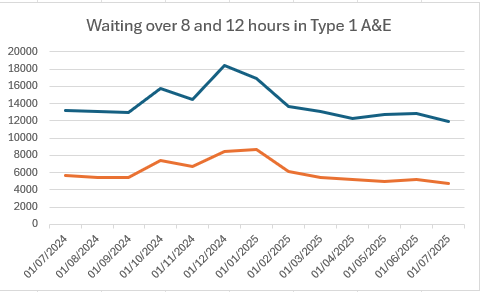
In NHS Scotland, we can see that the numbers waiting more than 8 and 12 hours have been improving. Seasonal variations such as the winter peaks are simply to be expected. What is clear is that fewer are waiting more than 8 and 12 hours in the summer of 2025 than in the summer of 2024.
In July 2024, for example, 13 247 waited more than 8 hours while 5 630 waited more than 12.
In July 2025, by contrast 11 928 waited more than 8 hours, 9.95% fewer , and 4 686 waited more than 12, 16.7% fewer.
For one year improvements, these are visible as steady in the graph, significant, especially the 16.7%, and worthy of media recognition.
They won’t get it.
Why is only BBC Scotland covering this when long waits are FOUR times more common in England?
From A&E activity: month ending 30 May 2025 published today:
There were 28,382 attendances at type 1 departments in NHS Scotland (compared to 27,560 the previous week, and 26,833 weekly average for 2024).Attendances of under 4 hours
19,160 (67.5%) of type 1 attendances were seen and resulted in a subsequent admission, transfer or discharge within 4 hours (compared to 18,367 (66.6%) the previous week, and 17,357 (64.7%) weekly average for 2024).Attendances of over 8 hours
2,852 (10%) patients spent more than 8 hours in a type 1 Department (compared to 3,108 (11.3%) the previous week, and 3,364 (12.5%) weekly average for 2024).Attendances of over 12 hours
1,104 (3.9%) patients spent more than 12 hours in a type 1 Department (compared to 1,204 (4.4%) the previous week, and 1,490 (5.6%) weekly average for 2024). https://www.publichealthscotland.scot/healthcare-system/urgent-and-unscheduled-care/accident-and-emergency/main-points/emergency-departments/
The above reveal increased attendance yet reduced numbers waiting, for each of the three waiting times measures – improved performance across the board.
In NHS England for the same period, also in Type 1, only 61.2% were treated within 4 hours. https://www.england.nhs.uk/statistics/statistical-work-areas/ae-waiting-times-and-activity/
This 6.3% difference, 10.3% better than 61.2%, means around 2 800 Scots were treated within 4 hours who would not have been had NHS England standards applied here and around 280 000 in England would have been been treated within 4 hours in England, had NHS Scotland standards applied there.
NHS England does not publish 8 hour data but 42 891 waited more than 12 hours, 40 times in crude terms, 4 times per head of population than the 1 104 in Scotland
How did Scotland’s media cover the above? They ignored it. STV used the one-week figures at the end of May to offer this – Scottish Government under fire over ‘swelling’ queues in A&E!
 Talking-up Scotland
last summer, partner had an allergic reaction to a bee sting. We went to local community a n e. They treated then an ambulance onto forth valley hospital AnE.
We waited patiently, periodically checked by nurse. Emergencies came through and straight into treatment. Everyone was triaged. Non emergencies appeared and were treated or left with appropriate advice.
We were there for 10 hours or so, but that was the time required to ensure no adverse reaction. Consultant approved release along with medication for future issues and letter for GP.
All NHS Scotland staff were professional, supportive, looking after everyone in AnE. Would not wish anything else.
dottieb
LikeLiked by 2 people
Good to see this ‘A&E crisis’ only in Scotland being called out on TuS.
There is so much more that could be written about the Royal College of Emergency Medicine’s (RCEM) statement on long waits in NHS Scotland’s emergency departments and their impact, and on the mainstream media’s coverage of this today.
And then there is the MSM’s amplification – without any critical appraisal – of quotes from the Tory Sandesh Gulhane and Labour’s Jackie Baillie.
From the BBC News website, the Independent online and no doubt other news outlets today (September 23) we read:
From Gulhane: ‘‘Scottish Tory health spokesman Dr Sandesh Gulhane said government ministers should “hang their heads in shame”. “These completely avoidable deaths are the direct result of the nationalists’ abject failure to meet their own A&E targets,” he said. “Frontline staff are working flat out for their patients, but they’ve been failed by successive SNP health secretaries who still haven’t come up with a credible plan to address this national emergency.”
The waiting times performance data of emergency departments in England when the Tories governing in Westminster were responsible, are readily for inspection. They show a substantially poorer performance by NHS England over years than that of NHS Scotland!
Baillie: ‘the “damning analysis lays bare the true cost of SNP failure”and “For years Scots have been dying as a result of dangerously long waits in A&E, but the SNP has stood idly by while this crisis ran riot” and “The SNP has no idea how to fix this crisis and our NHS cannot afford a third decade of this incompetence.”
The waiting times performance data of emergency departments in Wales where Labour have long been the responsible government are readily available for inspection. They show a substantially poorer performance by NHS Wales over years than that of NHS Scotland!
Candidly, the mainstream media is complicit in enabling Tory and Labour hypocrisy.
There are real challenges facing the NHS and its A&E performance across the UK. The mainstream media are only too keen – as arguably is the RCEM too – to highlight the performance of NHS Scotland but without context and without perspective that would reveal its relatively MUCH better performance than its peers in England, Wales and NI.
The mild response of the Scottish Government – the complete absence of a response from NHS Scotland health boards – to all this negative coverage about A&E services targeted on Scotland is to say the least, inadequate. The SNP leadership must surely realise that Labour and others will seek to exploit the NHS in the 2026 election campaign, with news media’s support. It (somehow) needs to get on the front foot to counter the dominant, negative framing.
LikeLiked by 2 people
The BBC Scotland website today also covered the RCEM report, but their focus was on the figures for excess deaths in Scotland.
“The college (RCEM) therefore estimated 818 excess deaths were recorded for people waiting more than 12 hours.
This is equal to about 16 deaths a week.”
The same BBC article failed to make a comparison with England.
Here’s why 👇
The RCEM published their figures for England on 15 May 2025
https://rcem.ac.uk/news/each-a-dearly-loved-family-member-excess-deaths-linked-to-long-ae-waits-increased-to-over-16600-last-year/
“Using the Standard Mortality Ratio – a method which calculates that there will be one additional death for every 72 patients that experience an 8–12-hour wait prior to their admission – RCEM estimates that there were 16,644 associated excess deaths related to stays of 12 hours or longer before being admitted.
That’s the lives of 320 people lost every week.”
England would have approximately double the rate for Scotland per head of population based on those figures.
LikeLiked by 1 person