


When the otherwise excellent Open Democracy seems to have swallowed the myth, much loved by Anas Sarwar, that Covid 19 deaths in care homes were the result of hospital discharges of untested patients into them, you know the campaign to turn around the story of Scotland’s better pandemic performance, is well on the way.
Yesterday, they had:
Care home deaths soared as Holyrood took two months to introduce testing for outgoing hospital patients, inquiry hears.
Donald Macaskill, the chief executive of Scottish Care, which represents the country’s independent social care sector, said he warned the then-secretary for health and sport, Jeane Freeman, about the need to test outgoing hospital patients for Covid in late February 2020.
At the time, guidance from Health Protection Scotland, part of Public Health Scotland, said patients set to be discharged to care homes should be subject to a clinical assessment. It was not updated to state that patients admitted to care homes should be tested until 21 April 2020.
There were 4,193 deaths registered in Scotland where Covid was mentioned on the death certificate between 16 March and 19 July 2020. Almost half of these deaths (47%) related to care homes, according to the National Records of Scotland.
https://www.opendemocracy.net/en/covid-care-homes-scotland-inquiry-test-hospital-patients-discharge-deaths/
The report is poorly researched.
First, the major cause of care home deaths?
The charitable MHA with a presence in Scotland did research into its own homes and discovered this: Large numbers of staff could have been unknowingly spreading coronavirus through care homes, according to the UK’s largest charitable care home provider. Data from MHA shows 42% of its staff members who recently tested positive were not displaying symptoms. Nearly 45% of residents who had a positive test were also asymptomatic. The MHA Chief Executive said: I think it’s very difficult not to see that the only real way that this can have come into our homes is through staff picking it up, just through the community contacts they would have had. I think that is what is so hard for all our staff, because they care. But if they don’t know they’ve contracted the virus, how can you manage this?
https://www.bbc.co.uk/news/health-52912538
An ONS study of 9 081 care homes in England found this: These emerging findings reveal some common factors in care homes with higher levels of infections amongst residents.These include prevalence of infection in staff, some care home practices such as more frequent use of bank or agency nurses or carers, and some regional differences (such as higher infection levels within care homes in London and the West Midlands). There is some evidence that in care homes where staff receive sick pay, there are lower levels of infection in residents.
https://www.ons.gov.uk/peoplepopulationandcommunity/healthandsocialcare/conditionsanddiseases/articles/impactofcoronavirusincarehomesinenglandvivaldi/26mayto19june2020#main-points
Former BBC Scotland Head of News, John Boothman, now at the Times, wrote: HC-One, Britain’s largest care home chain and the operator of Home Farm, faces allegations that it paid insufficient heed to the [Scottish] government’s lockdown by parachuting workers in from as far away as Kent, 645 miles away, to plug staff shortages in a sector where pay is notoriously poor.
https://www.thetimes.co.uk/article/coronavirus-kills-six-and-leaves-dozens-seriously-ill-at-skye-care-home-3g70vxbf6
Second, the comparative rate of care home deaths?
Discharges from hospitals to care homes, in Scotland, were made by professionals in both locations with a view to saving lives. The Scottish Government did not interfere other than to remind care homes of their longstanding responsibilities to protect residents by implementing the isolation procedures they should have had ready after decades of flu outbreaks.
The Scottish health secretary, contrary to her English equivalent, ensured earlier vaccination in care homes, in line with the JCVI guidance, to do so before all other groups and, consequently achieve a far lower death rate:
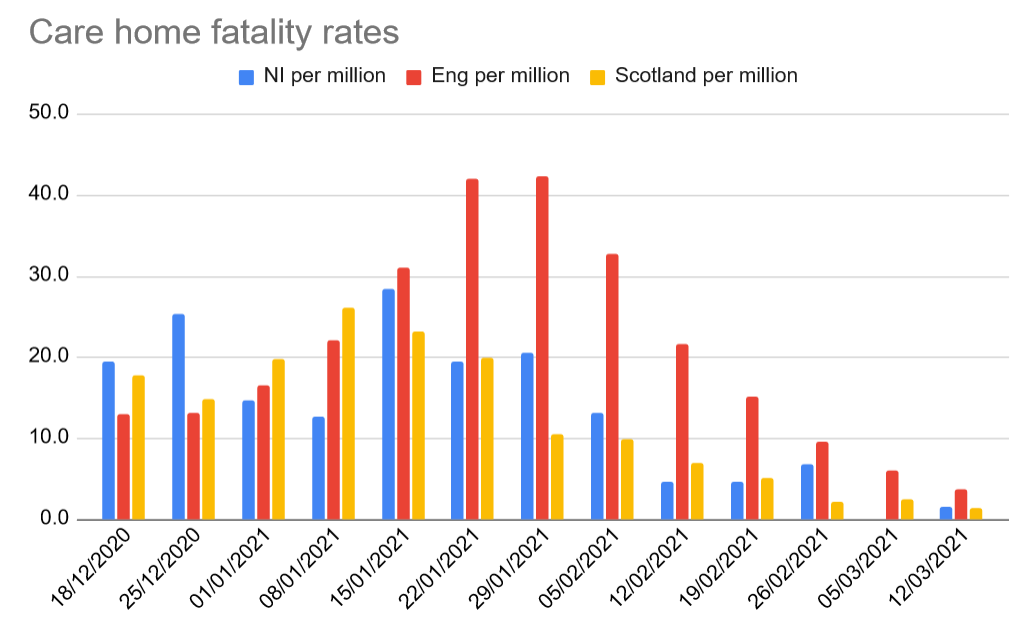
The above graph revealing starkly the cost in lives of the failure in England to fully implement the JCVI guidance and vaccinate care home residents before all other groups was compiled by Na Sirf Musiqi https://twitter.com/nasirfmusiqi from official sources.
It’s a story never told on MSM. It’s a far greater sin than wasting money on wallpaper.
This shows the impact of the vaccinations as the began to confer immunity on many in Scottish care homes from the middle of January 2021:
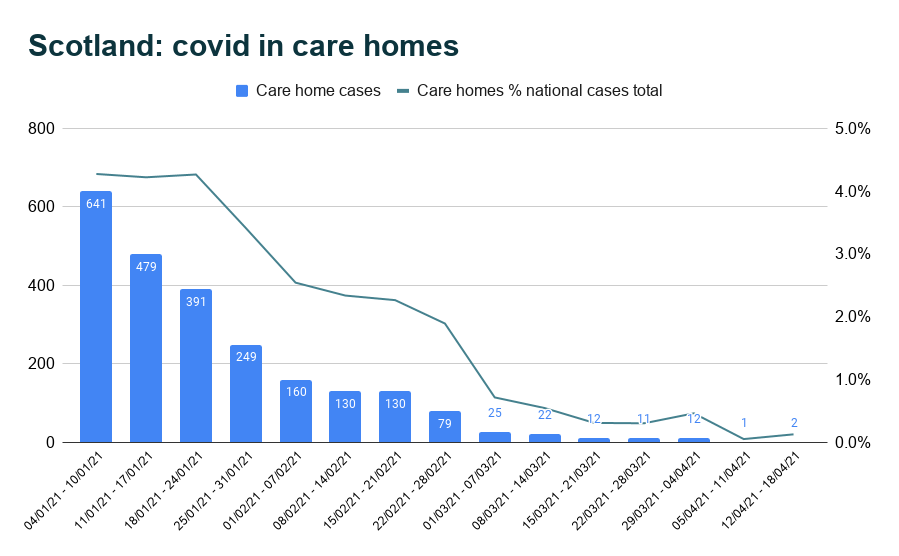
The contrast was stark in the first few months:
From the 1st of January 2021 until the 26th February, 9 088 care home residents in England died from confirmed Covid-19.
From the 1st of January 2021 until the 28th February, 532 care home residents in Scotland died from confirmed Covid-19.
England has ten times the population so pro-rata might have been expected to have ten times as many deaths, 5 320, but had around 3 700 more.
Had NHS England, followed the JCVI advice and vaccinated care home residents as a priority above all others, 3 700 lives might have been saved.
Who told them not to follow the JCVI advice? Who told NHS Scotland to follow it?
We know. Will the UK media tell everyone else?
Sources:

 Talking-up Scotland
It was entirely predictable that the Scottish media and the unionist politicians would attempt to frame things as the fault of the Scottish Government.
I was disappointed by the article in open Democracy. It is the kind of thing that self proclaimed ‘progressive, north London people perceive ‘the provinces’.
During the pandemic, BBC Scotland started platforming a health researcher in a Queen Mary University, London, who was clearly not au fait with the fact that Scotland has its own NHS and governance and was speaking in UK/England terms. She was chosen because people like Devi Shridhar and Lind Bauld were not saying what the BBC wanted.
Alasdair Macdonald
LikeLiked by 7 people
I wouldn’t criticise them for reporting on what Mcaskill said in evidence to the Inquiry, there appears to be an orchestrated news control on the go using BBC Scotland as the conduit to fill news feeds stories preferred, and limiting what is preferred not circulated.
The BBC Scotland “Scottish government criticised over care home Covid policy” is a wholly misleading summary to many hours of evidence given to the Inquiry, but being first on ‘the wires’, this framed how the National then followed.
eg – With Lesley Fraser’s evidence today, BBC Scotland’s latest headline is “Scottish government’s WhatsApp deletion policy is questioned”, yet what is being discussed is more far more wide ranging than ‘Did Nicola behave as Boris…’ as inferred by the headline…
LikeLiked by 4 people
Thanks for covering this John, this part of the inquiry is fascinating to listen to especially since readers here will be well aware of some public editing of which facts are relevant
I felt Donald Macaskill made many good points highlighting the particular nature of social care work and the difficulties of applying clinical conditions to what are of necessity less formal residential settings with residents often confused and unable to adhere or understand covid restrictions I would have liked him to be questioned on the tension between covid testing and an individuals ability to consent to this as I do remember Nicola addressing this several times. I think there was also a discussion about discharging elderly patients from hospitals where they would likely be more exposed to infection risks with the assumption care homes had more facility to offer private rooms. His evidence did I think strongly indicate issues such as low pay, work force capabilities, the structure and purpose of social care etc need to be addressed in any changes to care provision
I can also understand his points about feeling social care was judged and blamed for excess deaths and the difficulties an enhanced programme of scrutiny and clinical oversight – the reality that social care provision was neither respected, understood or valued can be exacerbated by unrealistic expectations and top down decision making. But the role of profit making private providers is not tackled nor the difficulties re the state’s role in how such provision should be managed. Maybe the best conclusions to draw from this evidence are that all parties made mistakes. the nature of social care contributed to excess deaths rather than the failings of individuals and that all this needs to feed into a radical overhaul of future social care provision
brobb
LikeLiked by 3 people
I agree Macaskill made good points, but the problem is not what the Inquiry heard rather than what the media present from among his evidence heard by the Inquiry.
IMHO Donald was wrong in his retrospect testing was quite so up to speed or accuracy at the time of the order, far from it – When the balloon went up and this emergency strategy and legislation emerged from London’s ‘experts’ it threw both SG and the Care-Homes sector into totally alien terrain with no manual to work from.
I’m not in the slightest criticising the ‘experts’ who derived their best assessment of solutions at the time, nor SG nor the NHS nor the Care-Home sector in attempting to reconcile the strategy – The purpose of the Inquiry is to learn lessons from the experience, not to play the blame game with which BBC Scotland particularly appear obsessed.
eg WhatsApp messages ? Seriously ?
LikeLiked by 2 people
Good to know you and I are part of the 300 people currently tuned in, I really am finding the inquiry compulsive viewing
The BBC (and wider MSM) were always going to look for the negatives just as they do with every report that risks presenting the Scot Gov in a good or better than England light. At least though we have a wealth of material here to challenge what they say whether we do this by comments here, radio phone ins, letters to papers or on social media. I know John gets the occasional guest spot on broadcastscot and caledon radio, there may be other new sites available elsewhere. Complaints to BBC seem pointless but maybe necessary if anyone can face it. We can’t compete with the MSM might and reach but we can keep chipping away
As for whatsapps, the BBC will be gutted they have no salacious titbits so far as reliance on tabloid type tittle tattle sums up their general approach to journalism. At least the civil servant this morning did a reasonable job at explaining how these were generally used and why deleted to take the hype out of the issue, rather than leaving minsters to waffle on about lost phones.
What did you think of the 2 trade union reps evidence this week? I thought Roz Foyer came across well but that the questions for Nicola Bailey (?) were very loaded towards SNP bad
brobb
LikeLiked by 3 people
Agreed
LikeLiked by 1 person
On the subject of testing. The UK developed a test early on and PHEng was in charge of the testing. They wanted all samples from Eng, Wales, Scot and possibly NI sent to their labs in England. I had the feeling that they were unaware of the lab set up in Scotland and thought it was like England where private labs have made inroads into testing of samples from NHSE. In Scotland it is still the case that testing is carried out in NHS labs which have to go through a very strict and rigorous accreditation process in order to test NHS samples.
After much toing and froing PHE agreed to distribute the Covid test kits to labs in Scotland – the Regional Virus lab in Glasgow and its counterpart in Edinburgh were the designated labs in Scotland. Testing in these labs in Scotland began around the 19th Feb or just after BUT any positive samples had to be sent to PHE lab for confirmation.
Community testing was ended on March 12th. By the end of April PHE was advising labs to buy commercial test kits. At various times there had been problems getting reagents for the UK developed test.
LikeLiked by 3 people
I accept your point/s, but we are still talking early days of the ‘Care-home’ plan having been delivered to be delivered, NE England and Wales had precisely the same problem – The NHS were struggling for tests for even the most at risk personnel, it is not as if tests were what they became, either in terms of simplicity of availability.
LikeLiked by 1 person
HC-1 and Kent stood out for me.
We had 10 deaths in our local care home, was HC-1 now SNHS, a couple of staff members told me that it was a HC-1 worker from Kent, brought in as relief staffing, that infected the old folk. Her mask hanging off her chin, even though she was constantly coughing.
Devastating for a small community.
Alan
LikeLiked by 3 people
A Public Health Scotland publication from 21st April 2021
“Discharges from NHS Scotland hospitals to care homes
Between 1 March and 31 May 2020”
https://publichealthscotland.scot/publications/discharges-from-nhsscotland-hospitals-to-care-homes/discharges-from-nhsscotland-hospitals-to-care-homes-between-1-march-and-31-may-2020-revised/
Main points
“Between 1 March and 31 May 2020, there were 5,198 discharges from NHS hospitals to care homes (4,804 individuals), this accounted for 5.3% of all hospital discharges during the same period.
There were 843 (77.8%) of the 1,084 care homes in Scotland that received hospital discharges between 1 March and 31 May.
Using laboratory confirmed cases, 348 (32.1%) care homes in Scotland experienced an outbreak of COVID-19 in the home between 1 March and 21 June.
In the statistical modelling analysis (see tables 10 and 11 for detailed commentary):
Hospital discharge is associated with an increased risk of an outbreak when considered on its own. It is important to note that after accounting for care home size and other care home characteristics, the estimated risk of an outbreak due to hospital discharge reduces. No statistically significant association was found between hospital discharge and the occurrence of a care home outbreak. However, due to the uncertainty observed, we cannot rule out a small effect, particularly for those patients who were discharged untested or discharged positive.
Care home size is much more strongly associated with the risk of an outbreak than other care home characteristics, including the different types (negative test, untested, positive test) of hospital discharge.
There were 106 people (who had a total of 110 discharges) where the last test for COVID-19 before hospital discharge to a care home was positive.
For these 106 people:
There were 80 people discharged to care homes with an existing outbreak of COVID-19, where the discharge could therefore not have caused the outbreak.
There were 7 people discharged 15 or more days after their first positive test for COVID-19, who would not be considered at risk of onward transmission of infection.
There were 9 people discharged to care homes which did not experience an outbreak of COVID-19.
There were 10 people discharged where the hospital discharge and care home outbreak showed an association in the timing of the hospital discharge and care home outbreak which required further review using viral genomic sequencing.
Mortality is high among people discharged to care homes, with 675 people dying within 30 days of discharge (14.1% of all of those discharged), COVID-19 was associated with 21.6% of deaths within 30 days of hospital discharge.
In the 30 days after their hospital discharge to a care home, 154 people tested positive for COVID-19 (3.5% of all people discharged who had not previously tested positive).
Viral genomic sequencing analysis was only possible for eight hospital discharges where the timing of discharge and outbreak was potentially consistent with the discharge causing introduction of infection. The findings are not consistent with hospital introduction of infection in the care homes examined. However, only a small proportion of outbreaks could be examined.”
LikeLiked by 2 people
Thanks Cuckooshoe, a little perspective goes a long way. Let’s not forget also just who exactly were screaming at and demanding from the SG those discharges to take place and the of course the reason why, to free up hospital beds.
Golfnut.
LikeLiked by 1 person
I see BBC Scotland is still promoting it’s ” UK Covid inquiry: Nicola Sturgeon’s Covid WhatsApp messages ‘all deleted’ ” piece in top spot, https://archive.ph/XZAHw 14 hours later – Although only focussing on a tiny portion of the day’s evidence to the Inquiry, it adopts the same pattern as exposed here on TuS – Construct the narrative, incorporate the innuendo, then platform opposition politicians to criticise the Minister concerned and back up the false narrative…
On this occasion the narrative is ‘WhatsApp’ messages were the official manner of exchanging information and arriving at decisions a la Boris, the Innuendo is cover-up a la Boris, the opposition is Douglas Ross and Jackie Baillie wailing whilst reciting the “defied the inquiry’s clear instructions from June 2021” as if it had any bearing on what happened in 2020…
Makes me wonder how BBC Wales would report the day’s hearings…
LikeLiked by 1 person